Episodi

  • 200 Episodes of B2B Sales Advice - The Lessons That Still Drive Sales Success
    Aug 11 2026
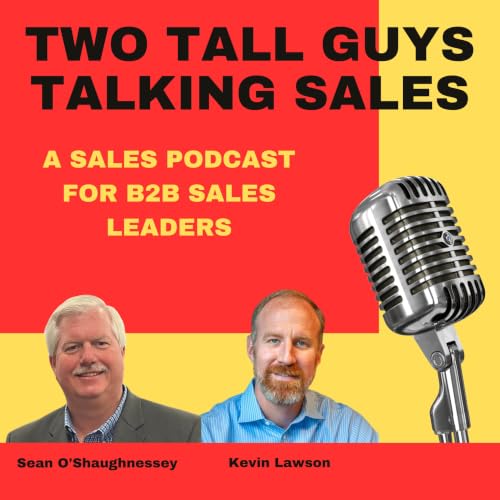
    For the 200th episode of Two Tall Guys Talking Sales, Sean O'Shaughnessey and Kevin Lawson do something they have never done before: record together, in person, with a live studio audience asking the questions. What follows is less a celebration than a wide-ranging examination of what actually drives B2B sales success. Sean and Kevin tackle the resurgence of human relationships in an AI-enabled selling environment, the discipline required to define an ideal client profile, how artificial intelligence and Workflow Automation should eliminate non-selling activities, why great salespeople do not necessarily need industry experience, and what sales management must do differently to coach rather than rescue. They also dig into compensation, value selling, sales productivity gains, and the danger of single-threading Complex Deals. It is 200 episodes of experience compressed into one candid conversation about building sales processes that work when the sales leader is not in the room. Key Topics Discussed 04:04 – What 200 Episodes Have Revealed About Sales Fundamentals Sean and Kevin reflect on the recurring problems they continue to see across sales organizations: unclear ideal client profiles, weak Messaging, inconsistent prospecting, and critical sales knowledge that exists in someone's head instead of in a documented process. Kevin makes the case that documentation turns tribal knowledge into an operating system that can connect sales, marketing, customer service, and delivery. A repeatable sales process must actually be written down before it can be taught, measured, or improved. 14:27 – The Return of Real Relationships in an AI-Enabled Sales World Asked what has changed most over the life of the podcast—other than AI—Kevin points to the renewed importance of authentic, in-person relationships and value realization. Sean pushes the idea further: when prospects are overwhelmed by email, social outreach, and text messages, effective Sales strategies may sometimes look surprisingly old-fashioned. Knock on the door. Attend the event. Send a thoughtful physical note. The technology may be new, but trust still separates signal from noise. 17:45 – Using AI to Create More Selling Time James Sayer asks how salespeople should think about artificial intelligence right now, and Sean immediately frames AI as a productivity tool rather than a novelty. Research, CRM administration, account preparation, and other non-selling activities consume enormous amounts of a salesperson's day. The objective is not to use Generative AI because it is fashionable; it is to use AI, automation, and better tools to create additional opportunities for actual selling. Kevin recommends identifying the most time-intensive task inside prospecting, selling, or customer retention and finding a way to automate it. That is where meaningful sales productivity gains begin. 23:30 – Curiosity, Business Acumen, and Solving Problems Instead of Selling Products When the audience asks what young sales professionals should learn, Kevin argues that sellers need to stop concentrating on what they want to sell and start understanding the problem the customer needs solved. Sean adds curiosity as a foundational skill: understand the customer's business, how it makes money, and—critically—how it loses money. That becomes especially important when selling to a CFO or defending ROI. Later, Sean connects the same curiosity to relationship building: ask open-ended questions, stop talking about yourself, and give the prospect room to reveal what is actually driving the opportunity. 33:43 – Hiring Salespeople, Defining the ICP, and Building a System They Can Enter The discussion turns to one of the most expensive mistakes a business owner can make: hiring a salesperson for an industry Rolodex instead of hiring someone who knows how to sell. Kevin argues that salespeople should be hired into a documented system with clear expectations, onboarding, knowledge checks, and a defined sales process. Sean makes the complementary case that industry knowledge can often be taught far faster than genuine selling skill. The conversation then moves into ICP development: study your friendliest or favorite customers, identify what they have in common, understand their buying signals and psychographics, and use those insights to improve prospecting, Messaging, hiring, and pipeline quality. 49:53 – Sales Leadership, Compensation, Trust, and Multi-Threading Complex Deals Mary Tutton asks what capability matters most for a sales manager, prompting Kevin to identify consistency and analytical thinking. At the same time, Sean draws a sharp distinction between coaching and taking over the salesperson's job. The discussion expands into compensation design—simple enough that the seller should be able to estimate the payout mentally—and then into the realities of Enterprise Sales. In a significant B2B opportunity, one relationship is rarely enough. Sean warns against...
    Mostra di più Mostra meno
    1 ora e 18 min
  • Stop Losing Deals: Map the Buying Committee Before You Sell
    Aug 4 2026
    Salespeople rarely lose complex deals because they forgot to follow up. They lose because they never developed a clear hypothesis about how the decision would be made, who would influence it, and what each stakeholder needed to believe. In this episode of Two Tall Guys Talking Sales, hosts Kevin Lawson and Sean O'Shaughnessey explain how a practical deal plan helps an AE move beyond the purchasing contact, understand the full buying committee, anticipate competitive threats, and coordinate the internal resources required to win. Using examples from sports, construction, manufacturing, and distribution, they show how disciplined planning improves sales execution, pipeline velocity, and long-term account growth. Key Topics Discussed Why Every Important Opportunity Needs a Deal Plan — 00:00 Kevin compares deal planning to the preparation elite athletes complete before taking the field. Great players do not simply understand their own position; they study their competition, anticipate likely reactions, and enter the game with a strategy. The same principle applies to B2B sales. A written deal plan increases the likelihood of closing the opportunity faster, executing more effectively, and avoiding preventable losses. Turning Assumptions into a Written Sales Hypothesis — 01:23 Sean explains that salespeople function as the quarterback of the opportunity. They must determine what they will do, how their teammates will contribute, and how the overall sales process should unfold. A sales hypothesis makes those assumptions visible: who will buy, what problem they are trying to solve, who benefits, and what conditions must exist for the deal to advance. If the hypothesis is not written down, it cannot be tested, improved, or consistently executed. Looking Beyond the Transactional Buyer — 02:32 A purchasing contact may control the transaction without receiving the greatest value from the product. Sean uses an HVAC compressor example to illustrate the broader stakeholder network: procurement, contractors, electricians, installers, building owners, maintenance teams, and eventual occupants may all influence the decision. Effective value selling requires messaging that addresses each stakeholder's priorities—not merely the requirements of the person issuing the purchase order. Understanding Decision Criteria and Stakeholder Influence — 05:05 Kevin expands the discussion through construction and engineered-specification sales. Manufacturers may need to influence architects, engineers, distributors, contractors, materials managers, and procurement teams long before an order is placed. Product specifications, installation requirements, availability, regional codes, service levels, and delivery capabilities can all become decision criteria. Strong business acumen allows a seller to connect those operational details to the buyer's desired outcome and measurable ROI. Mapping the Buying Committee and Informal Relationships — 08:32 Studying competitors is not enough. Salespeople must understand everyone "on the field," including the individuals who benefit from the solution, those who may resist it, and those who influence one another behind the scenes. Sean recommends creating a simple visual stakeholder map: write down the names, circle them, and connect the people who communicate, have worked together, attended school together, or maintain trusted relationships. Mapping the buying committee helps expose the informal decision network that a CRM contact list alone may not reveal. How Deal Plans Evolve into Account Plans — 10:45 A single stakeholder map supports one opportunity. Repeated deal plans reveal patterns across the account. Over time, the seller develops a record of who influenced previous decisions, why stakeholders supported or resisted the solution, and how internal relationships affected the outcome. That knowledge becomes the foundation of an account plan, giving sales management and Revenue management teams a stronger platform for expansion, retention, and more predictable revenue generation. Key Quotes Kevin Lawson — 00:57 "If you're not doing deal plans for your next deal, you're probably missing an opportunity to either close faster or more effectively, or you might even be increasing the chances that you're going to lose." Sean O'Shaughnessey — 01:44 "You are the quarterback of the team. Your job is to figure out what all of your teammates are going to help you do, but also what you're going to do." Kevin Lawson — 05:41 "It's just your opinion about who's going to buy, who it's going to benefit—which may be a different person—and then what are the other related people that could have influence over the deal?" Sean O'Shaughnessey — 09:15 "You need to understand everybody on the court, everybody on the pitch, everybody on the field." Sean O'Shaughnessey — 12:02 "Before long, your deal plans are becoming account plans." Additional Resources B2B Sales Lab The B2B Sales Lab is a ...
    Mostra di più Mostra meno
    17 min
  • Sindre Haaland Coaches on Managing the Game, Not the Scoreboard: Building Predictable Sales Performance
    Jul 28 2026
    Sales teams rarely fail because the quota was unclear. They fail because the daily behaviors required to reach it were never defined, measured, or reinforced. In this episode of Two Tall Guys Talking Sales, hosts Kevin Lawson and Sean O'Shaughnessey speak with Sindre Haaland, founder and CEO of SalesScreen, about why effective sales management requires leaders to manage the game, not merely watch the scoreboard. The conversation explores sales gamification, revenue architecture, CRM adoption, qualification discipline, and how AI can support more predictable B2B revenue generation without removing the human motivation that drives consistent execution. Key Topics Discussed Why sales leaders must manage the game, not the scoreboard — 01:19 Revenue targets tell salespeople where they are expected to finish, but they do not explain how to get there. Sindre argues that sales success begins by translating the quota into controllable, revenue-generating activities: calls, meetings, qualified opportunities, pipeline creation, and consistent execution throughout the quarter. Using gamification to change behavior—not merely celebrate outcomes — 02:19 Most sales contests reward closed business, but a salesperson cannot always control when a complex deal closes. Effective gamification focuses instead on meaningful behaviors that sellers can execute every day. Applied correctly, it can improve motivation, consistency, pipeline velocity, and performance among the middle of the sales team, not just recognize the top performers. Connecting activity metrics to conversion quality — 04:07 More activity is not automatically better activity. Measuring calls without examining results can produce meaningless behavior and distorted data. Sean, Kevin, and Sindre discuss the importance of combining activity targets with conversion rates, opportunity progression, and clear definitions of what good execution looks like. Building energy, recognition, and teamwork across the sales organization — 05:25 Sindre describes the moment SalesScreen demonstrated how software could create excitement throughout a sales floor when a deal closed. The larger lesson goes beyond celebration: real-time recognition helps managers reinforce productive behavior, improve engagement, and ensure individual accomplishments are not overlooked inside large sales organizations. Reverse-engineering the quota through revenue architecture — 08:15 Many sales teams know their targets but have never calculated how many calls, meetings, opportunities, and conversions are required to reach them. Without that basic revenue management discipline, prospecting becomes inconsistent, and the pipeline follows a predictable boom-and-bust cycle. Strong sales processes create continuity before pipeline weakness becomes a forecasting crisis. Gamifying qualification and opportunity progression in complex B2B sales — 09:25 In enterprise sales, closed deals may occur too infrequently to serve as useful daily performance signals. Teams can instead quantify progress through qualification frameworks such as MEDDPICC and SPICED, including CRM completeness, opportunity advancement, metric validation, and buying committee coverage. This creates better sales coaching data while reinforcing the behaviors that move complex deals forward. Key Quotes Sindre Haaland — 01:25 "Managers get one thing wrong: they're managing the scoreboard versus managing the game." Sindre Haaland — 04:07 "If you want to change behavior, you need to be in control of those behaviors." Sean O'Shaughnessey — 03:13 "The things you do at the beginning are going to affect the things that you do two, three, four, six, or ten months from now." Sindre Haaland — 08:27 "You need to understand how to get to goal and what real activity you need to put in, day in and day out, to get there." Kevin Lawson — 13:44 "Managing the game, not the scoreboard, is a key behavior." Additional Resources Sindre Haaland CEO and Founder at SalesScreen can be contacted on LinkedIn at linkedin.com/in/shaaland/ SalesScreen A sales performance management and gamification platform designed to quantify sales processes, reinforce productive activity, increase CRM engagement, and create more predictable sales performance. MEDDPICCC A qualification framework commonly used in enterprise sales and complex deals to evaluate metrics, the economic buyer, decision criteria, decision process, paperwork process, goal identification, coaches, champions, and competition. SPICED A sales qualification and discovery framework that helps sellers understand a buyer's situation, pain, impact, critical event, and decision process. A Significant Actionable Item from this Podcast Choose one sales role and reverse-engineer its quarterly quota into a weekly activity model. Start with the revenue target, then calculate the required number of closed deals, qualified opportunities, first meetings, and prospecting activities based on actual conversion ...
    Mostra di più Mostra meno
    17 min
  • Stop Asking Bad Discovery Questions: How Top B2B Sellers Earn Buyer Trust
    Jul 21 2026
    Most sales discovery questions fail before the buyer even answers them. Questions such as "What keeps you up at night?" and "What challenges are you facing?" have been used so often that buyers respond almost automatically, giving sellers little useful insight. In this episode of Two Tall Guys Talking Sales, Kevin Lawson and Sean O'Shaughnessey challenge sales professionals to replace generic scripts with informed, business-specific questions that improve discovery, uncover operational consequences, and help buyers think differently about their problems. They also explain how artificial intelligence and Generative AI can help sellers prepare deeper question paths, navigate Complex Deals, and establish themselves as trusted advisors rather than interchangeable vendors. Key Topics Discussed Why generic discovery questions produce generic answers — 00:00 Kevin and Sean open by dismantling familiar questions such as "What are your goals?" and "What keeps you up at night?" Buyers have heard these questions hundreds of times. Strong discovery must demonstrate Business acumen, industry knowledge, and a genuine understanding of the customer's operating environment. Researching the customer's business before discovery — 01:51 Public information about industries, competitors, economic pressures, and business trends is readily available. Sellers should use frameworks such as PESTEL and the Business Model Canvas to understand what drives the prospect's economics, how the company creates value, and where a proposed solution might improve Revenue generation, ROI, or operational performance. Using operational questions to expose real business problems — 03:11 Kevin illustrates how questions about month-end close procedures, manual spreadsheets, reporting delays, and disconnected Sales processes can produce a meaningful conversation. The goal is not merely to identify which system a prospect uses. It is to uncover the consequences, workarounds, handoffs, and hidden costs that make change valuable. Using AI to create better discovery question paths — 05:58 Sean presents a practical method for using ChatGPT, Claude, Gemini, Copilot, or another AI platform to develop branching discovery questions. Instead of asking an AI tool for one generic question list, sellers can ask it to anticipate several possible buyer answers and then generate the appropriate follow-up questions for each response. This turns AI prompts for B2B sales prospecting into preparation for a real business conversation rather than superficial personalization. Teaching the customer how to buy — 07:00 In Enterprise Sales, buyers often understand their current situation better than they understand the process of selecting and implementing a new solution. Sellers must guide the Buying Committee through workflow changes, implementation tradeoffs, user concerns, and expected outcomes. This is where Value selling becomes practical: the seller connects the solution to the customer's processes, risks, and desired business results. Improving questions through sales management and peer coaching — 10:03 Kevin explains how a VP of Sales or sales manager can improve discovery without simply criticizing the team's existing questions. Questions should be evaluated based on whether they advance the next step, increase deal value, improve Pipeline Velocity, or strengthen the seller's competitive position. Sales Enablement can also become more effective when AEs, SDRs, and sales leaders exchange successful questions and discuss the order in which they should be asked. Key Quotes Kevin Lawson — 00:00 "Buyers have heard these questions hundreds of times, and they answer them on autopilot." Sean O'Shaughnessey — 00:45 "Questions that show that you understand the business… force your customer or your prospect to have a clearer thought process." Sean O'Shaughnessey — 09:00 "You know more about selling your product than they know about buying your product. You have to lead them through the way." Kevin Lawson — 12:03 "Stop asking questions the buyer has already heard. Start asking the questions that get the buyer to say, 'I've never thought about that.'" Additional Resources PESTEL analysis: A framework for examining the political, economic, social, technological, environmental, and legal forces influencing an industry. Business Model Canvas: A tool for understanding how a company creates, delivers, and captures value. The Challenger Sale: A sales methodology centered on teaching customers something valuable, tailoring the conversation, and leading the buying process. Generative AI platforms: ChatGPT, Claude, Gemini, and Microsoft Copilot can help sellers research industries, anticipate buyer responses, and develop stronger discovery questions. B2B Sales Lab: A community where sales professionals and sales leaders can develop their sales acumen, discuss active opportunities, and improve their approach to B2B sales. A Significant Actionable Item from ...
    Mostra di più Mostra meno
    16 min
  • Weak Sales Discovery Creates a Weak Pipeline
    Jul 14 2026
    Discovery is not a preliminary conversation before the "real" selling begins. It is where complex B2B deals are either built on credible business value—or quietly undermined by weak assumptions, missing stakeholders, artificial urgency, and an unreliable forecast. In this episode of Two Tall Guys Talking Sales, Kevin Lawson and Sean O'Shaughnessey examine why strong discovery is essential to value selling, accurate revenue management, and sales success. They also explain how experienced sellers use business acumen to uncover operational constraints, quantify ROI, navigate the buying committee, and guide customers through decisions they may not yet understand how to make. Key Topics Discussed Why weak discovery creates a weak pipeline — 00:28 Poor discovery does not merely cause an awkward sales meeting. It produces shallow opportunities, fake urgency, premature proposals, discount pressure, inaccurate forecasts, and stalled decisions. Sean and Kevin establish discovery as the foundation of effective sales processes and B2B sales pipeline predictability. Understanding the business reason behind the purchase — 01:27 Knowing what the buyer wants is not enough. Sellers must uncover why the organization needs it, what business problem is driving the investment, who holds influence and authority, and what happens if the problem remains unresolved. This is where business acumen and value selling begin—and where the seller gathers the evidence needed to defend price and demonstrate ROI later in the deal. Why quoting without discovery makes the salesperson expendable — 02:43 Kevin challenges sellers who rush to educate the prospect, demonstrate features, and produce a quote. If the seller's contribution is limited to product information and pricing, the buyer can often replace that salesperson with a website, product sheet, or artificial intelligence tool. Discovery is what separates professional selling from order processing. Finding the hidden requirements that can derail complex deals — 04:28 A new CNC machine may require more than equipment and installation. Floor space, structural changes, utilities, drainage, environmental requirements, permits, contractors, and operational disruption may all affect the buying decision. In enterprise sales, the apparent purchase is often only one component of a much larger initiative. Effective discovery exposes those dependencies before they destroy pipeline velocity. Using expertise to guide the customer's buying process — 07:53 The seller has typically sold the solution more often than the customer has purchased it. That experience creates an obligation—and an advantage. By identifying questions the buyer has not considered, mapping the buying committee, and navigating multi-stakeholder deals, the salesperson becomes a trusted guide rather than another vendor competing on features and price. How discovery improves forecasting, marketing, and revenue generation — 08:49 Robust discovery strengthens more than the individual opportunity. It improves forecast integrity, exposes the true urgency of the problem, creates better feedback loops with marketing and RevOps, and helps the organization attract more qualified prospects. Weaknesses introduced during discovery inevitably reappear during proposals, negotiations, implementation planning, and closing. Key Quotes "Discovery is not just the stage of the sales process. Discovery is the foundation of the very deal." — Sean O'Shaughnessey, 00:44 "If you're just doing a volume of quoting with no discovery, your job is in jeopardy. Discovery is what separates us from a product sheet." — Kevin Lawson, 03:56 "You have sold your product more than your customer has bought your product. You know more about selling your product than they know about buying your product." — Sean O'Shaughnessey, 08:08 "Anything you do poorly in discovery is going to show up in the proposal, timeline, close, and negotiation stages." — Kevin Lawson, 10:09 Additional Resources Sean also discusses the B2B Sales Lab, a community where salespeople, sales leaders, founders, AEs, SDRs, and VPs of Sales can discuss active selling challenges, improve their sales strategies, and participate in live office-hours conversations with Kevin and Sean. Visit: b2b-sales-lab.com A Significant Actionable Item from this Podcast Before advancing to your next meaningful opportunity, conduct a discovery-gap review. Write down the business problem, the measurable financial or operational impact, the cost of inaction, the decision-making process, the economic buyer, the key influencers, the implementation requirements, and any external dependencies that could delay approval or execution. Do not rely on impressions. Identify what you know, what you have merely assumed, and what remains unanswered. Then use the next customer conversation to close the highest-risk gaps before preparing a detailed proposal or committing the opportunity to the forecast. This ...
    Mostra di più Mostra meno
    16 min
  • Happy 250th Birthday, America
    Jul 7 2026

    No big topics in this episode. Just a quick acknowledgment that the United States of America is now 250 years old.

    Go back to your family and enjoy your time with them.

    Check us out next week when we will be sharing great sales advice again.

    Mostra di più Mostra meno
    1 min
  • Should Sales Leaders Reset Quotas at Midyear
    Jun 30 2026
    Midyear exposes the truth in every sales organization. In this episode of Two Tall Guys Talking Sales, Kevin Lawson and Sean O'Shaughnessey tackle a problem many business owners, sales leaders, and salespeople quietly face at the halfway point of the year: unclear goals, weak commission plans, soft pipeline discipline, and the temptation to reset expectations instead of fixing the sales processes that created the gap. This is a practical conversation about B2B sales management, quota accountability, revenue generation, pipeline prioritization, and the uncomfortable but necessary work required to improve sales success in the second half of the year. Key Topics Discussed Midyear goal setting when the original plan was missing or unclear — 00:00 Sean explains why some companies reach July without properly documented sales goals or commission plans. The corrective action is not complicated, but it is often avoided: write the plan down, align compensation with company priorities, and make sure salespeople know exactly how they are being measured. Why sales leaders should not casually reset the goal — 02:14 Kevin argues that adjusting the target downward can create a dangerous management precedent. If the number was the right number, the job is to solve the gap through better sales strategies, qualification, activity, referrals, and pipeline focus—not move the scoreboard. The rare exception to keeping the original quota — 06:34 Sean adds an important leadership caveat. If the CEO or executive team built the number around a product launch, acquisition, market event, or business assumption that never materialized, that is not a salesperson's problem. That is an executive planning problem, and it should be handled honestly. Pipeline rationalization and better qualification — 09:57 Kevin walks through the discipline of deciding which deals deserve time and which ones do not. Complex deals, unclear next steps, bad-fit opportunities, and stalled prospects all consume selling capacity. Better qualification improves pipeline velocity by giving salespeople time back to pursue better opportunities. Time management, delegation, and protecting prospecting time — 13:43 Sean warns against the classic sales rollercoaster: closing current business while starving future pipeline. Whether a company uses SDRs, AEs, business development resources, or full-cycle salespeople, every stage of the sales process needs dedicated time. Revenue management requires knowing where the week actually went. Key Quotes Sean O'Shaughnessey — 01:14 "You didn't get it done at the first of the year. That doesn't mean you can't do it now." Kevin Lawson — 03:40 "You never adjust the goal. Your job as a salesperson is to hit the goal or your quota." Sean O'Shaughnessey — 08:34 "Salespeople can't make their goals for things that are outside of their control." Kevin Lawson — 10:22 "You've got to figure out which deals are aligned and which ones are not aligned to what you do." Sean O'Shaughnessey — 14:03 "We were so busy selling that we forgot to sell." Additional Resources EOS implementers — referenced as part of the broader business coaching and planning conversations happening at midyear. FocalPoint and ActionCOACH — mentioned as examples of coaching organizations business owners may turn to when trying to catch up or plan ahead. Microsoft PTAP — referenced by Kevin as "plan to exceed plan," a useful framing for quota planning and sales performance management. MEDDPICCC, BANT, and SPICED-style qualification methodologies — referenced as examples of structured approaches to qualification, deal inspection, and sales process discipline. Marketing-generated digital assets — discussed as one practical source of conversation creation when salespeople are behind and need to rebuild pipeline coverage. A Significant Actionable Item from this Podcast Audit your pipeline and calendar before changing the goal. Identify every active opportunity, mark which deals have clear next steps, remove or deprioritize poor-fit opportunities, and block time this week for prospecting, referral requests, outreach to past customers, and networking. Do not rely on optimism. If an opportunity does not match your ideal customer profile, lacks buyer commitment, or requires too much customization to win, it is likely stealing time from better revenue-generating work. Summary This episode is a timely midyear inspection for any B2B salesperson, VP of Sales, business owner, or sales management leader who is trying to protect the second half of the year. Kevin and Sean make a clear argument: missed goals are not solved by pretending the number changed. They are solved by stronger qualifications, clearer commission plans, better time allocation, disciplined sales processes, and more honest pipeline review. If you are behind, ahead, or unsure where you really stand, this conversation will help you decide whether you have a quota problem, ...
    Mostra di più Mostra meno
    20 min
  • From Marine Recon to Venture Capital: Paul Claxton on Sales Strategy, AI, and Founder Readiness
    Jun 23 2026
    In this episode of Two Tall Guys Talking Sales, hosts Kevin Lawson and Sean O'Shaughnessey sit down with Paul Anthony Claxton of Digirati Investments for a sharp conversation on venture capital, founder readiness, sales architecture, and why early-stage companies cannot hide behind product obsession or incomplete data. Paul brings a rare blend of Marine Corps reconnaissance discipline, sales leadership, investment judgment, and AI perspective to the table. The result is a fast-moving discussion about Business acumen, customer conversations, market intelligence, Sales processes, and the practical realities of Revenue generation when founders are trying to build something the market may not yet know it needs. Key Topics Discussed Founder adaptability and the path from Marine to venture capitalist — 00:20 Paul explains how adaptability, opportunity recognition, and power networking shaped his move from the Marines into venture capital. His point lands hard for anyone in sales management: the best salespeople and founders do not simply follow the plan. They adjust when the market, the customer, or life changes direction. Why investors look beyond the product — 02:19 Paul discusses what he looks for when evaluating founders and companies. Product matters, but it is not enough. Founders need to understand macroeconomics, microeconomics, contracts, deal structure, customer impact, and the broader commercial environment. That is where Business acumen becomes a serious differentiator. Inventing necessity and creating surrounding market demand — 03:24 Paul introduces Digirati Investments' phrase "inventing necessity" and explains why strong products do more than solve one isolated problem. They create adjacent needs, new sub-industries, and additional opportunities for Revenue generation. This is a useful framing for founders, sales leaders, and anyone building Sales strategies around emerging markets. The danger of product-centric founders — 04:43 Sean pushes into a critical founder question: how often do companies believe they have a market-changing product before they have validated the market? Paul's answer is direct. Too many founders are product-centric instead of people-centric. Real Sales success starts with human conversations long before the product is fully built. Data, AI, and consultative selling in modern sales ecosystems — 05:33 Paul argues that strong data flow is essential, but data alone cannot replace human interaction. He connects AI, CRM automation, customer engagement, and consultative selling to a broader point: modern Sales processes need both high-quality data and high-quality conversations. Reconnaissance, competitor intelligence, and explainable AI — 09:15 Drawing from his Marine background, Paul explains why companies must gather intelligence from both customers and competitors. AI can support that work, but leaders must understand where the data came from and whether it reflects the actual market. Bad assumptions create bad Messaging, weak qualification, and flawed Revenue management decisions. Key Quotes Paul Anthony Claxton — 00:35 "The best salespeople are the most adaptable people." Paul Anthony Claxton — 05:33 "A lot of times I'll run across founders that are product-centric instead of being people-centric." Sean O'Shaughnessey — 08:41 "How do you know that what you're doing is going to work if you don't have salespeople out pre-talking and pre-building up what that problem is?" Paul Anthony Claxton — 09:15 "If you don't have people gathering reconnaissance, it's not just talking to who you think your prospective customers are, but it's also understanding how your competitors qualify." Kevin Lawson — 11:49 "Not only do we have to know as sellers who our total addressable market is, but our service obtainable market is, but it's important to keep that data current." Additional Resources Paul Anthony Claxton — Venture capitalist, U.S. Marine, sales architecture thinker, and guest on this episode. https://www.linkedin.com/in/businessmanathletemarine/ Digirati Investments — Paul's investment firm, discussed in the episode through the lens of "inventing necessity." Explainable AI — Paul's podcast, referenced during the conversation about understanding the origin, quality, and accuracy of AI-driven data. PaulClaxton.io — Paul's personal website, where you can learn more about his work, investments, and related ventures. A Significant Actionable Item from this Podcast Before investing more time, money, or sales effort into a product, schedule direct market conversations with prospective customers and competitive intelligence reviews. Do not rely only on internal conviction, CRM data, AI summaries, or founder enthusiasm. Validate the problem, study how competitors qualify and sell, and pressure-test whether your Value selling story connects to a real business need. This one discipline improves Sales strategies, sharpens Messaging, and prevents companies ...
    Mostra di più Mostra meno
    16 min