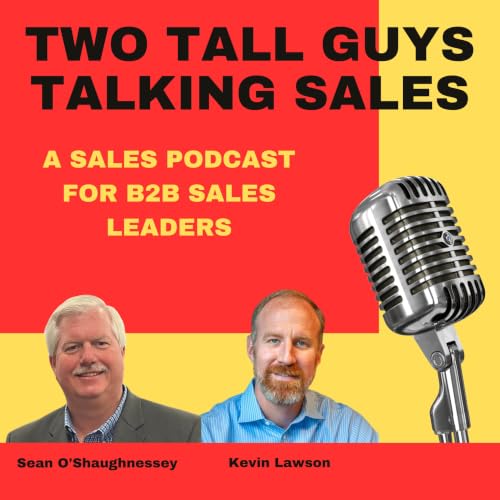
Two Tall Guys Talking Sales copertina

Two Tall Guys Talking Sales

Two Tall Guys Talking Sales

Di: Kevin Lawson and Sean O'Shaughnessey
Ascolta gratuitamente

"Two Tall Guys Talking Sales," where Sean O'Shaughnessey and Kevin Lawson discuss a single sales topic. Kevin and Sean together have about 60 years of experience in professional selling. This podcast helps people in sales, sales leadership, and business leadership or company owners realize the maximum value of their company by improving their revenue generation capability. This podcast is designed to help those people enhance their companies' sales management practices, methodologies, processes, teams, and messaging. Sean O'Shaughnessey and Kevin Lawson are Fractional Vice Presidents of Sales. They operate their own companies separately but have partnered for this podcast to advise salespeople and SMB companies on successful strategies and methodologies. Kevin is the CEO of Lighthouse Sales Advisors. Lighthouse Sales Advisors is a sales leadership solution provider for small businesses. Lighthouse helps business owners navigate the potential pitfalls around sales growth, sales turnaround, or scaling up by leveraging sales acumen and decades of experience to build effective sales teams. https://www.lighthousesalesadvisors.com/ Sean is the CEO of New Sales Expert. He helps company owners realize the maximum value of their company by improving their revenue generation capability. He helps owners enhance their sales management, methodologies, processes, teams, and messaging.2024 Economia Gestione e leadership Management
  • 200 Episodes of B2B Sales Advice - The Lessons That Still Drive Sales Success
    Aug 11 2026
    For the 200th episode of Two Tall Guys Talking Sales, Sean O'Shaughnessey and Kevin Lawson do something they have never done before: record together, in person, with a live studio audience asking the questions. What follows is less a celebration than a wide-ranging examination of what actually drives B2B sales success. Sean and Kevin tackle the resurgence of human relationships in an AI-enabled selling environment, the discipline required to define an ideal client profile, how artificial intelligence and Workflow Automation should eliminate non-selling activities, why great salespeople do not necessarily need industry experience, and what sales management must do differently to coach rather than rescue. They also dig into compensation, value selling, sales productivity gains, and the danger of single-threading Complex Deals. It is 200 episodes of experience compressed into one candid conversation about building sales processes that work when the sales leader is not in the room. Key Topics Discussed 04:04 – What 200 Episodes Have Revealed About Sales Fundamentals Sean and Kevin reflect on the recurring problems they continue to see across sales organizations: unclear ideal client profiles, weak Messaging, inconsistent prospecting, and critical sales knowledge that exists in someone's head instead of in a documented process. Kevin makes the case that documentation turns tribal knowledge into an operating system that can connect sales, marketing, customer service, and delivery. A repeatable sales process must actually be written down before it can be taught, measured, or improved. 14:27 – The Return of Real Relationships in an AI-Enabled Sales World Asked what has changed most over the life of the podcast—other than AI—Kevin points to the renewed importance of authentic, in-person relationships and value realization. Sean pushes the idea further: when prospects are overwhelmed by email, social outreach, and text messages, effective Sales strategies may sometimes look surprisingly old-fashioned. Knock on the door. Attend the event. Send a thoughtful physical note. The technology may be new, but trust still separates signal from noise. 17:45 – Using AI to Create More Selling Time James Sayer asks how salespeople should think about artificial intelligence right now, and Sean immediately frames AI as a productivity tool rather than a novelty. Research, CRM administration, account preparation, and other non-selling activities consume enormous amounts of a salesperson's day. The objective is not to use Generative AI because it is fashionable; it is to use AI, automation, and better tools to create additional opportunities for actual selling. Kevin recommends identifying the most time-intensive task inside prospecting, selling, or customer retention and finding a way to automate it. That is where meaningful sales productivity gains begin. 23:30 – Curiosity, Business Acumen, and Solving Problems Instead of Selling Products When the audience asks what young sales professionals should learn, Kevin argues that sellers need to stop concentrating on what they want to sell and start understanding the problem the customer needs solved. Sean adds curiosity as a foundational skill: understand the customer's business, how it makes money, and—critically—how it loses money. That becomes especially important when selling to a CFO or defending ROI. Later, Sean connects the same curiosity to relationship building: ask open-ended questions, stop talking about yourself, and give the prospect room to reveal what is actually driving the opportunity. 33:43 – Hiring Salespeople, Defining the ICP, and Building a System They Can Enter The discussion turns to one of the most expensive mistakes a business owner can make: hiring a salesperson for an industry Rolodex instead of hiring someone who knows how to sell. Kevin argues that salespeople should be hired into a documented system with clear expectations, onboarding, knowledge checks, and a defined sales process. Sean makes the complementary case that industry knowledge can often be taught far faster than genuine selling skill. The conversation then moves into ICP development: study your friendliest or favorite customers, identify what they have in common, understand their buying signals and psychographics, and use those insights to improve prospecting, Messaging, hiring, and pipeline quality. 49:53 – Sales Leadership, Compensation, Trust, and Multi-Threading Complex Deals Mary Tutton asks what capability matters most for a sales manager, prompting Kevin to identify consistency and analytical thinking. At the same time, Sean draws a sharp distinction between coaching and taking over the salesperson's job. The discussion expands into compensation design—simple enough that the seller should be able to estimate the payout mentally—and then into the realities of Enterprise Sales. In a significant B2B opportunity, one relationship is rarely enough. Sean warns against...
    Mostra di più Mostra meno
    1 ora e 18 min
  • Stop Losing Deals: Map the Buying Committee Before You Sell
    Aug 4 2026
    Salespeople rarely lose complex deals because they forgot to follow up. They lose because they never developed a clear hypothesis about how the decision would be made, who would influence it, and what each stakeholder needed to believe. In this episode of Two Tall Guys Talking Sales, hosts Kevin Lawson and Sean O'Shaughnessey explain how a practical deal plan helps an AE move beyond the purchasing contact, understand the full buying committee, anticipate competitive threats, and coordinate the internal resources required to win. Using examples from sports, construction, manufacturing, and distribution, they show how disciplined planning improves sales execution, pipeline velocity, and long-term account growth. Key Topics Discussed Why Every Important Opportunity Needs a Deal Plan — 00:00 Kevin compares deal planning to the preparation elite athletes complete before taking the field. Great players do not simply understand their own position; they study their competition, anticipate likely reactions, and enter the game with a strategy. The same principle applies to B2B sales. A written deal plan increases the likelihood of closing the opportunity faster, executing more effectively, and avoiding preventable losses. Turning Assumptions into a Written Sales Hypothesis — 01:23 Sean explains that salespeople function as the quarterback of the opportunity. They must determine what they will do, how their teammates will contribute, and how the overall sales process should unfold. A sales hypothesis makes those assumptions visible: who will buy, what problem they are trying to solve, who benefits, and what conditions must exist for the deal to advance. If the hypothesis is not written down, it cannot be tested, improved, or consistently executed. Looking Beyond the Transactional Buyer — 02:32 A purchasing contact may control the transaction without receiving the greatest value from the product. Sean uses an HVAC compressor example to illustrate the broader stakeholder network: procurement, contractors, electricians, installers, building owners, maintenance teams, and eventual occupants may all influence the decision. Effective value selling requires messaging that addresses each stakeholder's priorities—not merely the requirements of the person issuing the purchase order. Understanding Decision Criteria and Stakeholder Influence — 05:05 Kevin expands the discussion through construction and engineered-specification sales. Manufacturers may need to influence architects, engineers, distributors, contractors, materials managers, and procurement teams long before an order is placed. Product specifications, installation requirements, availability, regional codes, service levels, and delivery capabilities can all become decision criteria. Strong business acumen allows a seller to connect those operational details to the buyer's desired outcome and measurable ROI. Mapping the Buying Committee and Informal Relationships — 08:32 Studying competitors is not enough. Salespeople must understand everyone "on the field," including the individuals who benefit from the solution, those who may resist it, and those who influence one another behind the scenes. Sean recommends creating a simple visual stakeholder map: write down the names, circle them, and connect the people who communicate, have worked together, attended school together, or maintain trusted relationships. Mapping the buying committee helps expose the informal decision network that a CRM contact list alone may not reveal. How Deal Plans Evolve into Account Plans — 10:45 A single stakeholder map supports one opportunity. Repeated deal plans reveal patterns across the account. Over time, the seller develops a record of who influenced previous decisions, why stakeholders supported or resisted the solution, and how internal relationships affected the outcome. That knowledge becomes the foundation of an account plan, giving sales management and Revenue management teams a stronger platform for expansion, retention, and more predictable revenue generation. Key Quotes Kevin Lawson — 00:57 "If you're not doing deal plans for your next deal, you're probably missing an opportunity to either close faster or more effectively, or you might even be increasing the chances that you're going to lose." Sean O'Shaughnessey — 01:44 "You are the quarterback of the team. Your job is to figure out what all of your teammates are going to help you do, but also what you're going to do." Kevin Lawson — 05:41 "It's just your opinion about who's going to buy, who it's going to benefit—which may be a different person—and then what are the other related people that could have influence over the deal?" Sean O'Shaughnessey — 09:15 "You need to understand everybody on the court, everybody on the pitch, everybody on the field." Sean O'Shaughnessey — 12:02 "Before long, your deal plans are becoming account plans." Additional Resources B2B Sales Lab The B2B Sales Lab is a ...
    Mostra di più Mostra meno
    17 min
  • Sindre Haaland Coaches on Managing the Game, Not the Scoreboard: Building Predictable Sales Performance
    Jul 28 2026
    Sales teams rarely fail because the quota was unclear. They fail because the daily behaviors required to reach it were never defined, measured, or reinforced. In this episode of Two Tall Guys Talking Sales, hosts Kevin Lawson and Sean O'Shaughnessey speak with Sindre Haaland, founder and CEO of SalesScreen, about why effective sales management requires leaders to manage the game, not merely watch the scoreboard. The conversation explores sales gamification, revenue architecture, CRM adoption, qualification discipline, and how AI can support more predictable B2B revenue generation without removing the human motivation that drives consistent execution. Key Topics Discussed Why sales leaders must manage the game, not the scoreboard — 01:19 Revenue targets tell salespeople where they are expected to finish, but they do not explain how to get there. Sindre argues that sales success begins by translating the quota into controllable, revenue-generating activities: calls, meetings, qualified opportunities, pipeline creation, and consistent execution throughout the quarter. Using gamification to change behavior—not merely celebrate outcomes — 02:19 Most sales contests reward closed business, but a salesperson cannot always control when a complex deal closes. Effective gamification focuses instead on meaningful behaviors that sellers can execute every day. Applied correctly, it can improve motivation, consistency, pipeline velocity, and performance among the middle of the sales team, not just recognize the top performers. Connecting activity metrics to conversion quality — 04:07 More activity is not automatically better activity. Measuring calls without examining results can produce meaningless behavior and distorted data. Sean, Kevin, and Sindre discuss the importance of combining activity targets with conversion rates, opportunity progression, and clear definitions of what good execution looks like. Building energy, recognition, and teamwork across the sales organization — 05:25 Sindre describes the moment SalesScreen demonstrated how software could create excitement throughout a sales floor when a deal closed. The larger lesson goes beyond celebration: real-time recognition helps managers reinforce productive behavior, improve engagement, and ensure individual accomplishments are not overlooked inside large sales organizations. Reverse-engineering the quota through revenue architecture — 08:15 Many sales teams know their targets but have never calculated how many calls, meetings, opportunities, and conversions are required to reach them. Without that basic revenue management discipline, prospecting becomes inconsistent, and the pipeline follows a predictable boom-and-bust cycle. Strong sales processes create continuity before pipeline weakness becomes a forecasting crisis. Gamifying qualification and opportunity progression in complex B2B sales — 09:25 In enterprise sales, closed deals may occur too infrequently to serve as useful daily performance signals. Teams can instead quantify progress through qualification frameworks such as MEDDPICC and SPICED, including CRM completeness, opportunity advancement, metric validation, and buying committee coverage. This creates better sales coaching data while reinforcing the behaviors that move complex deals forward. Key Quotes Sindre Haaland — 01:25 "Managers get one thing wrong: they're managing the scoreboard versus managing the game." Sindre Haaland — 04:07 "If you want to change behavior, you need to be in control of those behaviors." Sean O'Shaughnessey — 03:13 "The things you do at the beginning are going to affect the things that you do two, three, four, six, or ten months from now." Sindre Haaland — 08:27 "You need to understand how to get to goal and what real activity you need to put in, day in and day out, to get there." Kevin Lawson — 13:44 "Managing the game, not the scoreboard, is a key behavior." Additional Resources Sindre Haaland CEO and Founder at SalesScreen can be contacted on LinkedIn at linkedin.com/in/shaaland/ SalesScreen A sales performance management and gamification platform designed to quantify sales processes, reinforce productive activity, increase CRM engagement, and create more predictable sales performance. MEDDPICCC A qualification framework commonly used in enterprise sales and complex deals to evaluate metrics, the economic buyer, decision criteria, decision process, paperwork process, goal identification, coaches, champions, and competition. SPICED A sales qualification and discovery framework that helps sellers understand a buyer's situation, pain, impact, critical event, and decision process. A Significant Actionable Item from this Podcast Choose one sales role and reverse-engineer its quarterly quota into a weekly activity model. Start with the revenue target, then calculate the required number of closed deals, qualified opportunities, first meetings, and prospecting activities based on actual conversion ...
    Mostra di più Mostra meno
    17 min
adbl_web_anon_alc_button_suppression_t1
Ancora nessuna recensione