Future of Foods Interviews - Alt Proteins, Cell Agriculture, an End to Factory Farming. copertina

Future of Foods Interviews - Alt Proteins, Cell Agriculture, an End to Factory Farming.

Future of Foods Interviews - Alt Proteins, Cell Agriculture, an End to Factory Farming.

Di: Alex Crisp
Ascolta gratuitamente

A proposito di questo titolo

Alex and guests discuss the food (R)evolution, cellular agriculture, novel foods, and an end to factory farming.

If you have any questions or comments, or wish to discuss collaboration, sponsorship or other, please contact me crisplexmail@gmail.com

Watch and subscribe on YouTube https://www.youtube.com/@FutureofFoods

DONATIONs are gratefully received.

https://www.paypal.com/donate/?hosted_button_id=ABYF9L6UY3A5Y

AlexCrisp2023
Arte Cucina Enogastronomia Scienza Scienze biologiche
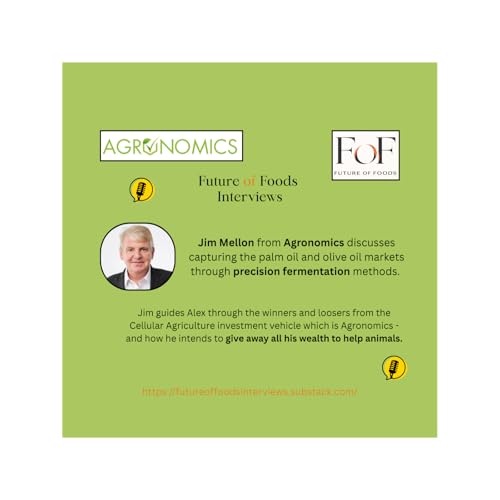
  • The Investment Case For Cultivated Proteins and Oils - Jim Mellon - Agronomics
    Jan 27 2026

    In this wide-ranging Future of Foods interview, Jim Mellon, co-founder of Agronomics, offers a characteristically candid take on where food, capital, and climate are really headed. Mellon is bullish on precision fermentation, far less convinced by today’s plant-based category, and unapologetically ambitious about what he sees as category-defining bets. He points to Clean Food Group in Liverpool as Agronomics’ most successful investment to date, predicting fermentation-derived oils could “own the palm oil—and even olive oil—markets within a decade,” delivering deforestation-free fats with lower saturated fat and no environmental trade-off, at price parity.

    We discuss Liberation Labs, why the Middle East will be a major growth engine for protein, and the strategic case for licensing IP over building pilot plants. Mellon is emphatic about cultivated meat—citing BlueNalu—and the health dangers attached to conventional seafood. He also reflects frankly on portfolio wins and losses, including Meatable, investment geography, Agronomics’ share price, and why he says every pound he makes goes back into improving animal welfare.

    Related episodes: Meatly, Liberation Labs, FAIRR, Meatable (with Helder).

    Mostra di più Mostra meno
    1 ora
  • What Investors Need to See - Funding Food Startups - Adam Bergman
    Jan 19 2026

    In this episode of Future of Foods Interviews, Alex Crisp speaks with Adam Bergman, Managing Director at EcoTech Capital, about the realities of investing in alternative proteins and novel foods in today’s tougher market.

    Adam shares an investor’s perspective on where the sector stands after years of hype and correction, explaining why capital has become more selective and what that means for founders. The conversation explores why plant-based meat has struggled to reach scale, how fermentation and ingredient-led approaches may offer more practical paths forward, and what it will take for cultivated meat to regain investor confidence.

    Drawing on his advisory work with food, agriculture, and climate-focused companies, Adam outlines what startups consistently underestimate from manufacturing complexity and timelines to the challenge of building trust with strategic partners. He also discusses new funding models beyond traditional venture capital, the role of blended products, and why credibility and focus now matter more than ambitious storytelling.

    Mostra di più Mostra meno
    52 min
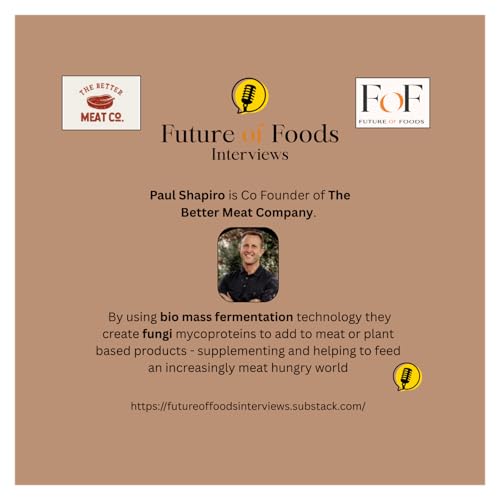
  • How BioMass Fungi is Supplementing Meat - Paul Shapiro
    Jan 5 2026

    In this episode of Future of Foods – Interviews, I speak with Paul Shapiro about one of the most pragmatic paths toward reducing the environmental impact of meat: biomass fungi.

    Rather than attempting to replace meat outright, Shapiro explains how fungal biomass, grown through fermentation, can supplement conventional meat in ways that dramatically cut cost, emissions, and resource use while preserving the sensory experience consumers expect. Drawing on his work at The Better Meat Company, he describes how mycelium, the fast-growing, protein-rich root structure of fungi, can be produced at industrial scale using existing fermentation infrastructure.

    A key insight from the conversation is that hybridization, not substitution, may be the fastest route to impact. By blending fungal biomass into meat products, producers can reduce reliance on animal protein without asking consumers to change behavior, taste preferences, or cooking habits. Shapiro argues that this approach avoids many of the bottlenecks facing fully plant-based or cultivated meat alternatives, particularly around cost, scale, and manufacturing complexity.

    The discussion also cuts through common misconceptions about fermentation-based foods. Shapiro emphasizes that biomass fungi are minimally processed, nutritionally dense, and well suited to large-scale production—making them a practical tool rather than a speculative technology. Ultimately, the episode frames biomass fungi not as a futuristic novelty, but as a quietly powerful lever for near-term change in the global food system.

    Mostra di più Mostra meno
    45 min
Ancora nessuna recensione