Episodi

  • Stop Picking Sides – Why Both/And Thinking Matters with Wendy Smith
    Sep 28 2026

    When two priorities both matter, why do leaders feel such pressure to choose one? The day-to-day work needs attention, but so does the future. A team needs room to act, but it also needs direction.

    Wendy Smith has spent more than 25 years studying these recurring tensions. She joins me to explore why an either/or decision can feel so satisfying in the moment, yet leave leaders facing the same problem again.

    We look at what both/and thinking asks of us in practice, including the conversations that become possible when different teams see a challenge from different sides. Wendy brings examples from organisational change, strategy and AI, and challenges the idea that holding two priorities means settling for a halfway compromise.

    In this episode, we explore:

    • Why old and new priorities continue to compete as organisations change
    • The four common organisational paradoxes Wendy studies
    • How to spot the either/or question hidden in a difficult decision
    • Why both/and thinking asks for more than meeting in the middle
    • How listening reveals what each side actually needs
    • The tension between business as usual and future strategy
    • What AI reveals about fear, emotion and human judgement
    • How to separate competing demands before connecting them
    • Why a shared goal matters across organisational divides
    • How guardrails and measures help sustain two priorities
    • What Wendy means by balancing rather than finding a fixed balance

    Wendy offers a practical starting point: name the tension, explore each side properly, then ask how you might accommodate both. It will not produce an easy answer to every decision. It can open up options that a quick choice would have kept out of view.

    If your team keeps circling the same choice, this conversation may help you ask a better question.

    Resources mentioned:

    • Both/And Thinking by Wendy Smith and Maryanne Lewis
    • Barry Johnson’s Polarity Map

    Explore more leadership and team conversations: https://www.youtube.com/@thrivingculture

    Subscribe for practical conversations about leading people and helping teams thrive.

    #Leadership #BothAndThinking #ThrivingTeams

    Mostra di più Mostra meno
    55 min
  • Best Of | Is Your Team Talking Without Really Communicating?
    Sep 22 2026

    What separates a meaningful team conversation from another meeting where people simply exchange information?

    In this Best Of episode of the Thriving Leaders Podcast, I revisit a standout moment from my conversation with Grant about the five skills behind better team conversations.

    We explore why the quality of a conversation matters more than the amount of talking taking place and how greater presence, listening, courage and intention can help teams move beyond transactional exchanges.

    You’ll hear us explore:

    • Why more meetings do not necessarily lead to better communication
    • What prevents people from being fully present
    • The skills that create greater depth and purpose in team conversations
    • Simple rituals that strengthen trust and connection
    • How hybrid teams can bring more humanity into the way they work

    If your team talks frequently but does not always reach the clarity, honesty or depth it needs, this Best Of episode offers a practical place to start.

    Subscribe for more standout insights from the Thriving Leaders Podcast and practical ideas for creating stronger leaders, healthier cultures and high-performing teams.

    Learn more about my work at Thriving Culture: https://thrivingculture.com.au

    #teamcommunication #leadership #highperformingteams

    Mostra di più Mostra meno
    10 min
  • Why Strategy Fails (and How to Make It Real) with Alicia McKay
    Sep 14 2026

    Why do so many strategies sound compelling in the boardroom but struggle to shape what people actually do?

    In this episode of the Thriving Leaders Podcast, I speak with Alicia McKay, an Aotearoa New Zealand-based writer, speaker and strategist who has spent 15 years advising leaders on strategy, change and leadership. She is also the author of From Strategy to Action, You Don’t Need an MBA and Local Legends.

    In this direct and thought-provoking conversation, Alicia and I challenge familiar assumptions about strategy, leadership and collaboration. We also examine what may be lost when judgement and decision-making are increasingly handed to automated systems.

    If you have ever watched a strong strategy lose momentum after the planning session, this conversation will give you a different way to understand why—and what you can do about it.

    In this episode, we cover:

    • How strategy is different in local government and the public sector than in corporate organisations
    • Why strategy often loses momentum after the planning process
    • How strategic thinking shows up in everyday leadership
    • What leaders may misunderstand about people and change
    • The transition from subject-matter expert to strategic leader
    • What gets in the way of cross-functional collaboration
    • How organisational systems influence behaviour
    • The relationship between trust, agency and accountability
    • What automation could mean for human judgement

    Watch the full episode to hear Alicia’s refreshingly direct perspective on what it really takes to turn strategy into action.

    About Alicia McKay

    Alicia McKay is a writer, speaker and strategist based in Aotearoa New Zealand. She works with executive and elected leaders to improve strategic thinking, decision-making and leadership in complex environments.

    Alicia is the author of:

    From Strategy to Action: A Guide to Getting Shit Done in the Public Sector

    You Don’t Need an MBA: Leadership Lessons That Cut Through the Crap

    Local Legends: How to Make a Difference in Local Government

    Resources and links

    • Alicia McKay’s website
    • About Alicia McKay
    • Alicia McKay’s books
    • You Don’t Need an MBA
    • From Strategy to Action

    Subscribe to the Thriving Leaders Podcast for practical conversations about leadership, team performance and creating thriving workplace cultures.

    Mostra di più Mostra meno
    59 min
  • Why Strong Teams Ask for Help | Leo Bottary
    Sep 8 2026

    Why do capable people find it so difficult to ask for help?

    Leo Bottary argues that strong teams treat asking for help as an act of resourcefulness—not an admission of weakness.

    In this Best Of episode of the Thriving Leaders Podcast, Leo and I explore the connection between psychological safety, feedback and shared accountability. We discuss why team members can struggle to speak up, how a simple change in language can make asking for help feel more inviting, and what happens when feedback becomes everyone’s responsibility.

    Leo also shares a memorable team exercise that demonstrates how difficult it is to improve when we are effectively working blind.

    You’ll hear us explore:

    – Why successful people view asking for help differently

    – How to turn a request for help into an invitation

    – Why teams need consistent feedback loops

    – The role of trusted intent when giving and receiving feedback

    – How preparation and shared expectations support teams under pressure

    Leo Bottary is an author, speaker, facilitator and the founder and managing partner of Peernovation. His work explores how peers help one another learn, perform and achieve more together.

    Watch the full conversation: https://youtu.be/DJa8pzThdjc

    I’m Claire Gray, leadership and team facilitator, executive coach, keynote speaker and author of Thriving Leaders and Thriving Teams. Through the Thriving Leaders Podcast, I share practical ideas for building stronger leaders, healthier cultures and high-performing teams.

    Learn more: https://thrivingculture.com.au

    Subscribe for practical conversations about leadership, psychological safety, accountability and creating teams where people can do their best work.

    #PsychologicalSafety #HighPerformingTeams #Leadership

    Mostra di più Mostra meno
    8 min
  • Best Of | How to Disagree Without Making It Personal
    Aug 25 2026

    How can teams disagree without damaging trust or making the conversation personal? Claire Gray and Dr Kaye Monk-Morgan explore how leaders can create healthier conflict and make honest challenge less risky.

    In this Best Of episode of the Thriving Leaders Podcast, Kaye explains why people sometimes need explicit permission to disagree, why challenging an idea is different from challenging authority, and how shared language can help teams work through difficult conversations.

    You will hear practical insights on:

    – Inviting healthy challenge within a team

    – Separating an idea from the person who raised it

    – Avoiding groupthink without creating unnecessary conflict

    – Using curiosity and shared language to depersonalise disagreement

    – Creating courageous spaces for honest feedback

    Dr Kaye Monk-Morgan is President and CEO of the Kansas Leadership Center. Claire Gray is a leadership and team facilitator, executive coach, speaker and author of Thriving Leaders and Thriving Teams.

    Explore leadership programs, team development, coaching and more: https://www.thrivingculture.com.au

    Subscribe for practical conversations about leadership, high-performing teams, psychological safety, accountability and workplace culture.

    #HealthyConflict #PsychologicalSafety #Leadership

    Mostra di più Mostra meno
    7 min
  • Neurodiversity at Work: Beyond Labels to Belonging with Mariane Power
    Aug 17 2026
    Do leaders need to know who is neurodivergent before they can lead more inclusively? I’m joined by Mariane Power, a behavioural scientist and former clinical psychologist whose work sits at the intersection of neurodiversity and leadership. Mariane works with neurodivergent founders and executives, workplace and government teams, and elite sport. She is also the creator of Master Your Magic and host of the Jagged Brilliance series. Many leaders want to create a more neuroinclusive workplace, but are unsure where to begin. They may be worried about using the wrong language, making assumptions or asking people to disclose something they would rather keep private. Mariane brings a thoughtful and practical perspective to those questions. We look at what leaders can do without knowing anyone’s diagnosis, why the day-to-day experience of work matters as much as policy, and how to make space for different ways of thinking and working. We also get into one of the harder tensions in this space: how leaders can offer flexibility and support while still having honest conversations about expectations, feedback and accountability. In this episode, we cover: What neuroinclusive leadership means beyond labels and formal accommodations Why some people choose not to disclose their neurodivergence at work What leaders can ask instead of making assumptions about what someone needs How psychological safety shapes people’s experience of inclusion What universal design can teach us about creating better workplaces The opportunities and challenges facing neurodivergent leaders How flexibility, feedback and accountability can sit alongside one another I wanted to ask Mariane some of the questions leaders may be thinking but feel nervous to ask. What if someone does not want to disclose? What if a leader gets the language wrong? And what happens when a request for flexibility begins to affect the role, the team or the work? Mariane does not reduce these questions to easy answers. She gives leaders a more useful place to start. If you are thinking about neurodiversity in your team, or wondering whether your workplace genuinely works for different minds, listen to the full episode and share it with someone who is part of that conversation. 00:00 – Why neurodiversity is becoming a leadership conversation 01:00 – Mariane Power’s path from clinical psychology to neuroinclusive leadership 02:40 – Moving beyond a deficit-based view of neurodivergence 07:00 – Why leaders find neurodiversity conversations difficult 12:00 – What workplaces can learn from inclusive education 17:00 – Disclosure, stigma and psychological safety 24:00 – Difference, masking and the double empathy problem 31:00 – Why teams should not diagnose one another 34:00 – Visibility, belonging and justice 40:00 – Universal design in practice 43:00 – Practical habits of a neuroinclusive leader 46:00 – Sustainable performance for neurodivergent leaders 50:00 – Neurodivergence, feedback and accountability 54:00 – Mariane’s message for thriving teams Resources Mariane Power website: https://www.marianepower.com.au/ Mariane Power on LinkedIn: https://www.linkedin.com/in/marianepower/ Master Your Magic: https://www.marianepower.com.au/masteryourmagic Jagged Brilliance: https://www.marianepower.com.au/jaggedbrilliance Jagged Brilliance YouTube series: https://www.youtube.com/playlist?list=PLdkWnsCuGuyLa9Kh-65uJYW1q-2j-uxvg Neurodiversity in Business and Birkbeck, University of London, Research Report 2023 (McDowall & Doyle, 2023): https://www.neurodiversityinbusiness.org/research/neurodiversity-in-business-research-report-2023 Neurodiversity in Business and Birkbeck, Research Report 2026 (McDowall & Srinivasan, 2026): https://neurodiversity.org/wp-content/uploads/2026/07/Neurodiversity_in_Business_Birbeck_Research_Report_2026.pdf Six-takeaways summary by Dr Nancy Doyle (Forbes): https://www.forbes.com/sites/drnancydoyle/2026/07/29/neurodiversity-in-business-report-2026-six-key-takeaways/ The three climates for psychological safety (Bruyère & Colella, 2022): https://library.oapen.org/bitstream/id/d77b6b1d-9111-4004-a35d-b2f3257139a9/9781003023616_1043249781003023616-2.pdf The double empathy problem (Milton, 2012): https://www.tandfonline.com/doi/abs/10.1080/09687599.2012.710008 Autistic peer-to-peer information transfer is highly effective (Crompton, Ropar, Evans-Williams, Flynn & Fletcher-Watson, 2020, Autism): https://journals.sagepub.com/doi/10.1177/1362361320919286 The 7 Principles of Universal Design (Center for Universal Design, North Carolina State University, 1997): https://universaldesign.ie/about-universal-design/the-7-principles-of-universal-design/ Subscribe to the Thriving Leaders Podcast for practical conversations about leadership, team performance, psychological safety and building cultures where people can thrive. #NeurodiversityAtWork #InclusiveLeadership #ThrivingLeaders
    Mostra di più Mostra meno
    1 ora
  • Best Of | Build Team Trust by Valuing Different Strengths
    Aug 11 2026

    How can leaders build team trust when people think, communicate and work differently? Understanding different working styles helps teams turn potential friction into stronger performance.

    In this Best Of conversation, I speak with Claire de Carteret from Gallup about the relationship between strengths, leadership bias and trust within teams.

    Claire shares the example of a fast-paced leader who unconsciously judged candidates according to how quickly they walked and spoke. Recognising this bias helped her appreciate what a slower, more deliberative person could bring to the team, including deeper analysis and greater awareness of risk.

    In this Best Of, we discuss:

    - Why different working styles can create tension in teams

    - How a leader’s strengths can become a source of bias

    - Why cognitive diversity makes teams stronger

    - How to identify complementary strengths and partnerships

    - Why strengths-based leadership makes difficult conversations easier

    - Why focusing on strengths does not mean ignoring weaknesses

    Claire de Carteret is a leadership expert from Gallup. In this conversation, she shares practical insights into strengths-based leadership and how leaders can get the best from people whose natural approach differs from their own.

    I’m Claire Gray, a leadership and team facilitator, executive coach, speaker and author of Thriving Leaders and Thriving Teams. Through Thriving Culture, I help leaders and teams unite, align and achieve.

    Subscribe for practical conversations about leadership, high-performing teams, workplace culture, psychological safety and accountability:

    https://www.youtube.com/@thrivingculture

    Watch the complete conversation with Claire de Carteret:

    https://youtu.be/wZFFB0NBVrM?si=X01gmOieAFenLIOD

    Chapters

    00:00 How to build trust quickly

    01:00 The hidden bias towards speed

    02:00 Seeing different working styles as advantages

    03:00 Why differences strengthen teams

    04:00 Leveraging strengths and team blind spots

    05:00 Finding complementary partnerships

    06:00 Strengths and difficult conversations

    07:00 When feedback feels punitive

    08:00 Strengths don’t mean ignoring weaknesses

    #teamtrust #strengthsbasedleadership #highperformingteams

    Mostra di più Mostra meno
    8 min
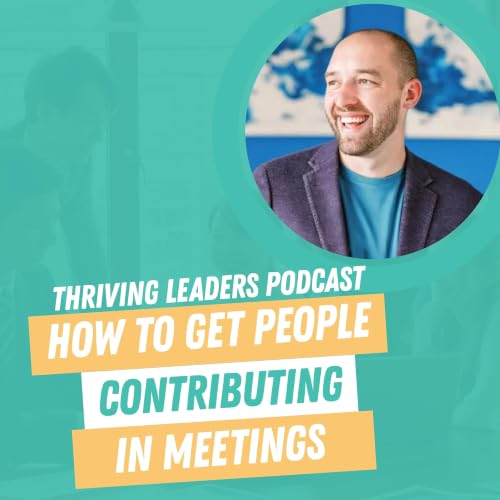
  • How to Get People Contributing in Meetings with Chad Littlefield
    Sep 1 2026

    Most meetings are designed around content. Someone presents, everyone else listens, and contribution is invited at the end with: “Any questions?”

    By then, it may be too late.

    Chad Littlefield believes connection is not the warm-up before the real work. It is part of the work — particularly when leaders need people to think together, speak honestly and collaborate beyond their usual teams.

    Chad is the co-founder and Chief Experience Officer of We and Me, a TEDx speaker, and the co-author with his late partner, Will Wise, of Ask Powerful Questions and How to Make Virtual Engagement Easy. He also created the We! Connect Cards, which are used in more than 80 countries.

    We explore how leaders can invite contribution earlier, create connection without resorting to awkward or unrelated icebreakers, and design meetings that feel more purposeful from the moment people arrive.

    We also talk about a challenge I see frequently in organisations: leaders may have strong relationships within their own functions, yet struggle to build the horizontal connections needed to deliver strategy. Chad shares a practical idea for helping those relationships continue after an offsite or senior leader forum — rather than leaving everyone with good intentions that disappear once they return to work.

    In this episode, we cover:

    • Why connection shapes the quality of the work that follows
    • What changes when leaders design for contribution rather than passive listening
    • How Chad’s Contribution Method rethinks the flow of a meeting
    • Why “connection before content” is different from an icebreaker
    • How a simple shift in format can change the energy in a room
    • Why teams need the right amount of connection — not necessarily more
    • How to extend cross-functional relationships beyond a one-off event
    • The question Chad believes can keep a team learning

    If you lead meetings, bring large groups together or want stronger collaboration across boundaries, Chad offers a different way to think about the time people spend together.

    And he leaves us with a question that is worth returning to — as leaders, as teams and as human beings.

    Chapters

    • 00:00 – Why connection is part of the work
    • 03:00 – Chad Littlefield’s work and why connection matters
    • 04:20 – Where Chad’s interest in connection began
    • 09:00 – Positive social risks and Chad’s first speaking opportunity
    • 12:00 – Why small groups are the units of transformation
    • 16:00 – The five-part Contribution Method
    • 20:00 – Connection before content
    • 23:00 – Designing content for contribution
    • 27:00 – How to close a meeting with energy
    • 29:00 – Applying the method in everyday meetings
    • 40:00 – The minimum effective dose of team connection
    • 45:00 – Making cross-functional connection continue after an event
    • 48:00 – The question that keeps a team learning
    • 49:30 – AI, speed and the value of slowing down
    • 51:00 – Being purposeful about time away from work

    Links and Resources:

    • We and Me / Chad Littlefield
    • We! Connect Cards
    • Ask Powerful Questions by Will Wise and Chad Littlefield
    • How to Make Virtual Engagement Easy by Chad Littlefield
    • Explore more leadership resources from Thriving Culture

    Mostra di più Mostra meno
    1 ora