Episodi

  • Ep. 120: A Double Canon (4 Parts from 2 Lines)
    Jan 19 2026

    A double canon from Bach’s Orgelbüchlein! A bit late, but Bach’s take on this Christmas tune is really wonderful. See how both melodies combine to make a double canon:

    German mystic, Heinrcih Seuse, author of ‘In Dulci Jubilo’

    English composer R. J. Pearsell’s setting of the melody.

    Spread the Love, Doubly Canonic:

    N.B. I’ve been wanting to make this rebrand for a while: The title of this podcast is no longer “The WTF Bach Podcast” but simply, “WTF Bach” — I hope this doesn’t cause any problems, if you run in to any issues as all, please alert us! Thanks!

    Want to help this resource? Here’s how:

    We encourage our listeners to become a paid subscriber atwtfbach.substack.comFree subscriptions are also beneficial for our stats. You can make a one-time donation:

    https://www.paypal.me/wtfbachhttps://venmo.com/wtfbach

    Supporting this show ensures its longevity. Thank you for your support!


    Get full access to W.T.F. Bach? at wtfbach.substack.com/subscribe
    Mostra di più Mostra meno
    23 min
  • Ep. 119: Special Guest! Paul Jacobs
    Jan 15 2026

    I had the great pleasure of speaking with Mr. Paul Jacobs. On the 250th anniversary of Bach’s death, July 28th, 2000, Jacobs played Bach’s complete organ works in one giant 18 hour concert— he was 23.

    Our conversation spans how to memorize, scholars vs. performers, pianists playing the organ, pop music, music for consumption, ‘social media musicians,’ music as a substitute for God, The Art of Fugue (harpsichord or organ?) and more…

    Become Your Best Buxtehude:

    Some links mentioned in the chat:

    Organmaster Shoes

    The Robertsbridge Codex

    Schumann’s advice for young musicians

    and of course, Paul’s website.

    Want to help this resource stick around? Here’s how:

    We encourage our listeners to become a paid subscriber atwtfbach.substack.comFree subscriptions are also beneficial for our numbers.

    You can make a one-time donation:

    https://www.paypal.me/wtfbachhttps://venmo.com/wtfbach

    Supporting this show ensures its longevity. Thank you for your support!


    Get full access to W.T.F. Bach? at wtfbach.substack.com/subscribe
    Mostra di più Mostra meno
    1 ora e 13 min
  • Ep. 118: How to Practice! (+ Advice for Teens)
    Jan 8 2026
    Update: Just got five promo codes to download Time Guru (the cool metronome app mentioned in the episode.) Send me a message or let me know down below you’re interested and I’ll share the codes! Happy PracticingLet’s get our good new habits in early in the year! In this episode, I read practical advice from three organists/organ method books. The organ method books are in a class of their own— highly entertaining reading.We begin with Francis Routh’s Teach Yourself The Organ (1958.) His asterisk marking the complete works of Buxtehude as ‘fairly easy’ is representative of this amusing book:Harold Gleason’s method book of 1962 makes up the bulk of this episode, the complete advice is pasted below.We feature some of Fayth Freese’s excellent article from The Diapason. I recommend the full read. And here is the advice to teens I made for the Harrison School for the Arts in Lakeland Florida. I cannot emphasize enough how music should be a joyous process at this age, never an abusive one.From Gleason (bold type is my emphasis)HOW TO PRACTICE:* Make a schedule for daily practice. Devote a definite amount of time to technique, to new music, to perfecting music already studied, and to memorizing. Devote at least one hour a day to piano practice. Later the student will need to reserve time for perfecting the many skills required for playing the church service.* Practice as if the piece were being memorized (see the section on Memorizing).* Study the music before beginning to practice. Note the key signature, time signature, note values, fingering, pedaling, structure, special problems, and general style. If the fingering and pedaling is not given or is inadequate, it should be carefully worked out according to the principles given in the sections on Fingering and Pedaling.* Memorize and always use the same fingering and pedaling. Incorporate the articulation, phrasing and interpretation into the practice.* Try to avoid playing wrong notes or incorrect time values from the first time an exercise or piece is practiced. If a wrong note or rhythm is played, do not immediately correct it. Go back to the beginning of the phrase and repeat the passage correctly a number of times.* Concentrate on the work at hand and avoid mechanical, unthinking practice and repetition. Always practice after a lesson.* Practice slowly in the following sequence: right hand; left hand; both hands; pedal; right hand and pedal; left hand and pedal; both hands and pedal. Begin the slow practice of short sections for both hands and pedal while working on separate parts.* When the phrases and sections of a composition have been mastered at a low tempo, play it all the way through. When this has been accomplished with complete muscular control and accuracy, the tempo may be gradually increased. Return to slow, detailed practice of sections which are not secure, and repeat this process at succeeding practice periods.* Always practice at a steady tempo. Do not play easy places fast and difficult places slowly.* Devote the most attention to difficult passages.* In contrapuntal music, play one or more parts and sing another part.* In passages of a technical nature, the practice of four-note groups in the various rhythmic patterns is helpful in developing speed and control.* Stop practicing and relax for a few minutes at the first sign of tension.* When practicing technical exercises for manuals and pedals, and when first learning a piece, use clear, quick-speaking stops of 8’ or 8’ and 4’ pitch (Gedackt 8’, Principal 4’).* As soon as the notes in a composition have been mastered, work out an appropriate registration.* The drawing of stops and the use of combination pistons and reversibles should be carefully practiced and synchronized, in order not to interfere with the performance of the music.* Above all, the student should learn to listen and hear that the parts are sounding together, are released together, and that the touch, rhythm, accents, and interpretation are actually being realized as intended.How’s Your Contrapuntal Journey Fugueing?HOW TO MEMORIZE:The principal reason for playing from memory lies in the fact that it will result in a better performance, both technically and musically. The perfectly memorized work becomes a part of the performer and gives him complete freedom of expression.When a piece of music is practiced correctly and efficiently, it is also being memorized, and good practice habits will lead to a continual improvement in the ability to memorize.After a composition has been thoroughly learned with the notes, the complete process of memory should be undertaken. Concentration and interest in learning are indispensable to the memory process.There are four types of memory which are used in music. Three of these types—aural, visual, and motor memory—depend on our senses or imagery. The fourth, and most important type, is known as cognitive memory. It is based on knowledge and is the memory...
    Mostra di più Mostra meno
    30 min
  • Ep. 117: I Forgot C Minor! BWV 847
    Dec 29 2025

    This famous piece:

    saw quite a few revisions between its conception and the version we know. For starters, note the earliest version’s key signature, and the E-flat in bar 2:

    The most striking feature of the early version is the abrupt end:

    No presto? No adagio? No allegro?

    The fugue (in 3 voices) is a fugue with two countersubjects. See them here, the first on top, the second below. Both countermelodies occur with every entrance of the main theme:

    Become your best Buxtehude.

    We also have a brief look at the c minor invention, BWV 773. The piece is almost entirely a canon.

    I also mentioned the issue of “stemming” at the beginning of the episode. Here is the chord I mentioned (BWV 867.) Note how Bach’s nine individual stems imply nine separate voices, whereas the print reduces them to only four:

    N.B. Most of the episodes of this podcast have been newly catalogued according to genre or theme or BWV on my Substack. Yet another reason for you to join the platform! You can now browse according to BWV, instrumentation, et cetera. Have a gander at wtfbach.substack.com

    Thanks to all my listeners for supporting me in 2025! Thanks to Romain Villet for reminding me to make this episode. Best of luck to him and to all brave enough to transpose Bach in 2026!

    We survive solely on donations. Thank you for your help!

    We encourage our listeners to become a paid subscriberat wtfbach.substack.comFree subscriptions are also great for our numbers.You can also make a one-time donation here:

    https://www.paypal.me/wtfbachhttps://venmo.com/wtfbach

    Supporting this show ensures its longevity.

    Concepts Covered:

    This podcast episode discusses Johann Sebastian Bach’s Well-Tempered Clavier, book 1, (1722) the second prelude and fugue in C minor. Including revisions, fugue structure, and contrapuntal technique, with a few hints at BWV 773 and BWV 867. There is a double countersubject, canonic writing, BWV 847a, and the earliest versions before source P. 415


    Get full access to W.T.F. Bach? at wtfbach.substack.com/subscribe
    Mostra di più Mostra meno
    53 min
  • Ep. 116: Chromatic Finale Of The First Half, BWV 857
    Dec 18 2025

    We’ve traveled halfway through the chromatic scale and Bach celebrates this victory with one of the more complex fugues in the collection. The subject is somber, full of half-steps and even a cross. It foreshadows the true finale at the close of all 24 pieces:

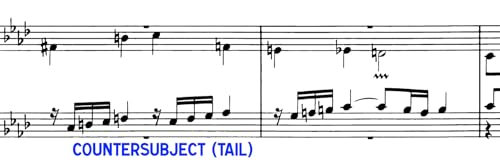
    This is one of the only fugues to make strict use of the countersubject, occurring in all but one (!) appearances of the subject.

    This motif, which we call the head of the countersubject, dominates all the episodic material both right side up, and upside down:

    Got Bach?

    The prelude contains some interesting revisions. Here is one I thought would be too subtle to hear, but I think it’s quite audible in the episode:

    The latter represents a rare simplification of harmony and texture in revision.

    The biggest addendum of all is the additional measures at the end of the piece. See how abruptly the early version ends:

    We survive solely on donations. Thank you for your help!

    We encourage our listeners to become a paid subscriberat wtfbach.substack.comFree subscriptions are also great for our numbers.You can also make a one-time donation here:

    https://www.paypal.me/wtfbachhttps://venmo.com/wtfbach

    Supporting this show ensures its longevity.

    Concepts Covered:

    J.S. Bach’s Well Tempered Clavier, Tuning, Revisions, Early verisions. The f minor prelude and fugue BWV 857, with its countersubject, analysis and study. Organ and harpsichord performances, Chromaticism, tone-rows,


    Get full access to W.T.F. Bach? at wtfbach.substack.com/subscribe
    Mostra di più Mostra meno
    58 min
  • (5 Min. Rant) How To Twist A Shirt
    Dec 15 2025

    YouTube These Days....

    Enjoying your contrapuntal journey? Here’s how you can help:

    We encourage our listeners to become a paid subscriber atwtfbach.substack.comFree subscriptions (yes, you can subscribe for free!) are also beneficial for our numbers.

    You can make a one-time donation here. We run a 501(c)3, so let us know if you want a tax deduction:

    https://www.paypal.me/wtfbachhttps://venmo.com/wtfbach

    Supporting this show ensures its longevity. Thank you for your support!


    Get full access to W.T.F. Bach? at wtfbach.substack.com/subscribe
    Mostra di più Mostra meno
    5 min
  • Ep. 115: F Major Prelude & Fugue, BWV 856
    Dec 8 2025

    Anyone else feel like we don’t have enough fugues in F major?

    In the last of Bach’s four layerings to the fair copy of The Well-Tempered Clavier, we see some beautiful details that would have been lost had Bach not made this last series of revisions in the 1740s. It makes you wonder if Bach would have made even more, should he have lived as long as Telemann!

    Bar 42 reads like this in A1-A3 into the 1740s:

    Then, in A4, Bach found expression in the tie and 32nd notes:

    Such a revision physically looks like this on fair copy:

    This particular revision may not be immediately clear to the naked eye, but some are (see the e minor revisions at the bottom of the post.) I believe it was X-ray technology that led to such breakthroughs in the scholarship, but some layers might be a sort of ‘white-out’ or paste that physically would stand out on the paper— any expertise would be appreciated in the comments! We know that in the Saint Matthew Passion, Bach quite literally ‘layered’ smaller pieces of paper onto the manuscript, but I think that has to do with repair, not necessarily revision. One famous layering in A4 looks as if it’s been pasted onto the manuscript… but it could be my imagination. From the first fugue, BWV 846:

    WTF Bach is free to all! Let’s spread the awareness of contrapuntal mastery. However, if you support financially, you’re much less likely to write parallel 5ths.

    There are a number of revisions also in the F Major prelude. Interestingly, the length of both prelude and fugue remains unchanged between earliest versions and the fair copy. Bach had the general harmonic rhythm right, but smooths out the insides of some measures:

    (Early versions, followed by the fair copy)

    And so on… (more demonstrations in the episode.)

    I finish the episode with four beautiful revisions to the e minor prelude (covered in Ep. 114) again made in A4. These are typical of his final revisions to the WTC1, bursting with 32nds. Here, one can somewhat plainly see the difference between inks:

    Before these revisions, the melody was as follows:

    We survive solely on donations. Thank you for your help!

    We encourage our listeners to become a paid subscriberat wtfbach.substack.comFree subscriptions are also great for our numbers.You can also make a one-time donation here:

    https://www.paypal.me/wtfbachhttps://venmo.com/wtfbach

    Supporting this show ensures its longevity.

    Concepts Covered:

    J.S. Bach’s late A4 revisions to the Well-Tempered Clavier I (BWV 846–869) in the F-major fugue BWV 856, the F major prelude, the discant adjustments that earlier manuscript stages (A1–A3) lack. The late embellishments in the E-minor prelude BWV 855, The genesis of WTK I, variant readings, fair-copy corrections, Harmonic analysis, contrapuntal rules, and the general genius of Bach.


    Get full access to W.T.F. Bach? at wtfbach.substack.com/subscribe
    Mostra di più Mostra meno
    40 min
  • Why You Should Listen To This Podcast (Ars Podcastica)
    Nov 27 2025

    Giving thanks to all my listeners today! Why do you listen to this podcast?

    The original Spanish of the Borges poem, as read by my good friend, Andrea Profili.

    Otro poema de los dones

    Gracias quiero dar al divinoLaberinto de los efectos y de las causasPor la diversidad de las criaturasQue forman este singular universo,Por la razón, que no cesará de soñarCon un plano del laberinto,Por el rostro de Elena y la perseverancia de Ulises,Por el amor, que nos deja ver a los otrosComo los ve la divinidad,Por el firme diamante y el agua suelta,Por el álgebra, palacio de precisos cristales,Por las místicas monedas de Ángel Silesio,Por Schopenhauer,Que acaso descifró el universo,Por el fulgor del fuego,Que ningún ser humano puede mirar sin un asombro antiguo,Por la caoba, el cedro y el sándalo,Por el pan y la sal,Por el misterio de la rosa,Que prodiga color y que no lo ve,Por ciertas vísperas y días de 1955,Por los duros troperos que en la llanuraArrean los animales y el alba,Por la mañana en Montevideo,Por el arte de la amistad,Por el último día de Sócrates,Por las palabras que en un crepúsculo se dijeronDe una cruz a otra cruz,Por aquel sueño del Islam que abarcóMil noches y una noche,Por aquel otro sueño del infierno,De la torre del fuego que purificaY de las esferas gloriosas,Por Swedenborg,Que conversaba con los ángeles en las calles de Londres,Por los ríos secretos e inmemorialesQue convergen en mí,Por el idioma que, hace siglos, hablé en Nortumbria,Por la espada y el arpa de los sajones,Por el mar, que es un desierto resplandecienteY una cifra de cosas que no sabemosY un epitafio de los vikings,Por la música verbal de Inglaterra,Por la música verbal de Alemania,Por el oro, que relumbra en los versos,Por el épico invierno,Por el nombre de un libro que no he leído:Gesta Dei per Francos,Por Verlaine, inocente como los pájaros,Por el prisma de cristal y la pesa de bronce,Por las rayas del tigre,Por las altas torres de San Francisco y de la isla de Manhattan,Por la mañana en Texas,Por aquel sevillano que redactó la Epístola MoralY cuyo nombre, como él hubiera preferido, ignoramos,Por Séneca y Lucano, de Córdoba,Que antes del español escribieronToda la literatura española,Por el geométrico y bizarro ajedrezPor la tortuga de Zenón y el mapa de Royce,Por el olor medicinal de los eucaliptos,Por el lenguaje, que puede simular la sabiduría,Por el olvido, que anula o modifica el pasado,Por la costumbre,Que nos repite y nos confirma como un espejo,Por la mañana, que nos depara la ilusión de un principio,Por la noche, su tiniebla y su astronomía,Por el valor y la felicidad de los otros,Por la patria, sentida en los jazmines,O en una vieja espada,Por Whitman y Francisco de Asís, que ya escribieron el poema,Por el hecho de que el poema es inagotableY se confunde con la suma de las criaturasY no llegará jamás al último versoY varía según los hombres,Por Frances Haslam, que pidió perdón a sus hijosPor morir tan despacio,Por los minutos que preceden al sueño,Por el sueño y la muerte, esos dos tesoros ocultos,Por los íntimos dones que no enumero,Por la música, misteriosa forma del tiempo

    Enjoying your contrapuntal journey? Here’s how you can help:

    We encourage our listeners to become a paid subscriber atwtfbach.substack.comFree subscriptions (yes, you can subscribe for free!) are also beneficial for our numbers.

    You can make a one-time donation here. We run a 501(c)3, so let us know if you want a tax deduction:

    https://www.paypal.me/wtfbachhttps://venmo.com/wtfbach

    Supporting this show ensures its longevity. Thank you for your support!


    Get full access to W.T.F. Bach? at wtfbach.substack.com/subscribe
    Mostra di più Mostra meno
    17 min