Episodi

  • AI, the Unauthorized Practice of Law, and the Future of Legal Fees
    Oct 13 2026
    The line between legal information and legal advice is disappearing, and AI is the reason. Damien Riehl, a lawyer and technologist at Clio who chairs the Minnesota State Bar Association’s AI Committee, explains why unauthorized practice of law concerns look different in the age of ChatGPT and shares three ways legal aid providers can stay on the right side of the line: sticking to legal information, using empathy, and offering statistics. He explains why transactional lawyers have embraced AI faster than litigators, why the more than 1,000 cases involving hallucinated citations are really a bad lawyering problem, and why a tool grounded in current case law can hallucinate less than a junior associate. Riehl also looks at how firms like Kirkland are trying to keep institutional knowledge from walking out the door with lateral hires, why Jevons paradox suggests cheaper legal work will create more of it, and how his own neighbor dispute over a fence showed what an experienced litigator still brings that AI cannot. He predicts flat fees and subscriptions will take a much larger share of legal billing, points to AAA’s bot arbitration as a glimpse of where access to justice could go for the 92% of legal needs that go unmet, and closes by rejecting the optimist versus pessimist framing in favor of deciding what kind of future lawyers want to build.
    Mostra di più Mostra meno
    43 min
  • Why Off-the-Shelf AI Tools Aren't Enough for Litigation Teams — Live from ILTACON 2026
    Oct 6 2026
    Recorded at Concorda's booth in Startup Alley at ILTACON, this conversation with founders Sam Oh and Ke Ma digs into the gap they saw in legal AI tools built mostly for transactional work while litigation teams were left without platforms that understood local court rules, judges' standing orders, and the formatting requirements tied to filing and service. Oh and Ma, both licensed attorneys, walk through how they built out that database starting with PACER and federal courts before expanding state by state to national coverage, and why their approach to firm adoption leans on embedding directly with attorneys and mapping the technology to a firm's actual workflows rather than dropping in an off-the-shelf tool. The conversation closes with their shared warning about the industry's biggest blind spot: no matter how advanced the models get, hallucination risk never fully disappears, which is why Oh argues that quick, visual source verification matters more than trusting a tool at face value.
    Mostra di più Mostra meno
    10 min
  • Firms Are Growing Revenue With AI, Not Just Cutting Hours — Live from ILTACON 2026
    Sep 29 2026
    Recorded on the show floor at ILTACON, this conversation with Thomas Bueler-Faudree, founder of August, tackles the question he says he hears most from law firms: does adopting AI mean undercutting your own billable hours. Bueler-Faudree argues that legal work is inelastic, so firms that lower costs with AI tend to win more work rather than less, pointing to case studies of firms doubling revenue and scaling from 100 to 400 lawyers after adopting AI systems. He also breaks down why Australia and the UK have outpaced the US in AI adoption due to their different ownership rules, why long pilot programs with a mix of skeptics and early adopters matter more than rushing a rollout, and why he pushes firms to measure ROI in top-line revenue rather than time saved. The conversation closes with Bueler-Faudree's read on where the market is headed next, including the shift from firms using AI individually to firms restructuring around it at a firm-wide level.
    Mostra di più Mostra meno
    13 min
  • How AI Is Quietly Transforming the Courts
    Sep 22 2026
    Most conversations about AI and the law focus on attorneys, but the courts themselves are moving fast in ways that get far less attention. Matt Davis, Vice President of Product Development at Tyler Technologies with over 20 years of experience in public sector courts and justice software, breaks down the three major categories where courts are actually deploying AI today: internal chatbots training up new staff, automation of repetitive clerk tasks like e-file review, and tools that help judges absorb case information faster without replacing their decision-making. Davis walks through real examples, including Orange County's internal chatbot, Alaska's AI tool for self-represented litigants navigating probate, and the Arizona Supreme Court's use of AI avatars to explain rulings in plain language for the public, and the conversation also covers the data custodian responsibilities courts carry, why judges and courts remain wary of AI touching outcomes even as they embrace it for analysis, and how Tyler's acquisition of FTR is shaping a new AI-powered experience for judges working with digital transcripts, before Davis and host Phillip Vaden close things out with a wide-ranging discussion on humanoid robots, AI safety, and where they each land on the optimist-versus-pessimist spectrum.
    Mostra di più Mostra meno
    43 min
  • Legal Tech AI Recap: Google, Thomson Reuters, LexisNexis, and iManage All Make Their Move
    Sep 14 2026
    A packed couple of weeks in legal tech coming out of ILTACON 2026 in Nashville, TN. Host Phillip Vaden covers Google's launch of Gemini Enterprise for Legal, Thomson Reuters' new proprietary legal LLM, LexisNexis's shift toward an orchestration layer, and iManage's new platform and partnerships. He closes with a California bill that could restrict attorneys from delegating legal work to generative AI, and what it could mean for the legal AI market.
    Mostra di più Mostra meno
    6 min
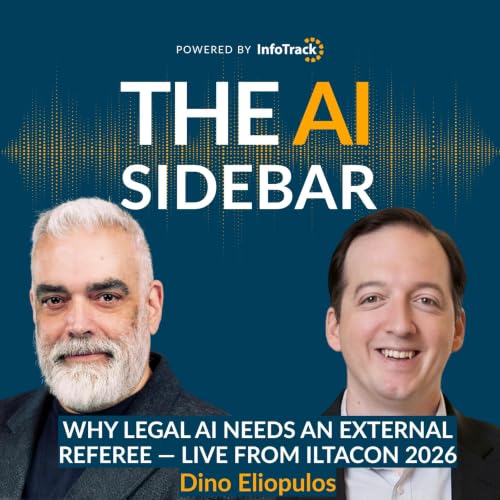
  • Why Legal AI Needs an External Referee — Live from ILTACON 2026
    Sep 8 2026
    Recorded live at ILTACON 2026, this conversation with Dino Eliopulos, SVP of Innovation at Fulcrum GT, digs into why AI shouldn't be trusted to grade its own work. Eliopulos explains the case for building external systems that audit AI outputs rather than letting the AI evaluate itself, and how that traceability matters when a firm has to defend a disputed bill or explain how an AI-corrected time entry came to be. He also talks through the discipline behind Fulcrum's internal startup incubator, how unstructured legal work product like briefs and narratives is finally becoming accessible to AI, and what he tells firms asking how to measure ROI on their AI investments without having a business case in place from the start.
    Mostra di più Mostra meno
    19 min
  • How Paralegals Are Becoming the AI Power Users of the Legal Industry
    Aug 26 2026
    Paralegals have been prompt engineers long before the term existed, and that background is shaping how they're approaching generative AI today. Kristine Custodio Suero, California Paralegal of the Year and paralegal educator at the University of San Diego School of Law, and Kelli Radnothy, a 20-plus year litigation paralegal with the Nevada Attorney General's office and chief ideas officer of KLR Paralegal, join the show to talk through how they're using AI tools in practice and in the classroom. They walk through their advice for paralegals just starting out, why starting low stakes and low risk matters before touching client data, and how they trained their own LLMs, nicknames included, to build confidence with the technology. The conversation covers the guardrails needed for confidentiality and ethics, the shift from task-based work to strategic work that AI is pushing paralegals toward, and why billing models may need to evolve alongside it. Suero and Radnothy also share how government and firm settings shape what tools they're allowed to use, their takes on Claude versus ChatGPT, and why they both land firmly on the techno-optimist side of the debate.
    Mostra di più Mostra meno
    42 min
  • AI Adoption in Law Firms: What's Really Happening Behind the Numbers
    Aug 18 2026
    Generative AI usage among attorneys jumped from 31% to 69% in a single year, but most law firms still haven't caught up with formal policies or training. Attorney and legal tech columnist Nicole Black, who has covered the intersection of law and technology for two decades, breaks down what's driving that gap and what it means for firms trying to keep pace. She explains why solo and small firms tend to adopt new technology faster than their mid-size and large counterparts, and why immigration attorneys in particular are using generative AI at a much higher rate than other practice areas. Black also discusses the slow erosion of the billable hour, why in-house counsel and insurance defense attorneys are among the most likely to push firms toward flat rate pricing, and what the current wave of legal tech consolidation means for the tools attorneys rely on day to day. The conversation turns to the rise of vibe coding in the legal industry, including attorneys building their own case management software from scratch, and Black shares her own experience using AI tools to navigate a New York liquor license application for a winery she and her husband are launching. She closes with her honest take on where she lands between AI optimism and AI pessimism, and why she thinks regulation may already be behind the curve.
    Mostra di più Mostra meno
    38 min