Steve Pretty On The Origin of the Pieces copertina

Steve Pretty On The Origin of the Pieces

Steve Pretty On The Origin of the Pieces

Di: Steve Pretty
Ascolta gratuitamente

Offerte di stagione | 0,99 €/mese per i primi 3 mesi

A seguire 9,99 €/mese – si applicano condizioni. Puoi disdire mensilmente.
A proposito di questo titolo

‘Wide-ranging and insightful’ - Guardian (pick of the week, January 2024)


A show for anyone who has ever listened to, played, improvised, written, or just enjoyed music and wanted to know more about these mysterious sounds. Are they 'auditory cheesecake' as cognitive scientist Steven Pinker claims, or actually a fundamental part of what has made us into modern humans?


With an enormous variety of guests ranging from well-known musicians, producers and industry figures through to those for whom music is central but who rarely have a voice, this show is unapologetically broad in scope.


In 'entertaining noises', Steve has musicians explain and demonstrate their instrument, giving fresh perspective on everything from the piano to modular synthesizers, via lesser-known folk instruments from around the world.


And in the flagship 'genre tombola' section, Steve is assigned a randomly-chosen genre from the list of 1334 music genres on Wikipedia, which he then goes away and researches, often talking to an expert in that music, before frequently attempting to make some music in that style... Whether he succeeds or not, there's lots of fascinating stuff to learn along the way!


As fun as it is thoughtful, this show aims to help you hear and appreciate music in new ways.


http://www.originofthepieces.com/

Hosted on Acast. See acast.com/privacy for more information.

Steve Pretty
Musica Successo personale Sviluppo personale
  • Gig Faces, Zebra Finches and Acid Horn
    Nov 10 2026
    Why can two people go to the same gig and have completely different experiences? Can a zebra finch help us hear something we have been missing? And does knowing more about music help us enjoy it, or just give us more things to worry about?This week, I compare notes with journalist Jo Caird before and after a Beirut gig, and try to explain my apparently miserable gig face. We talk about listening for the details, letting the whole thing wash over you, and whether it is ever possible to switch off the part of your brain that does this for a living.Along the way, Richard Feynman's thoughts about the beauty of a flower lead into the pleasures of understanding a little more, and Stevie Wonder's Pastime Paradise offers a chance to hear something new in a familiar recording.In the Listening Lab, we try an experiment inspired by research comparing humans and zebra finches. What happens when the pitch of a sound and its tone colour point in different directions? With examples from singing, a synthesizer filter and a wah pedal, we listen beyond the notes themselves.Then I pick up a tenor horn to join The Listening Project for Jeremy Deller's Acid Brass at Simple Things Festival, Bristol Beacon, on 7th November 2026. I work on Strings of Life before taking it to the stage, with some brass-band muscle memory to contend with along the way. The episode includes footage from that performance, so you can hear how it went.LINKS AND REFERENCESExplore the podcast, browse by subject and sign up for The Open Ear Dispatch:https://www.originofthepieces.com/Explore the episode map:https://www.originofthepieces.com/mapJo Caird:https://jocaird.com/Try the listening experiment, 'Can you do better than a songbird?':https://www.mcg.uva.nl/humansvszebrafinches/Research: Zhi-Yuan Ning, Jiaxin Li, Carel ten Cate and Henkjan Honing, 'Divergent Processing Strategies for Auditory Sequence Recognition in Humans and a Songbird' (2026):https://doi.org/10.1038/s42003-026-11035-9Simple Things Festival:https://simplethingsfestival.co.uk/The performance featured in this episode: The Listening Project Presents: Jeremy Deller's Acid Brass, Simple Things Festival, Bristol Beacon, 7th November 2026 (event listing):https://bristolbeacon.org/whats-on/simple-things-2026/About The Listening Project, founded by trumpet player Jack Jones:https://www.jackjonescurates.co.uk/the-listening-projectThe Listening Project - music, news and links:https://linktr.ee/thelisteningprojectVIDEO EXCERPT CREDITSAnna-Maria Hefele - 'overtone singing - lesson 1: basics':https://www.youtube.com/watch?v=HP0iotICL7kMarc Doty - 'Filter- Cutoff Control', published by the Bob Moog Foundation, from a macProVideo synthesis tutorial:https://www.youtube.com/watch?v=213faH98plEGriff Hamlin / Blues Guitar Unleashed - 'How To Use A Wah Pedal':https://bluesguitarunleashed.com/blog/how-to-use-a-wah-pedal/ Hosted on Acast. See acast.com/privacy for more information.
    Mostra di più Mostra meno
    38 min
  • Dal:um: Korea, Strung Differently
    Oct 19 2026

    Two Korean string instruments, two very different ways of shaping a sound. Dal:um’s Ha Suyean and Hwang Hyeyoung join me after their concert in Finland to explore the gayageum and geomungo, from delicate silk-string sounds to surprisingly powerful, percussive playing.

    We get close to the instruments: a bamboo playing stick, frets, pitch bends and movable bridges called “goose feet”. They explain how their modern instruments differ from traditional versions, and demonstrate a way of feeling Korean rhythm through breath and dance movement.

    There’s music from the concert, demonstrations from both players, and a performance recorded especially for the conversation. The video edition lets you see how their hands shape the sounds.

    Later, I share “Basildon Made Me Baby”, a collaboration with spoken-word artist Emy P, through a project with filmmaker and poet Aaron Shrimpton. My music takes a hip-hop direction, with a few nods to Basildon’s electropop heritage; Emy’s words explore place, identity and finding her people.

    Plus: Sound / Visuals / Spoken at the Towngate Theatre on 12th November 2026, and Origin live with Beardyman at Wilton’s Music Hall on 10th March 2027.

    IN THIS EPISODE

    • Dal:um in concert and conversation
    • Korean rhythm, breathing and dance
    • Inside the geomungo and gayageum
    • Silk strings, bamboo, frets and “goose feet”
    • A performance by the duo
    • Emy P, Basildon and a new spoken-word track
    • Live dates with Steve Pretty

    WATCH / EXPLORE

    Origin of the Pieces — video editions, transcripts and more

    https://www.originofthepieces.com/

    Dal:um at Glitterbeat / tak:til

    https://glitterbeat.com/artists/dalum/

    Sound / Visuals / Spoken — 12th November 2026

    https://towngatetheatre.co.uk/estuary-sound-visuals-spoken/

    Origin live with Beardyman — 10th March 2027

    https://wiltons.org.uk/whats-on/steve-pretty-and-friends-on-the-origin-of-the-pieces-3/

    MUSIC FROM THIS EPISODE

    Dal:um: Ha Suyean (gayageum), Hwang Hyeyoung (geomungo).

    “Basildon Made Me Baby”: spoken word by Emy P; music and audio production by Steve Pretty, for a project with Aaron Shrimpton.

    CLARIFICATION

    Basildon is shortlisted for UK Town of Culture 2028; my tentative reference to it holding the title this year is mistaken.

    MORE FROM ORIGIN OF THE PIECES

    Join The Open Ear Dispatch and find the Patreon link at https://www.originofthepieces.com/

    Hosted on Acast. See acast.com/privacy for more information.

    Mostra di più Mostra meno
    30 min
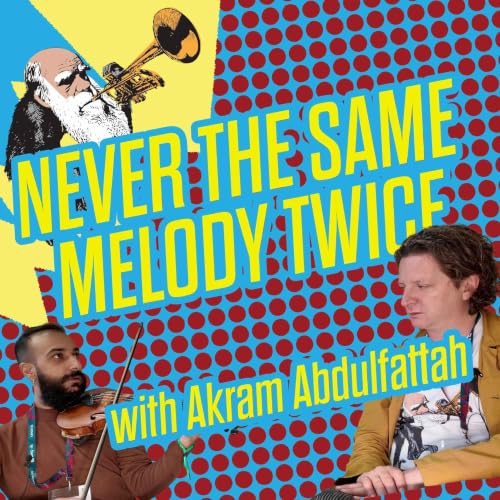
  • Never the Same Melody Twice with Akram Abdulfattah
    Sep 24 2026

    How much can you change a melody before it becomes something else? Palestinian-American violinist and composer Akram Abdulfattah joins me to explore a tradition in which variation is part of learning the tune from the start.

    Recorded at WOMEX in Finland in 2025, this conversation comes with plenty of violin demonstrations. Akram explains why a maqam is more than a scale, introduces the expressive possibilities between familiar notes, and shows how a phrase can take a different route each time it is played.

    His six-string violin extends into an unusually low register. We hear what those extra strings make possible, how they change the physical experience of playing, and why the instrument can sound so close to a human voice. There is an original solo performance along the way.

    We also talk about learning musical rules and finding freedom within them, Arabic roots and wider influences, and the pleasure of hearing a familiar melody change without losing its identity.

    Towards the end, Akram reflects on music, family and his Palestinian-American identity, before we discuss the challenges of making a living as a musician and helping audiences discover something unfamiliar.


    IN THIS EPISODE

    00:00 – Welcome to Origin

    00:26 – Introducing Akram Abdulfattah

    02:33 – Live at WOMEX 2025

    03:11 – Meet Akram

    04:28 – Arabic roots, many influences

    06:33 – Maqam: more than a scale

    08:19 – Tarab and musical feeling

    09:07 – The notes between the notes

    10:29 – Hearing microtones on violin

    16:49 – Tradition and improvisation

    19:18 – Never the same melody twice

    22:57 – A six-string violin

    27:33 – An original solo performance

    30:04 – Why the violin sounds like a voice

    33:28 – What is music for?

    36:08 – Music and Palestinian-American identity

    39:02 – Where is music heading?

    42:11 – Becoming more adventurous listeners

    44:11 – Tradition, innovation and what comes next

    46:47 – Support the show


    WATCH & EXPLORE

    Akram Abdulfattah — official website

    Akram's music

    Akram's listening and social links


    MUSIC FROM THIS EPISODE

    Live excerpts from WOMEX 2025, an original solo composition and violin demonstrations by Akram Abdulfattah.


    MORE FROM ORIGIN OF THE PIECES

    Website — episodes, transcripts and mailing list

    YouTube

    Patreon

    If you enjoy the show, please share it with a friend or leave a rating or review. Stay musically curious.

    Hosted on Acast. See acast.com/privacy for more information.

    Mostra di più Mostra meno
    48 min
adbl_web_anon_alc_button_suppression_t1
Ancora nessuna recensione