Episodi

  • Podcast Then & Now #43: Teresa Cherfas in conversation with Linor Goralik
    Oct 8 2026
    Welcome to the 43rd edition of the Russian-language podcast Then & Now with me, Teresa Cherfas Today our guest is the poet, writer, artist and activist Linor Goralik. Linor was born into a Jewish family in 1975 in Dnipropetrovsk. In 1989 her family emigrated to Israel. From 2000 to 2014, Linor lived and worked in Moscow. After that, she divided her time between Israel and Russia until November 2021. In March 2022, just two weeks after the start of the so-called ‘Special Military Operation’, Linor Goralik travelled to Tbilisi, Yerevan and Istanbul before returning to Israel – to Tel Aviv and Jerusalem – documenting the mass exodus of people from Russia triggered by the full-scale invasion of Ukraine. She subsequently presented these people’s testimonies in a bilingual publication by the Tamizdat Project entitled Exodus-22. The book was published last year. ‘In March 2022, after the full-scale invasion of Russian forces into Ukraine, I went on a trip that took me from Israel to Tbilisi to Yerevan to Istanbul and back to Israel. I hoped to take notes on this ‘Exodus-22’ – that is, to create a record of people leaving Russia over the course of these weeks. This experience was incredibly important for me, and I am endlessly grateful to the people who met with me, spoke with me, and helped me work with this material. I should add that all of the Ns in these notes are different people, and the order of the notes for each location is roughly chronological’ – Linor Goralik ‘Exodus-22 | Исход-22’ is published by the Tamizdat project Questions Do you remember your initial reaction when you heard the news about Russia’s full-scale invasion of Ukraine? What prompted you to set off on this journey? You started in Tbilisi. Tell us what you found there and how you began working with your interviewees. After Tbilisi, you travelled to Yerevan. Did you notice a difference in the way Russian immigrants were received there? You decided to refer to all your interviewees, without exception, as ‘N’. Why? There’s a very palpable sense of disorientation in your interviewees’ conversations, regardless of where they are. Is this the experience of refugees everywhere or are there specific characteristics that are particular to Russians? Did you observe any similarities in your respondents’ reflections whilst carrying out your research? Many of those you spoke to are parents. What, in your view, lies in store for their children’s generation? You yourself emigrated to Israel with your parents at a young age. Did you identify with their situation when you listened to their answers to your questions? Among the new immigrants from Russia, is there a noticeable difference in attitudes between Jews and Russians? Russians who left Russia after February 2022 are often accused of having an imperialist mindset. Is this justified, in your view? Has their understanding of what it means to be Russian changed? Did you sense any hope for Russia’s future? The word ‘mosaic’ is often used to describe your book. Did you deliberately set out to present the experience of the new wave of Russian emigration in this way? Is there a connection between your work and, say, the work of Svetlana Alexievich or Teffi? In his review of Exodus-22, Ilya Utekhin wrote: ‘Diary entries preserve the contours of a moment before it becomes frozen in narrative, before a feeling is transformed into theory.’ Could you name some “moments” that surprised you in your conversations with your various ‘N’s?
    Mostra di più Mostra meno
    25 min
  • Podcast Then & Now #42: Teresa Cherfas in conversation with Masha Slonim
    Jun 2 2026

    Pictured: Masha Slonim

    28 May 2026

    Welcome to the 42nd edition of the Russian-language podcast Then & Now with me, Teresa Cherfas

    I’m one of thousands of Facebook followers of Russian-British journalist Masha Slonim. Masha and I met forty years ago when we were colleagues at the BBC Russian Service.

    Scrolling through Facebook a couple of weeks ago, I unexpectedly discovered that Masha’s cousin, Nina Litvinova, had died. It was May 13. The next day, May 14, Masha posted again:

    “Today, RIA Novosti reported, citing law enforcement sources, that our sister Nina Litvinova had taken her own life. In other words, the cops leaked this information. They also wrote that Nina had left a handwritten suicide note.”

    Masha then published excerpts from Nina’s suicide note, explaining: “Of course, no one—neither RIA nor Gazeta.ru, which reported this—will publish the note…’

    The note speaks of a feeling of helplessness, of the number of people in prison for not supporting the war against Ukraine, of how life had become unbearable. Of her shame that she had given up, surrendered.

    Nina Litvinova

    On the evening of 12 May 2026, at the age of 80, Nina, a human rights activist and academic, was found unconscious beneath the windows of her apartment building on 3rd Frunzenskaya Street in Moscow. Clearly, Nina had thrown herself out of the window.

    I found the story haunting, and not just because I could imagine where and how it happened—I had lived on 3rd Frunzenskaya Street when I worked in Moscow in 1998.

    I wanted to understand why Nina Litvinova’s act had had such an effect not only on me, but on so many others—both those who knew her and those who didn’t—in Putin’s Russia and beyond.

    I asked Masha to talk about her sister and the significance of her decision to take her own life.

    QUESTIONS
    • Masha, how did you find out that Nina had died? Did you understand straightaway what had happened?
    • You published excerpts from the letter Nina left her family and loved ones. What do you make of her final note?
    • You grew up with Nina in Moscow—tell us about your family. Your grandfather was Maxim Litvinov, Stalin’s People’s Commissar for Foreign Affairs from 1930 to 1939. How did you understand his role in the history of the Soviet Union?
    • Nina’s older brother was Pavel Litvinov, who on August 25, 1968, took part in the “Demonstration of Eight” on Red Square, protesting the Soviet invasion of Czechoslovakia. Did his actions influence the direction of Nina’s future life?
    • Pavel Litvinov left for America; you and your sister Vera also left, first to America and then to England. Why did Nina stay in Russia? What kept her there?
    • What did Nina do in her professional life?
    • Many people came to the wake for Nina in Moscow. What was your impression of it?
    • You wrote on Facebook that by publishing excerpts from Nina’s last note, you had taken the decision to reveal the real cause of her death and you accused Putin of Nina’s murder. What exactly did you mean?
    • Do you remember Irina Slavina, who died in 2020 after setting herself on fire in Nizhny Novgorod? She blamed the Russian Federation for her death…. And then there was Alexander Okunev in Kaliningrad who also
    Mostra di più Mostra meno
    44 min
  • Podcast Then & Now #41: Teresa Cherfas in conversation with Ksenia Luchenko
    May 14 2026

    8 May 2026

    by Teresa Cherfas

    Welcome to the 41st edition of the Russian-language podcast Then & Now with me, Teresa Cherfas.

    Mostra di più Mostra meno
    52 min
  • Podcast Then & Now #40 [Part 2]: Teresa Cherfas in conversation with Tanya from Mariupol
    Mar 24 2026
    1 ora e 1 min
  • Podcast Then & Now #40 [Part 1] - Teresa Cherfas in conversation with Tanya from Mariupol
    Mar 16 2026
    1 ora e 1 min
  • RiR Interview: Prosecuting Russian war crimes - with Bill Bowring and Steve Crawshaw
    Feb 27 2026
    This month Mary Page’s guests to discuss Russia’s ongoing invasion of Ukraine, and in particular the issue of prosecuting for war crimes and other human rights abuses committed by Russia in Ukraine, are both from the UK: the academic and human rights lawyer Bill Bowring (pictured left) and Steve Crawshaw, journalist, author and human rights activist (pictured right). Mary’s Guests Emeritus Professor Bill Bowring is an academic since 1990 and practising barrister since 1976 who has since 2006 taught human rights and international law at Birkbeck College, University of London. Bill was a Trustee of the Redress Trust, working for reparation for torture survivors, which led the Victims Coalition in the drafting of the 1998 Rome Statute for the International Criminal Court. Bill worked with the Redress Legal Officer Fiona McKay who drafted the provisions for victims in the Rome Statute. Fiona went on to become Chief of the Victims Participation and Reparations Section at the ICC, from August 2004 till December 2015, 11 years. She now serves with Bill as a Trustee of Lawyers for Palestinian Human Rights, taking a keen interest in prosecution of individuals suspected of war crimes in the conflict in the Occupied Palestinian Territories. With Colonel Reverend Nicholas Mercer, the senior Army Lawyer in Iraq who blew the whistle on British war crimes and resigned, Fiona has participated in teaching Bill’s course at Birkbeck on International Criminal Justice. Steve Crawshaw is a former UK director and UN advocacy director at Human Rights Watch and has also worked previously as Russia and east Europe editor, and chief foreign correspondent, at The Independent newspaper. He has also held senior roles at Amnesty International and Freedom from Torture. His latest book, Prosecuting the Powerful: War Crimes and the Battle for Justice, was shortlisted for the Moore Prize for Human Rights Writing. Steve travelled four times to Ukraine while writing the book, as well as to Israel/West Bank and post-Assad Syria. His reporting as a journalist on Russia formed the background to Goodbye to the USSR (1992). Steve’s other books include Easier Fatherland: Germany and the Twenty-First Century (2004) and two books on creative protest: Small Acts of Resistance (with John Jackson, foreword by Václav Havel, 2010) and Street Spirit: The Power of Protest and Mischief (foreword by Ai Weiwei, 2017).
    This discussion was recorded on 26 February 2026
    Mary’s questions: 1) Great efforts are being put into documenting war crimes and other human rights abuses committed by Russia during its war on Ukraine. What are the chances for prosecuting Russian actors? 2) As you know, peace negotiations (such as they are) have primarily been between the US and Russia, and only more recently also involving Ukraine. How do you see these negotiations? 3) How do you see the role and effectiveness of civil society organisations in today’s climate – on the international level human rights NGOs such as, for example, Amnesty International and Human Rights Watch, and more local groups such as the Centre for Civil Liberties, the ZMINA Human Rights Centre or the Crimean Human Rights Group in Ukraine? 4) Finally, what is your prognosis for the future of human rights at this point in the 21st century?
    Mostra di più Mostra meno
    51 min
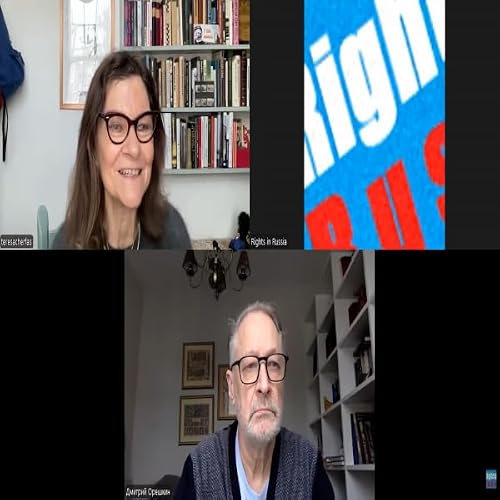
  • Podcast Then & Now #39 - Teresa Cherfas in conversation with Dmitry Oreshkin
    Feb 13 2026
    1 ora e 6 min
  • Podcast Then & Now #38 - Teresa Cherfas in conversation with Mikhail Fishman
    44 min