Episodi

  • From Touring Theatre Actor to Writing and Producing Short Films
    Aug 13 2026

    Valerie Bundy has spent nearly 30 years working as a theatre actor, before quietly building a second career writing, directing and producing her own short films on next to no budget.


    In this episode, Val talks honestly about breaking in without drama school on her CV, the years of touring theatre that followed, and the confidence it eventually took to call herself a writer.


    In this episode:

    • The last-minute phone call that led to her first professional job
    • Years of touring theatre, from performances in schools to small venues and theatre festivals
    • Writing, producing and funding her own short films from scratch
    • A cast most independent productions could only dream of, and the festival rejections that came anyway
    • Imposter syndrome, whether it's actor or actress, and AI's growing role in music and writing

    --------------------------------------------------------------------

    Chapters

    0:00 Introduction — Valerie Bundy, actor, writer and filmmaker

    0:30 Imposter syndrome — even a famous director has it

    2:05 Theatre training without drama school

    3:04 A last-minute call and moving to London within a week

    4:08 Touring Shakespeare — three plays, one company

    6:00 Touring with Black Hat Theatre and CragRats

    6:44 The 247 Theatre Festival — and meeting her husband

    8:10 Stepping back from touring after having children

    8:54 Writing, shooting and editing her first short film, Henry

    9:46 The Raising Films course and caring for her mum

    10:46 Winning a BAFTA-linked writing competition

    11:28 Choosing Miranda Hart as a mentor

    12:59 AI, ChatGPT, and what actually counts as writing

    20:06 Test screenings and reworking a film score

    21:01 AI-generated music, Suno and Udio, and copyright

    25:12 Scoring Facade with composer Troy Masters

    26:00 Meeting director Darren Westwood and writing Facade

    27:08 Crowdfunding and producing for the first time

    29:00 Writing a feature film using the Save the Cat method

    32:26 How Covid affected freelance and TV work

    33:18 Three TV and advert jobs that never made it to air

    38:44 Told not to bother with comedy, so she wrote a comedy short

    43:00 Actor or actress? The debate over titles

    45:36 How many ways can you say one line? Directing voiceovers

    50:08 Writing 'What Would Julie Do?' and casting Julie Hesmondhalgh

    54:54 A long-shot letter that got a surprising reply

    57:38 Festival rejections despite a dream cast

    59:06 Turning rejections into festival wins

    1:02:19 Getting paid for music on short films

    1:03:55 Why sound design gets forgotten on tight budgets

    1:06:18 Royalties, stock music, and considering film scoring

    1:07:04 An idea for exclusive podcast intro music

    1:08:02 Self-taught, and how the music actually gets written

    1:10:07 Writing routines — Spike Lee, Stephen King and Aaron Sorkin

    1:13:44 Being mentored by Miranda Hart

    1:16:24 Finding composers and sound designers through networking

    1:18:18 The debate over working for free early in a career

    1:21:09 What's next — Facade, a new feature, and a sitcom pilot

    --------------------------------------------------------------------

    Media Music Now Conversations — real, unscripted chats with people working in the music and media industry. Hosted by Lee Pritchard, co-founder of Media Music Now.

    Find out more at mediamusicnow.co.uk/conversations.aspx

    Mostra di più Mostra meno
    1 ora e 24 min
  • From Radio and Television Producer to Senior Lecturer in Broadcast Media
    Jul 8 2026

    Lyndon Saunders spent seventeen years working across radio and television before he ever stepped into a lecture hall. He started at a small independent production company in his early twenties, the best possible training ground, and went on to high-profile documentary work and major entertainment television.

    In this conversation, Lyndon talks honestly about that career and why he eventually chose teaching over another location shoot.

    In this episode:

    • Making radio documentaries and touring with Badly Drawn Boy in his early twenties
    • Being dispatched to New York within 48 hours of 9/11 to produce a Five Live Report special
    • A live radio broadcast that came within minutes of not making it to air, and had to be rebuilt from scratch under pressure
    • Five series producing Dragon's Den, then Strictly Come Dancing
    • Why factual and drama production currently has a flat no on generative AI
    • Why he believes the real issue with AI was never the technology itself, but who controls it

    Media Music Now Conversations — real, unscripted chats with people working in the music and media industry. Hosted by Lee Pritchard. Find out more at mediamusicnow.co.uk/conversations.aspx

    Mostra di più Mostra meno
    1 ora e 43 min
  • From Touring Musician to Composer for Film, TV and Games
    Jun 23 2026

    Ben Harris-Hayes has worked across pretty much every corner of the music industry. Bands, touring, session work, record labels, writing for other artists, composing for film and TV, and now a full-time role in games audio alongside a busy freelance life.


    He didn't follow a straight path to get there. He followed whatever was in front of him and figured it out along the way.
    In this conversation, Ben talks honestly about what that kind of career actually looks like — the highs, the dry spells, and everything in between.

    In this episode:
    - The feast and famine of freelance work and how networking has driven most of the opportunities
    - Getting down to the final two for a major games role in Canada, and why he didn't get it
    - AI and music — the data scraping problem, copyright, and what the EU AI Act changes
    - Music theft from personal experience and why contracts matter
    - Content ID, stock music, and how the library music world has changed
    - Coming full circle — why live music is the one thing AI can't replicate

    Media Music Now Conversations — real, unscripted chats with people working in the music and media industry. Hosted by Lee Pritchard.

    Find out more at mediamusicnow.co.uk/conversations.aspx

    Mostra di più Mostra meno
    1 ora e 17 min
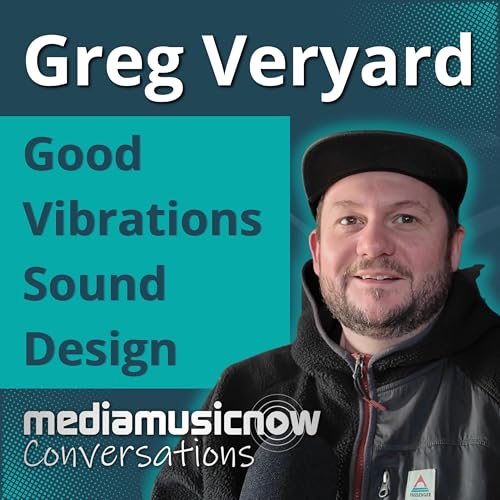
  • How Greg's Best Worst Week Launched His Audio Engineering Career
    Jun 2 2026

    Greg spent ten years managing telecoms teams, working his way up, doing what was expected, and feeling dead inside for most of it. Then in the same week, he was made redundant and had his shoulder broken, and he called it the best week of his life.

    That week gave him the time, the push, and the redundancy payout to do something about it. He paid his share of the mortgage up front for a year, found his way to 80Hz Studios at The Sharp Project in Manchester, and offered six months of his time for free. He turned up to his first session with his arm in a sling.

    In this conversation, Greg talks honestly about what it actually takes to make a career change into audio engineering with no formal training and no industry contacts, and what it feels like when the work you do stops feeling like work.

    In this episode:

    • Ten years in telecoms, one terrible week, and why it turned out to be the best thing that happened
    • Giving six months for free to get a foot in the door — and what came next
    • The psychology of working with artists in a studio environment
    • AI in music — what it's actually good for and where it's being abused
    • The EU AI Act, compulsory content labelling, and what changes in August 2026
    • Why the description of a music track matters more than the track itself
    • Freelance life — the honest reality of feast and famine

    Media Music Now Conversations — real, unscripted chats with people working in the music and media industry. Hosted by Lee Pritchard.

    Find out more at https://www.mediamusicnow.co.uk/conversations.aspx

    Mostra di più Mostra meno
    1 ora
  • Co-founding Northern Film Orchestra, why the royalty-free music model is broken, and what comes next
    Apr 23 2026

    Jack Hughes co-founded Northern Film Orchestra at 25, not because he had a grand plan, but because he organised one string quartet session and enjoyed the logistics more than the recording. That thread wherever it went.

    That included getting made redundant from both his jobs the moment Covid hit, which turned out to give him exactly the time he needed to build the business properly.

    In this conversation, Jack talks honestly about what it actually takes to run a professional orchestra in the UK, the Musicians' Union agreements, the challenge of competing with Eastern Europe on price, the realities of working with composers at very different stages of their careers, and what it means to be trying to punch through to major film and TV projects when your competition is suddenly Abbey Road.

    We also get into the wider music industry, the royalty-free model that worked well for a decade and then didn't, what subscription libraries did to composer income almost overnight, why sync is now the only realistic path for most independent composers, and whether the economics of music will ever properly recover.

    No scripts, no prepared answers. Just a real conversation about what working in this industry actually looks and feels like right now.

    In this episode:

    • How Northern Film Orchestra started from one string quartet session
    • Launching a business in January 2020 and what happened next
    • What composers need to know before booking an orchestra session
    • Why the royalty-free music model changed — and what replaced it
    • The Musicians' Union, chain of title, and protecting your rights
    • Where Northern Film Orchestra is headed next

    Media Music Now Conversations: real, unscripted chats with people working in the music and media industry. Hosted by Lee Prithcard, co-founder of Media Music Now.

    Find out more at:

    https://www.mediamusicnow.co.uk/conversations.aspx

    Mostra di più Mostra meno
    1 ora e 16 min