• Ep 147: Crepitus: What Are The Hip & Knee Popping Sounds?
    Oct 19 2026

    Have you ever heard popping, clicking, cracking, and grinding sounds in your or your students' knees and hips? If your students are experiencing this, they'll likely look to you for more information or to tell them whether it's a problem or not. This episode explains what crepitus is; I'll explain the anatomy of the hip and knee, break down the three main sources of joint sounds, and I'll give you clear, scope-of-practice-appropriate language for responding when a student asks you about it.

    • What Is Crepitus?
    • The Three Main Sources of Joint Sounds
    • The Hip Anatomy
    • The Knee Anatomy
    • Your Scope: Always Refer for Diagnosis
    • Why Your Response Matters

    Now Available: Anatomy Refresh Mini Course

    A self-paced mini course that helps you build real, usable understanding of the human body, so you can make alignment decisions and sequencing choices with confidence.

    Further Reading

    Yoga Journal: Yoga Teachers, Here's How to Support Students With Injuries Without Giving Medical Advice

    Click HERE to send me a text & let me know your thoughts on this episode!

    Support the show

    Let's connect:

    • Check out my website: Enhanced Body
    • Connect with me on Instagram & Threads @monicacbright
    • Wanna work together? Book a Discovery Call
    • YouTube: Yoga with Monica Bright
    • Join my Newsletter for teachers below!

    Want me to discuss a topic? Click HERE to submit it!

    Become a supporter of the Essential Conversations for Yoga Teachers Podcast! Starting at $3/ month.

    Mostra di più Mostra meno
    20 min
  • Ep 146: Transitions: Why They’re Just As Important As The Poses
    Oct 12 2026

    Are you a yoga teacher who sequences by choosing poses and arranging them in an order that feels varied and interesting? This is how many of us were taught. But that approach leaves transitions as an afterthought, which means students are solving movement problems in real time without a lot of preparation. This episode helps you understand the important role that transitions have (and that they deserve at least as much attention as the poses themselves), breaks down a real sequencing example through an anatomy lens, and gives you questions to use while you plan your next class.

    • Transitions Are The Movements Without Names
    • The Trap Creative Sequencing Creates
    • A Real Sequencing Example: Twisted Kneeling Lunge to Half Splits
    • Questions to Consider When You're Sequencing
    • How Your Sequencing Changes When You Include Anatomy

    Now Available: Anatomy Refresh Mini Course

    A self-paced mini course that helps you build real, usable understanding of the human body, so you can make alignment decisions and sequencing choices with confidence.

    Further Reading

    Yoga Journal: Yoga Teachers, Here's How to Support Students With Injuries Without Giving Medical Advice

    Click HERE to send me a text & let me know your thoughts on this episode!

    Support the show

    Let's connect:

    • Check out my website: Enhanced Body
    • Connect with me on Instagram & Threads @monicacbright
    • Wanna work together? Book a Discovery Call
    • YouTube: Yoga with Monica Bright
    • Join my Newsletter for teachers below!

    Want me to discuss a topic? Click HERE to submit it!

    Become a supporter of the Essential Conversations for Yoga Teachers Podcast! Starting at $3/ month.

    Mostra di più Mostra meno
    20 min
  • Ep 145: Warrior One vs Crescent Lunge: Which Should You Teach?
    Oct 5 2026

    Warrior One and Crescent Lunge (also called High Lunge) look very similar. The difference comes down almost entirely to what the back foot is doing, and that single variable changes what the ankle, knee, hip, and pelvis are able to do above it. This episode breaks down what each pose actually demands from students, who each one serves, and how to choose between them with intention.

    I'll cover:

    • Why The Back Foot Changes Everything
    • Warrior One: Foot Placement & Hip Positioning
    • Crescent Lunge: Foot Positioning and Ankle Injuries
    • Crescent Lunge: Why It Teaches Hips-Forward Alignment Better
    • Four Questions for Your Sequencing

    Now Available: Anatomy Refresh Mini Course

    A self-paced mini course that helps you build real, usable understanding of the human body, so you can make alignment decisions and sequencing choices with confidence.

    Further Reading

    Yoga Journal: Yoga Teachers, Here's How to Support Students With Injuries Without Giving Medical Advice

    Click HERE to send me a text & let me know your thoughts on this episode!

    Support the show

    Let's connect:

    • Check out my website: Enhanced Body
    • Connect with me on Instagram & Threads @monicacbright
    • Wanna work together? Book a Discovery Call
    • YouTube: Yoga with Monica Bright
    • Join my Newsletter for teachers below!

    Want me to discuss a topic? Click HERE to submit it!

    Become a supporter of the Essential Conversations for Yoga Teachers Podcast! Starting at $3/ month.

    Mostra di più Mostra meno
    22 min
  • Ep 144: Side Plank Hand Placement: Stacked or Slightly Forward?
    Sep 28 2026

    Two very well-trained yoga teachers can cue Side Plank differently, one stacking the hand directly under the shoulder and the other placing it slightly forward, and both have legitimate and very good reasoning for teaching the way they do. This episode explains the anatomy of the shoulder joint, unpacks what's actually happening in each version, examines the real tradeoffs of joint stacking as a teaching principle, and gives you five questions to ask when deciding which alignment to teach in your next class.

    • Understanding the Shoulder Joint
    • Why Stacking Joints Is Helpful
    • Why The Hand Slightly Forward Teaches Something Different
    • Five Questions To Consider While You're Sequencing

    Now Available: Anatomy Refresh Mini Course

    Build real, usable understanding of the shoulder and the other joints you cue every day, so you can make alignment decisions with confidence instead of defaulting to inherited rules.

    Further Reading

    Yoga Journal: Yoga Teachers, Here's How to Support Students With Injuries Without Giving Medical Advice

    Click HERE to send me a text & let me know your thoughts on this episode!

    Support the show

    Let's connect:

    • Check out my website: Enhanced Body
    • Connect with me on Instagram & Threads @monicacbright
    • Wanna work together? Book a Discovery Call
    • YouTube: Yoga with Monica Bright
    • Join my Newsletter for teachers below!

    Want me to discuss a topic? Click HERE to submit it!

    Become a supporter of the Essential Conversations for Yoga Teachers Podcast! Starting at $3/ month.

    Mostra di più Mostra meno
    23 min
  • Ep 143: Interoception: Teaching Students How to Feel What's Happening Inside
    Sep 21 2026

    Interoception is the sense of the internal state of the body: your heartbeat, breath, hunger, temperature, muscular effort, tension, and pain. It sits alongside exteroception, our perception of the outside world, and proprioception, our sense of where the body is in space. Every person has a different level of interoceptive awareness, and the good news is, it is a trainable skill. A yoga class is one of the best environments there is for developing it. This episode defines interoception clearly, explains why it matters especially for students managing pain or injury, and gives you specific, usable strategies for building it into any of your classes.

    • Why Interoception Matters
    • Five Ways to Teach Interoception
    • Questions for Teachers to Consider
    1. How much time do I actually leave for students to notice anything?
    2. Am I being specific about what to notice?
    3. Does my language invite curiosity or evaluation?
    4. Have I told students that not noticing much is okay?
    5. And how confident do I feel when a student tells me what they noticed?

    Your Scope of Practice

    Yoga Journal article: Yoga Teachers, Here's How to Support Students With Injuries Without Giving Medical Advice

    Teaching interoception often leads students to disclose more about what they are experiencing, which can raise questions about where a teacher's role ends. My article in Yoga Journal addresses this directly.

    Click HERE to send me a text & let me know your thoughts on this episode!

    Support the show

    Let's connect:

    • Check out my website: Enhanced Body
    • Connect with me on Instagram & Threads @monicacbright
    • Wanna work together? Book a Discovery Call
    • YouTube: Yoga with Monica Bright
    • Join my Newsletter for teachers below!

    Want me to discuss a topic? Click HERE to submit it!

    Become a supporter of the Essential Conversations for Yoga Teachers Podcast! Starting at $3/ month.

    Mostra di più Mostra meno
    22 min
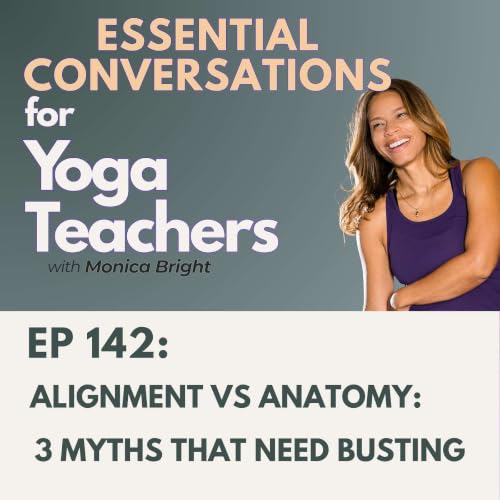
  • Ep 142: Alignment vs Anatomy: 3 Myths That Need Busting
    Sep 14 2026

    When we were taught to cue a movement or a yoga asana, we were led to believe that every student could perform it with enough effort or practice. But sometimes a student cannot do what is being cued, not because of a lack of flexibility or effort, but because their skeletal anatomy does not allow for it. This episode busts three common anatomy myths that shape the way we cue, covering the knee, the ankle, and the hip, so that you can cue and visualize the various skeletal differentiations in mind rather than an idealized generic body type.

    Listen as I cover:

    • Alignment vs Anatomy
    • Myth One: The Knee Being Only a Hinge Joint
    • Myth Two: Ankle Positioning vs Ankle Range of Motion in Standing Poses
    • Myth Three: Every Student's Hip Can Achieve the Same Range and Movement

    When you teach as if everyone shares the same anatomy, it sets some students up to fail at something never possible for their skeleton. Understanding anatomy allows you to work with (and teach) the real bodies in front of you.

    Related Episode

    Ep 134: How A Student's Neutral Alignment Should Affect the Cues You Use

    Coming Soon: Anatomy Refresh Mini Course

    Across these anatomy-focused episodes, one thing keeps coming up: teachers are hungry for a real anatomy foundation that most trainings never provided. That's why I'm creating the Anatomy Refresh mini course, a low-cost, approachable way to strengthen your understanding of the structures that matter most in your teaching, so everything discussed on the podcast clicks into place, and you can cue with confidence. More details coming soon.

    Free Resource

    Sequencing for Students with Injuries

    If you want help building classes that develop strength and functional capacity safely, especially for students with injuries or limitations, download the free Sequencing for Students with Injuries guide.

    Click HERE to send me a text & let me know your thoughts on this episode!

    Support the show

    Let's connect:

    • Check out my website: Enhanced Body
    • Connect with me on Instagram & Threads @monicacbright
    • Wanna work together? Book a Discovery Call
    • YouTube: Yoga with Monica Bright
    • Join my Newsletter for teachers below!

    Want me to discuss a topic? Click HERE to submit it!

    Become a supporter of the Essential Conversations for Yoga Teachers Podcast! Starting at $3/ month.

    Mostra di più Mostra meno
    25 min
  • Ep 141: Movement Skill: Falls, Injuries, and How You Can Help
    Sep 7 2026

    There is a reason the social media challenge around sitting down and standing up from the floor without using your hands has caught on: the ability to get up and down from the floor is one of the most protective, trainable skills a person can maintain as they age. In this episode, I will cover the sobering statistics on falls among older adults, why falls so often become life-threatening, the research behind the sitting-rising test, and concrete, non-fear-based ways yoga teachers can weave this vital skill into classes for students of every age.

    This is a personal story for me, as my mother and grandmother both suffered from the effects of falling. It initiated my curiosity and started my research on why falling can be so catastrophic and life-altering.

    • Why Understanding This Matters
    • The Research and the Sitting-Rising Test
    • How to Talk About The Skill Without Inducing Fear
    • Five Ways to Weave It Into Your Teaching

    Free Resource

    Sequencing for Students with Injuries

    If you want help building classes that develop strength and functional capacity safely, especially for students with injuries or limitations, download the free Sequencing for Students with Injuries guide.

    Journal Article:

    Sitting-Rising Test Predicts Long-Term Mortality Risk

    A 12-year study of over 4,000 adults found that poor performance on a basic sitting and rising test was strongly linked to increased risk of death from natural and cardiovascular causes.

    Source: European Journal of Preventive Cardiology

    Click HERE to send me a text & let me know your thoughts on this episode!

    Support the show

    Let's connect:

    • Check out my website: Enhanced Body
    • Connect with me on Instagram & Threads @monicacbright
    • Wanna work together? Book a Discovery Call
    • YouTube: Yoga with Monica Bright
    • Join my Newsletter for teachers below!

    Want me to discuss a topic? Click HERE to submit it!

    Become a supporter of the Essential Conversations for Yoga Teachers Podcast! Starting at $3/ month.

    Mostra di più Mostra meno
    23 min
  • Ep 140: Incorporating Different Movement Modalities: Is It Still Yoga?
    Aug 31 2026

    If you're a yoga teacher who wonders whether incorporating strength training, joint control work, myofascial release, or movements borrowed from other disciplines means you are no longer teaching yoga, then this episode helps to reframe that question entirely. Rather than asking whether other modalities are allowed, the question asks whether you can articulate the reasoning behind what you're including in your classes. When we think of yoga as a whole practice, we realize that it's much more than the asanas you teach.

    This episode helps you realize the intention behind your teaching choices, which is a better way to determine whether it's still yoga that you're teaching.

    • What's The Real Question?
    • What Other Modalities Can Offer In Your Sequencing
    • Purpose: What Is Yours?
    • Remembering the Other Limbs of Yoga
    • Going Forward: Questions to Ponder

    Free Resource

    Download the free Sequencing Made Easy guide, which will offer you a clear, practical framework for building classes that are accessible and well-structured so you can stop thinking you need to start from scratch every week.

    Sequencing Made Easy

    Click HERE to send me a text & let me know your thoughts on this episode!

    Support the show

    Let's connect:

    • Check out my website: Enhanced Body
    • Connect with me on Instagram & Threads @monicacbright
    • Wanna work together? Book a Discovery Call
    • YouTube: Yoga with Monica Bright
    • Join my Newsletter for teachers below!

    Want me to discuss a topic? Click HERE to submit it!

    Become a supporter of the Essential Conversations for Yoga Teachers Podcast! Starting at $3/ month.

    Mostra di più Mostra meno
    21 min