Episodi

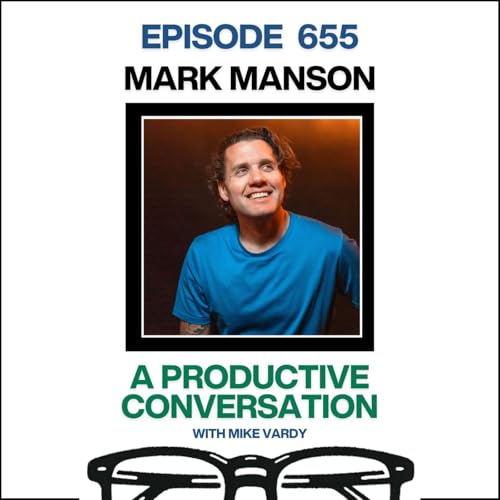
  • The Backwards Law: Why More Self-Improvement Might Be Making Things Worse (with Mark Manson)
    Apr 29 2026

    This episode is brought to you by Your Clockwise Week—a personalized weekly structure built around your actual life, not an ideal one. If your week feels full but not fitting, you can learn more at mikevardy.com/yourclockwiseweek.


    There's an assumption buried inside almost every productivity system, self-help framework, and optimization routine: that you're not enough yet. That the gap between who you are and who you should be is the central problem to solve. I've spent fifteen years in this space, and I've watched that assumption quietly do a lot of damage. My guest today has spent roughly the same amount of time making the case that sometimes the belief that you need to improve is a bigger problem than whatever you're trying to fix.

    Mark Manson is the author of The Subtle Art of Not Giving a F*ck and Everything Is F*cked: A Book About Hope, two of the most widely read books in the personal development space over the last decade. He's the host of the Solved podcast, where he and his research team do exhaustive, long-form deep dives on the ideas most podcasters treat like talking points. And he recently co-founded Purpose, an AI-powered platform designed to make personal growth coaching accessible at scale. Mark and I have a lot of shared territory in this conversation—and a few places where we push each other in productive directions.

    Six Discussion Points

    • The backwards law in action: why every message of "you need to improve" carries an implicit second message—that you're not enough as you are right now
    • Why optimal is suboptimal—and how relentless optimization can make the quality of your actual life measurably worse, not better
    • The two dimensions of productivity most advice ignores: hours worked is not the same as leverage, and until you separate them, no system will help you
    • Why effort is a double-edged sword—it only creates meaningful output when it's aligned with something that actually matters to you, and it actively works against you when it isn't
    • How language shapes whether an idea lands—why the same truth needs to be said differently at different moments in a person's life, and why that's not semantics, it's everything
    • The question Mark poses before chasing any goal: do you actually want the costs? Not the highlights—the daily friction, the ongoing compromise, the downside of the dream

    Three Connection Points

    • Mark Manson's website and free twice-weekly newsletter
    • The Solved podcast: Mark's long-form, research-heavy series on the ideas people say they've heard before but haven't actually examined
    • Learn about Purpose, Mark's AI coaching and personal growth platform

    Mark's most useful provocation in this conversation isn't the one with the sharpest edge. It's the quieter one: before you add another goal, another system, another layer of self-improvement, ask yourself whether you actually want to live with what it costs. Not the version of it that works. The version on the hard days. The answer to that question tells you more about whether you're chasing the right thing than any productivity metric ever will.

    If this episode resonated, I’m exploring ideas like these more deeply in my upcoming book, Productiveness. You can follow along as it takes shape at mikevardy.com/productiveness.

    Mostra di più Mostra meno
    36 min
  • The Subtle Problem with Productivity
    Apr 22 2026

    This episode is brought to you by Your Clockwise Week—a personalized weekly structure built around your actual life, not an ideal one. If your week feels full but not fitting, you can learn more at mikevardy.com/yourclockwiseweek.


    We've turned busy into a badge of honor. The fuller the calendar, the longer the to-do list, the more people seem to think we're crushing it. But after more than a thousand conversations about productivity across multiple shows and well over a decade of this work, I've come to believe that the number one thing people get wrong isn't their system, their tools, or even their habits. It's this: they've confused motion with meaning.


    In this episode, I'm thinking out loud with you about what I call intentional productivity — not productivity as a set of tips or tricks, but as a philosophy, a way of living. If you've been following my work for a while, you know where this leads. If you're new here, this is as good a place as any to start. It's also my way of setting the table for next week's conversation with Mark Manson, whose work on values and what actually matters in life is more aligned with this than you might expect.

    Six Discussion Points

    • Busy has always meant anxious or occupied with worry — we've just rebranded it as a virtue, and that rebranding has real costs to the quality of our output and our lives.
    • Applying machine-era metrics to human beings is where productivity thinking goes most wrong: machines don't need rest, and they don't need meaning — you do.
    • Attention without intention is aimless, and intention without attention is powerless; real productivity is the active link between the two.
    • Most systems miss the most important variable: doing the right things at the right time, in the right way, for the right reasons — that last piece is where meaning lives.
    • Time crafting, as distinct from time management, implies ongoing creative direction rather than control — you don't stop crafting until your relationship with time is over.
    • Three questions that cut through the noise every day: What is the most important thing I could do today? What would make today feel complete — not full, but complete? And what am I doing out of obligation versus intention?

    Three Connection Points

    • "Why Doing Nothing Might Be the Most Productive Thing You Can Do" (APC652): If rest still feels like a reward you have to earn rather than a part of the system, this episode is the companion piece.
    • Stop Managing Time. Start Crafting It: The Medium post that started many readers on the TimeCrafting path — a clear, practical case for why managing time sets you up to fail, and what to do instead.
    • The Productivity Diet: The book where I go deeper into horizontal theming, daily themes, and why a framework beats a schedule every time.

    Intentional productivity doesn't look impressive from the outside. It's quiet. It compounds. It doesn't post about itself. The person doing deep, meaningful work often looks like they're doing less than the person who's always visibly occupied — and that's precisely the point. The real question isn't how much you got done today. It's whether what you did moved you closer to who you want to be and the life you want to live. That question is uncomfortable. It requires you to actually know what you value. But that's the work — not the app, not the system, not the morning routine. Start there.

    If this episode resonated, I’m exploring ideas like these more deeply in my upcoming book, Productiveness. You can follow along as it takes shape at mikevardy.com/productiveness.

    Mostra di più Mostra meno
    29 min
  • From Routines to Rituals: How to Stop Living on Autopilot and Start Living on Purpose (with Erin Coupe)
    Apr 15 2026

    This episode is brought to you by Your Clockwise Week—a personalized weekly structure built around your actual life, not an ideal one. If your week feels full but not fitting, you can learn more at mikevardy.com/yourclockwiseweek.


    Most of us aren’t burned out because we’re doing too much. We’re burned out because we’re doing too much of the wrong things — on autopilot, running inherited scripts, and mistaking busyness for meaning. The distinction between a routine and a ritual sounds small. It isn’t. One checks a box. The other changes who you are.


    Erin Coupe spent 25 years in the corporate world before she recognized that her carefully structured life had become a kind of comfortable numbness. Her book, I Can Fit That In: How Rituals Transform Your Life, begins with a provocation right on the cover — the word “routines” is crossed out and replaced with “rituals.” That single strikethrough tells you everything about what this conversation is about. We dig into why rituals and routines are not the same thing, how autopilot living quietly erodes the quality of your days, and what it actually means to steward your energy rather than manage your time.

    Six Discussion Points

    • Rituals vs. routines is not a semantic debate: Routines are repetitious rhythms you follow; rituals are repetitious rhythms you choose, because you know they’ll give something back to you. That distinction changes how you relate to your own schedule.
    • Autopilot living is often comfortable enough to go undetected: The threshold between comfort and complacency is razor-thin, and Erin traces her own awakening to the moment she realized she wasn’t unhappy, she was simply numb.
    • Inherited scripts are the hidden architecture of a life unlived: The beliefs instilled by family systems, school, and corporate culture don’t expire on their own; they require deliberate questioning before they’ll release their grip.
    • Energy stewardship, not time management, is the real leverage point: Asking “do I have time for this?” keeps you trapped; asking “is this worth fitting in?” puts intention back in the driver’s seat.
    • Intentional pauses are not passive — they are productive: Silence and stillness feel counterintuitive to high performers, but they are precisely where self-awareness gets built and better decisions get made.
    • The luna moth is more than a book cover image: It carries a message: the caterpillar’s insatiable appetite mirrors our culture of endless striving, and the moth’s transformation is an invitation to live fully now, not at 65.

    Three Connection Points

    • Erin’s website
    • Erin's book
    • Erin's podcast

    Rituals don’t require more time. They require more intention. What Erin Coupe is pointing at — and what this conversation keeps circling back to — is that the quality of your life is shaped less by your calendar and more by your relationship with yourself inside that calendar. The pause isn’t wasted time. It’s where the transformation starts. If this episode landed for you, spend some time with the question Erin puts front and center: not “do I have time for this?” but “is it worth fitting in?”


    If this episode resonated, I’m exploring ideas like these more deeply in my upcoming book, Productiveness. You can follow along as it takes shape at mikevardy.com/productiveness.

    Mostra di più Mostra meno
    42 min
  • Why Doing Nothing Might Be the Most Human Thing You Can Do (PM Talks S3E4)
    Apr 8 2026

    This episode is brought to you by Your Clockwise Week—a personalized weekly structure built around your actual life, not an ideal one. If your week feels full but not fitting, you can learn more at mikevardy.com/yourclockwiseweek.


    We spend a lot of time trying to fix things—our schedules, our systems, our lives. But what if that instinct, that constant push to optimize, is actually pulling us away from something more essential?


    In this PM Talks episode, Patrick Rhone and I explore what it means to be human in a world that increasingly treats us like machines. From travel and perspective to curiosity, ego, and even the power of doing nothing, this conversation leans into something deeper than productivity—it leans into presence.

    Six Discussion Points

    • The instinct to “fix” everything can distance us from our humanity
    • Travel expands perspective by shifting us from transactional thinking to relational awareness
    • Much of what feels urgent today will be forgotten—humanness lives beyond immediacy
    • Curiosity is a distinctly human force that leads to better questions, not just better answers
    • Not every problem requires intervention—sometimes the most human response is restraint
    • Letting go of the need to be right (or have the last word) is a quiet but powerful act of maturity

    Three Connection Points

    • Productiveness
    • Your Human-Size Life
    • Shifting Vocabulary: How Changing Our Words Changes Our Work (ft. APC Episode 637 w/ Erik Fisher)

    If there’s a thread running through this conversation, it’s this: being human isn’t about doing more—it’s about knowing when to step back. When we loosen our grip on control, we create space for curiosity, perspective, and even wonder. And in that space, we don’t just get more done—we begin to understand what’s worth doing at all.

    If this episode resonated, I’m exploring ideas like these more deeply in my upcoming book, Productiveness. You can follow along as it takes shape at mikevardy.com/productiveness.


    Mostra di più Mostra meno
    50 min
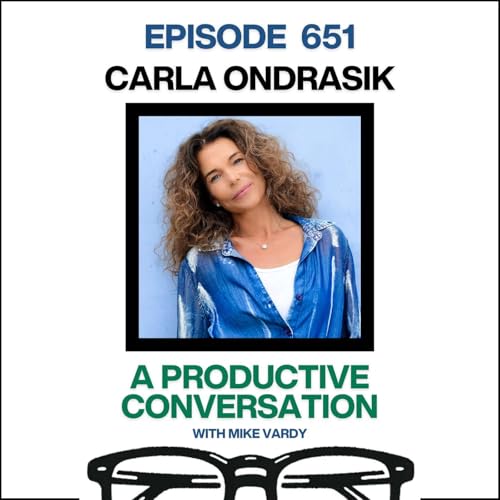
  • Why "I'll Try" Is the Most Dishonest Thing You Can Say (with Carla Ondrasik)
    Apr 1 2026
    This episode is brought to you by Your Clockwise Week—a personalized weekly structure built around your actual life, not an ideal one. If your week feels full but not fitting, you can learn more at mikevardy.com/yourclockwiseweek.Most of us have been taught that trying is virtuous — that saying "I'll try" signals good intentions and a willingness to show up. But what if trying is actually a way of opting out? What if it's the most socially acceptable excuse we've built into our language — a built-in escape hatch dressed up as effort? That's the question that sits at the center of this conversation, and I haven't been able to stop thinking about it since we recorded.Carla Ondrasik spent twenty years in the competitive world of music publishing — a world where trying, in her words, means dying. She's worked with artists at the highest levels of the industry, and she's spent the last two decades studying the psychology and neuroscience behind why we say we'll try and what it actually costs us. Her book, Stop Trying: The Life Transforming Power of Trying Less and Doing More, is one of those rare reads that reframes something so ordinary and so deeply ingrained that you can't un-see it once it's been named. I know, because she caught me using the word in the middle of our conversation — while talking about her book. That's how deep this goes.Six Discussion PointsTrying is a mental activity, not a physical one. Carla makes a simple but devastating distinction: doing is a strong, determined action; trying is the loop you run in your head while the thing stays undone. The "try test" she walks through in the episode makes this viscerally clear in about thirty seconds.We use "try" to avoid accountability — and to avoid saying no. The word opens a door for excuses and blame before anything has even been attempted. Carla unpacks how trying functions as a social shield, letting us appear committed while quietly reserving the right to bail.Talking about what you're trying to do tricks your brain into feeling like you're doing it. The dopamine, serotonin, and adrenaline hits from announcing your intentions are real — and they're why so many people are still "trying to write a book" five years later. Talking about it is stealing the reward your brain should only get from finishing it.Saying "no" clearly is kinder than saying "I'll try." People pleasing drives a huge portion of our try behavior, and it's one of the most corrosive patterns Carla covers. An honest no respects everyone's time and attention — including your own. The other person stops saving you a seat. You stop dreading the follow-up.Silence protects the doing. Carla wrote her entire book without telling most people. The reason is strategic, not secretive: outside opinions — even well-meaning ones — introduce doubt, friction, and the need to justify the work before it's done. Protecting your goals with silence is a way of keeping all the energy pointed in one direction.A no-try life starts small. Awareness comes first, then one small completion — the junk drawer, the bag of clothes you meant to donate. The neurochemical reward from finishing even a tiny thing creates the momentum to do the next one. This is how the pattern breaks.Three Connection PointsCarla's book and resources: stop-trying.com — including where to find the book in print, digital, and audio formats.Carla on Instagram: @carlaondrasik — she posts daily reminders and real-world examples of the try/do distinction.Related reading on intentional action: Stop Doing Productive and Start Being Productive — if the distinction between trying and doing resonates, the idea of moving from doing productive to being productive goes even deeper here.The shift Carla is describing isn't just semantic — it's a structural change in how you relate to your own intentions. When you stop using "try" as a buffer between yourself and commitment, something has to fill that space: a real decision, in either direction. Do it or don't. Both are more honest than the middle ground most of us live in. If this conversation landed, I'd encourage you to sit with it before moving on. And if you've got someone in your life who lives in try mode — consider what one honest conversation might make possible.If this episode resonated, I’m exploring ideas like these more deeply in my upcoming book, Productiveness. You can follow along as it takes shape at mikevardy.com/productiveness.
    Mostra di più Mostra meno
    41 min
  • Why Procrastination Persists Even When You Care Deeply (with Jon Acuff)
    Mar 25 2026

    This episode is brought to you by Your Clockwise Week—a personalized weekly structure built around your actual life, not an ideal one. If your week feels full but not fitting, you can learn more at mikevardy.com/yourclockwiseweek.


    Procrastination is often framed as avoidance of what we don’t want to do. But in this conversation, it becomes clear that it shows up just as often in the things we do want to do—the work that matters most.


    That’s what made this discussion with Jon Acuff so compelling. Jon’s latest book, Procrastination Proof, doesn’t treat procrastination as a flaw to fix but as a pattern to understand—and ultimately, to work with rather than against.


    Six Discussion Points

    • Procrastination isn’t a laziness issue—it’s a pattern driven by time, task, fear, history, and ego
    • Permission can unlock progress more effectively than pressure or discipline
    • Smaller actions reduce friction and make consistency sustainable rather than forced
    • Review is the most overlooked multiplier—it reveals truth, direction, and better decisions
    • Planning is where optimism meets realism—and most people get stuck between the two
    • Alignment between “night you” and “morning you” turns intention into action without resistance

    Three Connection Points

    • Get Procrastination Proof
    • Jon's previous appearance on APC
    • Join the community to gain access to The Procrastination Course (and more)

    What stood out most in this conversation is that procrastination isn’t something you defeat once—it’s something you learn to navigate. When you shift from forcing action to understanding patterns, the work changes. And more importantly, your relationship with the work changes. That’s where real progress begins.

    If this episode resonated, I’m exploring ideas like these more deeply in my upcoming book, Productiveness. You can follow along as it takes shape at mikevardy.com/productiveness.

    Mostra di più Mostra meno
    45 min
  • How to Stop Managing Everything and Start Leading What Matters (with Rich Czyz)
    Mar 18 2026

    This episode is brought to you by Your Clockwise Week—a personalized weekly structure built around your actual life, not an ideal one. If your week feels full but not fitting, you can learn more at mikevardy.com/yourclockwiseweek.

    There’s a quiet trap many of us fall into when the pace picks up: we start reacting instead of leading. The inbox fills, the interruptions stack, and before long, the day is no longer ours—it’s everyone else’s.


    In this conversation, I sit down with Rich Czyz, author of Autopilot: Practical Productivity for School Leaders, to explore how systems—not willpower—can help us reclaim that sense of direction. While his work is rooted in education, what we discuss applies far beyond school walls. This is about shifting from firefighting to forward thinking.


    Six Discussion Points

    • Productivity isn’t about doing more—it’s about reclaiming space for what actually matters
    • The inbox is often just a collection of other people’s priorities unless you set boundaries around it
    • Systems work best when they are simple enough to start immediately and flexible enough to evolve
    • Batching and theming aren’t constraints—they’re ways to restore focus in fragmented environments
    • Delegation requires letting go of control, not just tasks
    • Elimination—not optimization—is often the most powerful first move toward meaningful work

    Three Connection Points

    • Autopilot: Practical Productivity for School Leaders
    • Four O'Clock Faculty
    • The Practice of Productiveness

    If there’s a throughline in this conversation, it’s this: the goal isn’t to perfect your system—it’s to make space for what matters most. Whether you’re leading a school, a team, or simply your own day, the question is the same: what can you remove so that what remains has room to matter?


    If this episode resonated, I’m exploring ideas like these more deeply in my upcoming book, Productiveness. You can follow along as it takes shape at mikevardy.com/productiveness.

    Mostra di più Mostra meno
    39 min
  • Why Practice Matters More Than Results (PM Talks S3E3)
    Mar 11 2026

    The latest episode in our monthly PM Talks series explores a deceptively simple idea: practice. It’s a word we hear constantly—in sports, work, and creative pursuits—but we rarely stop to examine what it actually means or why it matters so much.

    In this conversation, Patrick Rhone and I unpack the many layers of practice—from the fundamentals that shape excellence to the quiet discipline of repetition that rarely gets the spotlight. Along the way we explore identity, devotion, habits, AI, and why focusing on fewer things might actually help us do them better.

    Six Discussion Points

    • Practice is both an act of trying something and the art of doing it well—one evolves into the other over time.
    • High performers separate themselves through relentless practice, often long after others have stopped.
    • Fundamentals matter more than flash; mastery comes from repeatedly doing the simple things well.
    • Habits and routines are often the result of practice, but the practice itself is what creates them.
    • Technology—including AI—can short-circuit practice if it replaces the act of doing rather than supporting it.
    • Devoting yourself to fewer things can deepen practice and produce higher quality results over time.

    Three Connection Points

    • Patrick Rhone — https://patrickrhone.com
    • Productiveness updates — https://mikevardy.com/productiveness
    • Relentless by Tim Grover

    Practice isn’t something we graduate from. It’s something we live inside of. The people who truly excel understand this—whether they’re athletes, creators, entrepreneurs, or anyone simply trying to get better at what matters to them. The question isn’t whether we practice. The question is what we choose to practice, and how consistently we show up to do it.


    Mostra di più Mostra meno
    56 min