

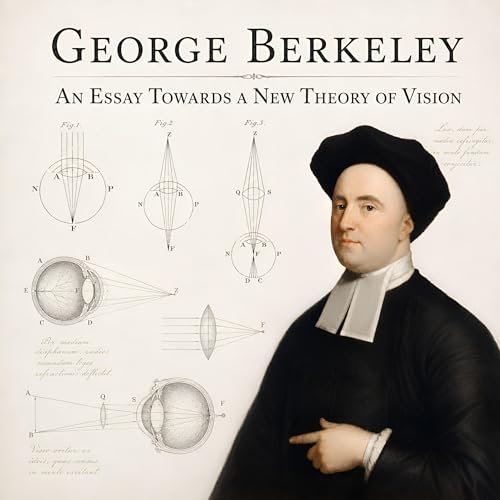
An Essay Towards A New Theory Of Vision
Impossibile aggiungere al carrello
Puoi avere soltanto 50 titoli nel carrello per il checkout.
Riprova più tardi
Riprova più tardi
Rimozione dalla Lista desideri non riuscita.
Riprova più tardi
Non è stato possibile aggiungere il titolo alla Libreria
Per favore riprova
Non è stato possibile seguire il Podcast
Per favore riprova
Esecuzione del comando Non seguire più non riuscita
0,00 € per i primi 30 giorni
Offerte di stagione
0,99 €/mese per i primi 3 mesi
L'offerta termina il 28 dicembre 2026.
Dopo 30 giorni (60 per i membri Prime), 9,99 €/mese. Puoi cancellare ogni mese
Risparmia più del 90% nei primi 3 mesi.
Ascolta quanto vuoi, scegliendo tra migliaia di audiolibri e serie originali inclusi.
Scarica il tuo audiolibro e ascolta offline, senza interruzioni
Rinnovo automatico a 9,99 €/mese dopo 3 mesi. Disdici mensilmente. L'offerta termina il 28 dicembre 2026.
Ascolta senza limiti migliaia di audiolibri, podcast e serie originali
Disponibile su ogni dispositivo, anche senza connessione
9,99 € al mese. Puoi cancellare ogni mese.

An Essay Towards A New Theory Of Vision
Letto da:
AI Voice Daniel
Acquista ora a 7,04 €
-
Letto da:
-
AI Voice Daniel
-
Di:
-
George Berkeley

Questo titolo è stato narrato da una voce virtuale
La voce virtuale è generata da un computer, e viene utilizzata per la narrazione degli audiolibri.
First published in 1709, Berkeley’s Essay is a landmark in the philosophy of perception. Its central claim is that we do not immediately see distance, depth, or three-dimensional space. Instead, vision presents signs (colors, lights, shapes, and appearances) that we learn to connect with touch, movement, and bodily action. What seems obvious to sight is, for Berkeley, the result of habit, association, and interpretation.
Before developing his immaterialism in the "Principles of Human Knowledge" and the "Three Dialogues", Berkeley uses vision to question what is truly given in perception. The work prepares his critique of abstract ideas, his challenge to mind-independent matter, and his idea that the natural world functions like a language through which God guides human beings.
Although modern vision science has moved far beyond Berkeley’s specific explanations, the questions he raises remain deeply relevant. His view of perception as learned, practical, and action-oriented anticipates later concerns in pragmatism, where meaning is tied to use and experience, and in phenomenology, where perception is understood through embodiment and our lived relation to the world. His emphasis on the coordination of sight, touch, and movement also resonates with contemporary cognitive science and theories of embodied perception. For listeners interested in philosophy, psychology, or the history of ideas, "An Essay Towards A New Theory Of Vision" remains a concise and provocative starting point for thinking about how we come to experience the world.
adbl_web_anon_alc_button_suppression_t1
Ancora nessuna recensione