The Crux of Medtech copertina

The Crux of Medtech

The Crux of Medtech

Di: The Crux of Medtech
Ascolta gratuitamente

A proposito di questo titolo

Welcome to The Crux of Medtech, where we sit down with special guests from the medtech industry. We tell the stories of this incredible sector by looking inside businesses from across the trade. Our guests are leaders from companies at all levels, from pre-seed startups and scale-ups to global-scale players. We’re uncovering experiences from the whole medtech ecosystem.The Crux of Medtech Economia
  • Kidney Monitoring Hasn’t Changed Since 1936 with Todd Dunn
    Apr 21 2026

    Henry Norton sits down with Todd Dunn, CEO of Accuryn Medical, for a conversation that starts on an OR floor and ends with a question about what it really means to lead with integrity. Todd didn’t come to medtech through a lab or a VC fund, he came through a hospital in Charlotte, where a CRNA pointed under a bed and showed him that the kidney, medicine’s most sensitive organ, was still being monitored by a gravity-fed bag invented in 1936. A decade on from that moment, he’s now running the company trying to fix it.


    Key Topics

    • Why kidney monitoring hasn’t meaningfully advanced since CR Bard’s 1936 Foley catheter

    • What AKI (acute kidney injury) actually is and why CMS now classifies it as a hospital-acquired harm

    • How Accuryn’s SmartFoley detects kidney distress up to 12 hours before blood tests can

    • The ‘diagnosis before prescription’ framework Todd built at Atrium Health

    • Transitioning from health system innovator to medtech CEO


      Related Insights

    • Why hospital financing explains why the kidney was the last vital organ to be digitised

    • The real cost of AKI: 13 million cases annually, 300,000 deaths, and $10–24bn in US healthcare spend

    • Why serum creatinine is the wrong marker for kidney function and what replaces it

    • How clinical partnership rather than conventional sales tactics is breaking through hospital inertia


      Core Challenges

    • The standard of care for urinary output measurement hasn’t changed since 1936. While the heart, lungs, and brain are fully digitised in critical care settings, hospitals still rely on a gravity-dependent system prone to stagnation, back-pressure, and manual error. ICU nurses carry the cognitive burden and patients pay the price when outputs go unrecorded.

    • Creatinine blood tests only flag kidney injury once function has already dropped to 60%. By the time the lab result returns, damage is done. Urine output is the real-time vital sign — and Accuryn is the only FDA-cleared platform that automates and digitises it, giving clinicians up to a 12-hour head start.

    Tune in now to find out why the most sensitive organ in the body has been flying blind for nearly a century and what one former hospital innovator is doing to fix it.


    The Crux of MedTech podcast is brought to you by Cruxx, a specialist surgical robotics recruitment agency.


    To learn more about Cruxx,⁠⁠⁠⁠⁠⁠⁠⁠⁠⁠⁠⁠⁠⁠⁠⁠⁠⁠⁠ ⁠click here.⁠⁠⁠⁠⁠⁠⁠⁠⁠⁠⁠⁠⁠⁠⁠⁠⁠⁠⁠


    A big thank you to our sponsors on this season of the podcast;


    ⁠⁠⁠⁠⁠⁠⁠⁠⁠⁠⁠⁠⁠⁠⁠⁠⁠⁠TTP plc⁠⁠⁠⁠⁠⁠⁠⁠⁠⁠⁠⁠⁠⁠⁠⁠⁠⁠⁠⁠ With a 35-year track record, TTP excels in turning innovative ideas into market-ready solutions. Their team of 300+ experts deliver breakthrough solutions in areas ranging from endoluminal robotics and navigation systems to ultrasound imaging. Whether you're a startup or a multinational, ⁠⁠⁠⁠⁠⁠⁠⁠⁠⁠⁠⁠⁠⁠⁠⁠⁠⁠⁠⁠TTP plc⁠⁠⁠⁠⁠⁠⁠⁠⁠⁠⁠⁠⁠⁠⁠⁠⁠⁠⁠⁠ can accelerate your development with the latest technologies. Learn more at ⁠⁠⁠⁠⁠⁠⁠⁠⁠⁠⁠⁠⁠⁠⁠⁠⁠⁠⁠⁠TTP.com⁠⁠⁠⁠⁠⁠⁠⁠⁠⁠⁠⁠⁠⁠⁠⁠⁠⁠⁠⁠


    Mostra di più Mostra meno
    54 min
  • Robotic Prostatectomy Has Run Its Course with Dr. Arun Menawat
    Apr 14 2026

    In this episode of The Crux of MedTech, Henry Norton is joined by Dr. Arun Menawat, Chairman and CEO of Profound Medical, the company behind the TULSA-PRO® system, an MRI-guided, incision-free platform that’s directly challenging robotic prostatectomy with head-to-head clinical data.

    Arun shares the clinical trial results that show step-change improvements in patient outcomes, the commercial lessons from building and exiting Novadaq (acquired by Stryker), and why he believes incision-free surgery isn’t just a product, it’s the next wave.

    Key Topics:

    • Head-to-head clinical trial data: TULSA-PRO vs. robotic prostatectomy

    • How MRI-guided thermal ultrasound works and why it matters for patient outcomes

    • The Novadaq journey: from fluorescence imaging to a Stryker acquisition

    • Building a KOL strategy for a novel surgical platform

    • Why incision-free surgery is positioned to disrupt the next decade of surgical care

    Related Insights:

    • Why you can’t sell to surgeons by telling them they need to be better

    • The role of AI in standardising MR imaging for surgical planning

    • Why CMS reimbursement for TULSA now exceeds robotic surgery

    • How different KOL personas early adopters, visionaries, and conservatives each serve a commercialisation strategy

    Core Challenges:

    • Robotic prostatectomy, despite being the current standard, carries a 75% risk of incontinence or erectile dysfunction. The robot mimics the surgeon’s hands with more reach, but it doesn’t address the precision problem the prostate sits in a highly congested area surrounded by nerve bundles and sphincter muscles.

    • Profound Medical’s TULSA-PRO uses real-time MRI guidance and thermal ultrasound to ablate tissue at 57°C the lowest lethal temperature with AI-driven boundary mapping. The result: dramatically reduced side effects, no incision, and patients going home the same day.

    Tune in now to hear how Profound Medical is challenging the robotic surgery status quo with clinical data, MR-guided precision, and a vision for incision-free surgery across oncology and beyond.


    The Crux of MedTech podcast is brought to you by Cruxx, a specialist surgical robotics recruitment agency.


    To learn more about Cruxx,⁠⁠⁠⁠⁠⁠⁠⁠⁠⁠⁠⁠⁠⁠⁠⁠⁠⁠⁠ ⁠click here.⁠⁠⁠⁠⁠⁠⁠⁠⁠⁠⁠⁠⁠⁠⁠⁠⁠⁠⁠


    A big thank you to our sponsors on this season of the podcast;


    ⁠⁠⁠⁠⁠⁠⁠⁠⁠⁠⁠⁠⁠⁠⁠⁠⁠⁠TTP plc⁠⁠⁠⁠⁠⁠⁠⁠⁠⁠⁠⁠⁠⁠⁠⁠⁠⁠⁠⁠ With a 35-year track record, TTP excels in turning innovative ideas into market-ready solutions. Their team of 300+ experts deliver breakthrough solutions in areas ranging from endoluminal robotics and navigation systems to ultrasound imaging. Whether you're a startup or a multinational, ⁠⁠⁠⁠⁠⁠⁠⁠⁠⁠⁠⁠⁠⁠⁠⁠⁠⁠⁠⁠TTP plc⁠⁠⁠⁠⁠⁠⁠⁠⁠⁠⁠⁠⁠⁠⁠⁠⁠⁠⁠⁠ can accelerate your development with the latest technologies. Learn more at ⁠⁠⁠⁠⁠⁠⁠⁠⁠⁠⁠⁠⁠⁠⁠⁠⁠⁠⁠⁠TTP.com⁠⁠⁠⁠⁠⁠⁠⁠⁠⁠⁠⁠⁠⁠⁠⁠⁠⁠⁠⁠


    Mostra di più Mostra meno
    49 min
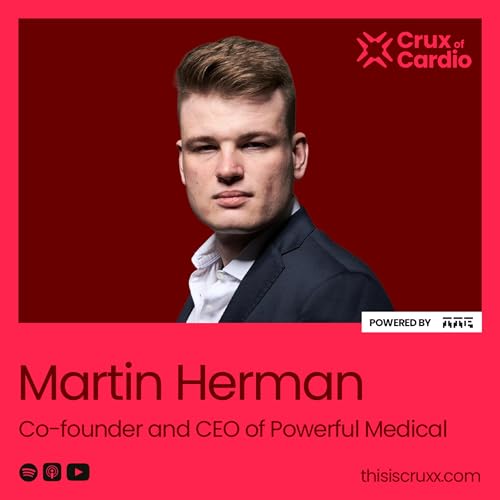
  • The AI That Reads ECGs Better Than Your Cardiologist with Martin Herman
    Apr 2 2026

    In this episode of the Crux of Cardio, host Jordan Burgin is joined by Martin Herman, co-founder and CEO of Powerful Medical the AI-powered cardiac diagnostics company behind PM Cardio.

    Martin shares how a software engineering background, a medical student brother, and a search for a truly pioneering problem led him to build an AI platform that can now diagnose 46 cardiovascular conditions from a single 12-lead ECG with over 120,000 doctors already using it in clinical practice.

    They cover the journey from early scepticism to clinical proof, the brutal reality of MedTech fundraising, and what FDA breakthrough designation means for Powerful Medical's imminent US commercial launch.

    Key Topics:

    • How Powerful Medical identified the ECG as cardiology's biggest unsolved problem

    • Building AI that outperforms experienced cardiologists on the hardest cases

    • The clinical and commercial case for PM Cardio in US heart attack centres

    • FDA breakthrough designation and the road to US approval this summer

    • Raising €46M in non-dilutive EU grant funding and what comes next

    • Winning MedTech Innovator and what it means for partnerships and validation

    Related Insights:

    • Why starting with the biggest clinical sceptics is actually a growth strategy

    • How 64 American physician-investors validated the product with $3.5M in funding

    • The difference between pre- and post-ChatGPT AI fundraising environments

    • Why young founders have a structural advantage in MedTech and how to use it

    Core Challenges:

    • Beyond the cardiologist, almost no clinician can reliably read an ECG creating a critical diagnostic gap at the first point of patient contact that PM Cardio is designed to close.

    • US hospitals chasing heart attack accreditation KPIs are generating false positive rates as high as 70–80%, costing up to $15,000 per unnecessary cath lab activation. PM Cardio reduces false positives by ~90% while maintaining diagnostic sensitivity.

    • Regulatory fragmentation across 27 EU healthcare markets and the complexity of US FDA approval has been the single biggest bottleneck to commercial scale, despite overwhelming clinical evidence.

    Tune in now to hear how Martin Herman turned a software engineering background and a medical student brother into a platform already saving thousands of lives and why the biggest breakthrough may still be ahead.


    The Crux of MedTech podcast is brought to you by Cruxx, a specialist surgical robotics recruitment agency.


    To learn more about Cruxx,⁠⁠⁠⁠⁠⁠⁠⁠⁠⁠⁠⁠⁠⁠⁠⁠⁠⁠⁠ ⁠click here.⁠⁠⁠⁠⁠⁠⁠⁠⁠⁠⁠⁠⁠⁠⁠⁠⁠⁠⁠


    A big thank you to our sponsors on this season of the podcast;


    ⁠⁠⁠⁠⁠⁠⁠⁠⁠⁠⁠⁠⁠⁠⁠⁠⁠⁠TTP plc⁠⁠⁠⁠⁠⁠⁠⁠⁠⁠⁠⁠⁠⁠⁠⁠⁠⁠⁠⁠ With a 35-year track record, TTP excels in turning innovative ideas into market-ready solutions. Their team of 300+ experts deliver breakthrough solutions in areas ranging from endoluminal robotics and navigation systems to ultrasound imaging. Whether you're a startup or a multinational, ⁠⁠⁠⁠⁠⁠⁠⁠⁠⁠⁠⁠⁠⁠⁠⁠⁠⁠⁠⁠TTP plc⁠⁠⁠⁠⁠⁠⁠⁠⁠⁠⁠⁠⁠⁠⁠⁠⁠⁠⁠⁠ can accelerate your development with the latest technologies. Learn more at ⁠⁠⁠⁠⁠⁠⁠⁠⁠⁠⁠⁠⁠⁠⁠⁠⁠⁠⁠⁠TTP.com⁠⁠⁠⁠⁠⁠⁠⁠⁠⁠⁠⁠⁠⁠⁠⁠⁠⁠⁠⁠


    Mostra di più Mostra meno
    1 ora e 4 min
Ancora nessuna recensione