• The Business Case for Syntropic Farming: 2.5 Hectares, 115k in Revenue (Forest Foods Kenya)
    Jan 29 2026

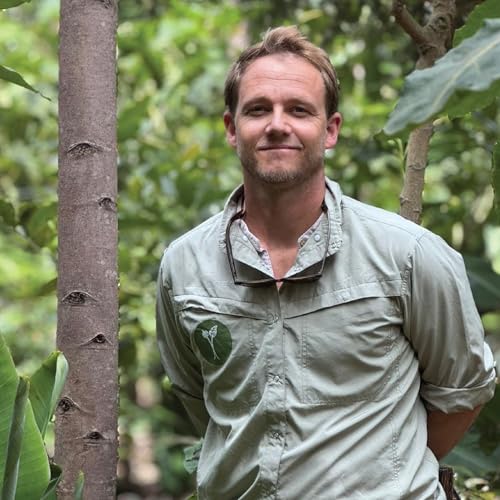
    Syntropy isn’t about the tropics—it’s about the physics of life. In this episode, Samuele sits down with Sven Verwiel, CEO & Co‑Founder of Forest Foods (Kenya), to unpack syntropic agroforestry: a regenerative farming approach designed to compound productivity over time through stratification (vertical layers) and succession (time).

    We go from field reality to unit economics: what it takes to regenerate degraded soils, why syntropic systems can reach ~200–230% land‑use efficiency, and how Forest Foods is proving a commercial model with outdoor production, zero chemicals, and strong market demand for premium quality.

    We also discuss livestock integration (pasture‑raised chickens), the hardest founder challenges (land access, capital, logistics, cold chain), and why regenerative agriculture must become a career path that attracts the next generation.

    Key topics: syntropy vs entropy, soil regeneration, agroforestry design, profitability, go‑to‑market, scaling regenerative food systems in Africa

    Mostra di più Mostra meno
    37 min
  • The 80/20 of Dairy Profitability: Nutrition + Reproduction
    Jan 19 2026

    In this episode, Samuele speaks with Apollo Gabazira—Country Director at CARE International (Uganda) and an award‑winning regenerative farmer—about what it takes to make farming profitable, scalable, and youth‑attractive in East Africa.

    Apollo shares the Asaba Farm System and its “quad model”:

    1. dairy as a foundation

    2. agronomy and circularity (turning waste into value)

    3. skilling youth through hands‑on learning

    4. community extension through local one‑stop hubs (“Farmers Point Outlets”)

    We also unpack Apollo’s most actionable insight: the 80/20 rule in dairy—focus on nutrition and reproduction to shift the majority of outcomes, from milk yield to economics.

    Finally, we zoom out to the bigger levers: what must change in policy, access to capital, and public‑private collaboration so regenerative and climate‑smart agriculture can become the norm—not the exception.

    Key topics: profitable regenerative farming, extension models, youth skilling, policy, capital, SME partnerships.

    Mostra di più Mostra meno
    31 min
  • Can we really put a price on nature? This nature‑finance expert says we must.
    Dec 19 2025

    When you clear a forest to plant maize and make charcoal, you’ve already put a price on nature—the future cash flows from the maize and the wood. The problem is that price is far too low.

    In this episode of The Samuele Tini Show, I speak with Josep Oriol, Managing Partner at Okavango Capital Partners and a leading nature‑finance expert working across Sub‑Saharan Africa.

    A Catalan who fell in love with African wildlife as a child, Josep trained as a lawyer, moved into venture capital and banking, then finally to Southern Africa to build a different kind of private equity firm—one that backs nature‑positive businesses whose performance depends on how they treat forests, soil and water. Today, Okavango‑backed companies help protect around 8–9 million hectares of land (about twice the size of Switzerland) and create income streams for hundreds of thousands of rural people.

    We dive into:

    • The mispricing of nature: every land‑use decision—from forest to maize field—is already a price signal, and why that’s dangerous if we ignore the true value of ecosystems.
    • Forest carbon in practice: the story of BioCarbon Partners, REDD+ projects, and rural families living on ~$20/month in cash who now earn income by keeping forests standing.
    • Carbon market backlash: Josep’s response to critics of carbon credits, and why, compared to agriculture, mining or logging, high‑integrity projects are often far more transparent and generous to local communities.
    • Three big opportunity themes:
      • smarter agriculture and agroforestry to boost yields and cut waste,
      • tech for soil, post‑harvest, insurance and finance,
      • monetising ecosystem services via tourism, carbon, biodiversity and water credits—and why fuelwood is still the elephant in the room.
    • Why classic 5‑year 10x PE funds don’t fit Africa: and how Okavango uses longer horizons and flexible instruments (loans with equity options, convertibles, prefs) instead of only straight equity.

    We close with Josep’s advice for entrepreneurs in nature‑based sectors—live with existential threat, love cash flow and margins, and assume everything will take twice the time and three times the money—and his vision of Africa’s future looking more like South Korea or Malaysia than Europe, if we get the nature piece right.

    If you care about where climate capital should actually go, this is a sharp, grounded conversation from inside the deal flow.

    Mostra di più Mostra meno
    34 min
  • The Most Underrated Climate Tool You’ve Never Heard Of: Biochar Explained
    Dec 9 2025

    We talk a lot about tree planting, but far less about what happens to all the agricultural and organic waste we burn or dump. That’s where biochar comes in.

    In this episode of The Samuele Tini Show, I’m joined by Luisa Marin, Executive Director of the International Biochar Initiative (IBI). After 25+ years in conservation with organisations like Conservation International and The Nature Conservancy, Luisa moved into carbon project development—and discovered biochar: a carbon‑rich “black sponge” made by pyrolysing crop residues, prunings, manure and other organic waste instead of letting them rot or burn.

    9th December Luisa Marin (1)_ot…

    Done well, biochar can:

    • Lock away carbon in soils and materials for hundreds to thousands of years

    • Regenerate soils, boosting water retention, porosity and microbial life

    • Cut fertiliser and irrigation needs for farmers

    • Create new revenue streams through products and carbon credits—especially in the Global South

    Luisa explains how research suggests biochar could remove up to 6% of global annual emissions—roughly like switching off 800 coal plants for a year—and why just 1 gram of biochar can have the surface area of two tennis courts. She also talks frankly about “good biochar” vs “bad biochar”, the importance of standards and lab tests, and the most common mistake she sees: projects chasing carbon money without proper technical and financial feasibility or patient capital.

    9th December Luisa Marin (1)_ot…

    We also hear real examples from Kenya, Zimbabwe, Ghana and Latin America, where farmers and communities are already turning waste into value using both industrial and artisanal kilns—with support from NGOs, digital MRV tools and local governments.

    9th December Luisa Marin (1)_ot…

    If you care about climate action, soil health and future markets in the Global South, this episode is a clear, grounded introduction to one of the most powerful—and underrated—tools on the table.

    Mostra di più Mostra meno
    38 min
  • Will Your Business Survive When Customers Start Asking for Proof?
    Nov 29 2025

    In most emerging markets, “sustainability” has been designed for big exporters, banks and multinationals. Everyone else – the micro, small and medium businesses that actually employ people and move the economy – is basically left out but more and more customers are asking for proofs.

    In this episode, Luke Hayman, Executive Director of Sustainable Kenya, explains how his team is trying to flip that script with an Africa-first sustainability infrastructure.

    Instead of 40-page ESG questionnaires in foreign jargon, they use:

    • Short, contextualised assessments in English and Swahili

    • AI to analyse answers, documents and even voice notes

    • Clear scorecards plus realistic next steps, not just a vanity score

    • A growing public directory of businesses that can actually prove what they claim

    We talk about why sustainability is fast becoming a language of credibility in Kenya: if you can show evidence, you unlock customers, finance and partnerships; if you cannot, you are increasingly invisible. Luke also shares what Kenyan consumers are really saying about “sustainable products”, why price and trust still block action, and how shared data could stop every investor inventing their own ESG scoring system.

    If you are tired of ESG theatre and want to see what practical, bottom-up sustainability looks like, this conversation is for you.

    Mostra di più Mostra meno
    27 min
  • Contested Conservation: What People Really Think | Special Episode 7 ORC 2025
    Nov 26 2025

    Special Episode — Recorded live at the Oppenheimer Research Conference 2025. The global conservation debate is loud — but often poorly informed about what people who live with wildlife actually think. In this revealing episode, researchers Dr. Darragh Hare (Oxford) and Dr. Lovemore Sibanda share evidence from multi-country surveys exploring views on militarised conservation, ranger powers, trophy hunting, wildlife crime penalties, and protected area governance.

    What they found is both nuanced and surprising: • Communities living near wildlife aren’t always opposed to ranger enforcement • Support varies dramatically depending on governance models • Magadi (Kenya) stands out as a case where community scouts foster high acceptance • Assumptions from global media often misrepresent local realities • Sustainable conservation must factor in perspectives of those most affected

    A crucial episode for anyone designing policy, funding projects or shaping the future of African conservation.

    Mostra di più Mostra meno
    24 min
  • Human-Centred Conservation: Redefining Our Relationship with Nature | Special Episode 6 ORC 2025
    Nov 25 2025

    pecial Episode — Recorded live at the Oppenheimer Research Conference 2025. How do we build conservation models that work for both people and nature? In this eye-opening conversation, Lessah Mandoloma (Oxford) and Katie Mackenzie (Jamma Conservation & Communities) unpack the principles of human-centred conservation—a framework that challenges siloed thinking, brings communities into decision-making, and addresses the real trade-offs that shape conservation outcomes.

    They explore: • Why conservation must start with honest conversations about power, rights, and benefits • How to break silos between health, climate, food systems and biodiversity • Why communities must be treated as partners, not passive beneficiaries • The importance of co-defining goals and returning research findings to communities

    A hopeful and practical roadmap for conservation that recognises humanity as part of nature—not outside of it.

    Mostra di più Mostra meno
    21 min
  • Stop Chasing Sexy Startups: Why Boring Businesses Win in Africa
    Nov 19 2025

    Stop Chasing Sexy Startups: Why Boring Businesses Win in Africa

    Fifteen years ago, Kyle Schutter had a choice: get a PhD in biofuels or move to Africa and start a biofuel company. He chose the second option — and landed in Kenya after what he calls the “blue cheese test”: if a country could produce local blue cheese, it probably had enough cold chain, middle class and basic infrastructure to build serious businesses.

    His first venture, a biogas company selling to low-income farmers, raised money and revenue… but never made a profit. His second, a Thai restaurant in Nairobi buying from poor farmers and selling to rich Nairobians, was profitable from month one. That contrast led him to a simple conclusion: a good entrepreneur in a bad business will still lose.

    Today Kyle runs Kuzana, an investment and acceleration platform that backs what he proudly calls “boring and profitable businesses” — soybean aggregators, agri-SMEs, and other non-flashy companies that feed the economy and can grow without burning cash. Kuzana offers small, fast capital (starting around $20k), plus a 12-week programme focused on focus, professionalisation and community. On average, companies in the programme 2x their revenue and gross profit in just 12 weeks.

    We talk about why tech in Africa is often overbought, why SMEs face 100% interest locally while the same trade can be financed at 10% in Europe, and what it takes to mint 1,000 millionaires from “boring” businesses. Along the way, Kyle shares concrete stories — like Greenwells, a soybean aggregator that 4x’d in seven months and produced Kuzana’s first on-paper millionaire.

    If you care about where real, scalable wealth in Africa will come from, this episode is a sharp, honest reality check.

    Mostra di più Mostra meno
    36 min