The Samuele Tini Show - where business, innovation, and sustainability converge copertina

The Samuele Tini Show - where business, innovation, and sustainability converge

The Samuele Tini Show - where business, innovation, and sustainability converge

Di: Samuele Tini
Ascolta gratuitamente

A proposito di questo titolo

The Samuele Tini Show-Where business, innovation, and sustainability converge to shape our future. Join Samuele and global changemakers as they uncover bold ideas, share inspiring stories, and explore actionable solutions. Tune in and be part of the quest for progress!Copyright 2026 All rights reserved. Economia Gestione e leadership Leadership Scienza Scienze sociali
  • The Business Case for Syntropic Farming: 2.5 Hectares, 115k in Revenue (Forest Foods Kenya)
    Jan 29 2026

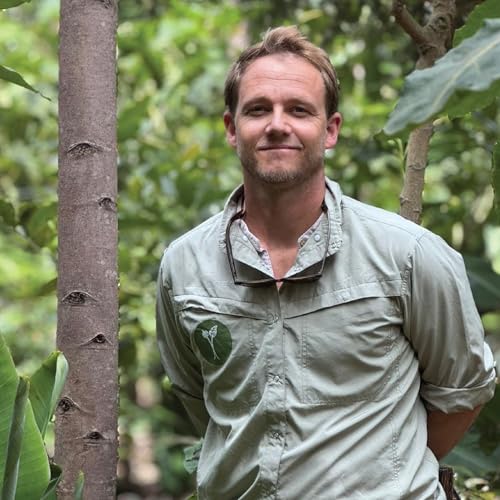
    Syntropy isn’t about the tropics—it’s about the physics of life. In this episode, Samuele sits down with Sven Verwiel, CEO & Co‑Founder of Forest Foods (Kenya), to unpack syntropic agroforestry: a regenerative farming approach designed to compound productivity over time through stratification (vertical layers) and succession (time).

    We go from field reality to unit economics: what it takes to regenerate degraded soils, why syntropic systems can reach ~200–230% land‑use efficiency, and how Forest Foods is proving a commercial model with outdoor production, zero chemicals, and strong market demand for premium quality.

    We also discuss livestock integration (pasture‑raised chickens), the hardest founder challenges (land access, capital, logistics, cold chain), and why regenerative agriculture must become a career path that attracts the next generation.

    Key topics: syntropy vs entropy, soil regeneration, agroforestry design, profitability, go‑to‑market, scaling regenerative food systems in Africa

    Mostra di più Mostra meno
    37 min
  • The 80/20 of Dairy Profitability: Nutrition + Reproduction
    Jan 19 2026

    In this episode, Samuele speaks with Apollo Gabazira—Country Director at CARE International (Uganda) and an award‑winning regenerative farmer—about what it takes to make farming profitable, scalable, and youth‑attractive in East Africa.

    Apollo shares the Asaba Farm System and its “quad model”:

    1. dairy as a foundation

    2. agronomy and circularity (turning waste into value)

    3. skilling youth through hands‑on learning

    4. community extension through local one‑stop hubs (“Farmers Point Outlets”)

    We also unpack Apollo’s most actionable insight: the 80/20 rule in dairy—focus on nutrition and reproduction to shift the majority of outcomes, from milk yield to economics.

    Finally, we zoom out to the bigger levers: what must change in policy, access to capital, and public‑private collaboration so regenerative and climate‑smart agriculture can become the norm—not the exception.

    Key topics: profitable regenerative farming, extension models, youth skilling, policy, capital, SME partnerships.

    Mostra di più Mostra meno
    31 min
  • Can we really put a price on nature? This nature‑finance expert says we must.
    Dec 19 2025

    When you clear a forest to plant maize and make charcoal, you’ve already put a price on nature—the future cash flows from the maize and the wood. The problem is that price is far too low.

    In this episode of The Samuele Tini Show, I speak with Josep Oriol, Managing Partner at Okavango Capital Partners and a leading nature‑finance expert working across Sub‑Saharan Africa.

    A Catalan who fell in love with African wildlife as a child, Josep trained as a lawyer, moved into venture capital and banking, then finally to Southern Africa to build a different kind of private equity firm—one that backs nature‑positive businesses whose performance depends on how they treat forests, soil and water. Today, Okavango‑backed companies help protect around 8–9 million hectares of land (about twice the size of Switzerland) and create income streams for hundreds of thousands of rural people.

    We dive into:

    • The mispricing of nature: every land‑use decision—from forest to maize field—is already a price signal, and why that’s dangerous if we ignore the true value of ecosystems.
    • Forest carbon in practice: the story of BioCarbon Partners, REDD+ projects, and rural families living on ~$20/month in cash who now earn income by keeping forests standing.
    • Carbon market backlash: Josep’s response to critics of carbon credits, and why, compared to agriculture, mining or logging, high‑integrity projects are often far more transparent and generous to local communities.
    • Three big opportunity themes:
      • smarter agriculture and agroforestry to boost yields and cut waste,
      • tech for soil, post‑harvest, insurance and finance,
      • monetising ecosystem services via tourism, carbon, biodiversity and water credits—and why fuelwood is still the elephant in the room.
    • Why classic 5‑year 10x PE funds don’t fit Africa: and how Okavango uses longer horizons and flexible instruments (loans with equity options, convertibles, prefs) instead of only straight equity.

    We close with Josep’s advice for entrepreneurs in nature‑based sectors—live with existential threat, love cash flow and margins, and assume everything will take twice the time and three times the money—and his vision of Africa’s future looking more like South Korea or Malaysia than Europe, if we get the nature piece right.

    If you care about where climate capital should actually go, this is a sharp, grounded conversation from inside the deal flow.

    Mostra di più Mostra meno
    34 min
Ancora nessuna recensione