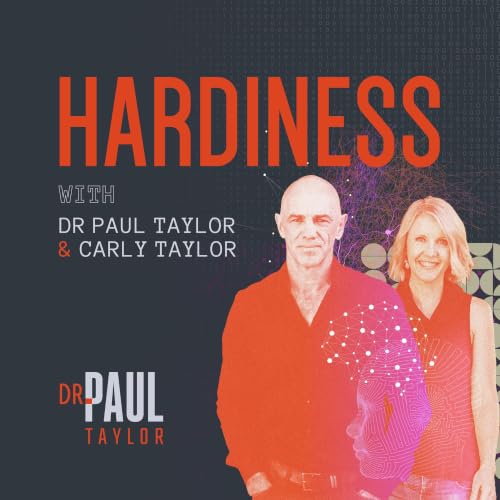
Hardiness with Dr Paul Taylor copertina

Hardiness with Dr Paul Taylor

Hardiness with Dr Paul Taylor

Di: Paul Taylor
Ascolta gratuitamente

Offerte di stagione | 0,99 €/mese per i primi 3 mesi

A seguire 9,99 €/mese – si applicano condizioni. Puoi disdire mensilmente.

Host Dr Paul Taylor, a Psychophysiologist, Neuroscientist, Exercise Scientist, and Nutritionist interviews experts from around the world on cutting edge research and practices related to improving hardiness in your mind, body and brain to become your best self.

2026 Paul Taylor
Igiene e vita sana Psicologia Psicologia e salute mentale Successo personale Sviluppo personale
  • Your Brain Runs on Your Body: A Whole-Body Approach to Cognitive Health with Dr Christobelle Yeoh
    Oct 30 2026
    In this episode, Dr Paul Taylor talks with integrative practitioner Dr Christobelle Yeoh about protecting cognitive health. They start with the rise of early cognitive decline, brain fog and stress, including during menopause. Dr Yeoh's central idea is that thinking depends on the body. Cognition rests on the lower-order systems that feed the brainstem: the gut, vascular tone, blood chemistry, breathing and the cranial nerves that read signals of safety. They explain how chronic stress and the brain's constant threat prediction affect it. They also cover why top-down approaches like CBT work best alongside bottom-up, body-based ones. The second half is practical. They look at common mismatches and what to do about them: get morning sunlight and keep a circadian rhythm, eat at regular times in daylight hours and prioritise protein and whole foods, and fix the basics before relying on supplements such as DHA, creatine and ubiquinol. They also cover CO₂-tolerance breathing, and movement that challenges balance and coordination to support neuroplasticity. Key takeaways Brain and body are not separate. Cognition depends on the health of the body's regulation systems.Get outside for morning light soon after waking, and top up with light through the day.Eat in daylight hours, include protein early, favour seasonal whole foods, and cut ultra-processed food.Sort out the basics (light, food, sleep, hydration) before relying on supplements.Combine top-down tools like CBT and ACT with bottom-up work like breathing, movement and gut health.Choose movement that challenges balance and coordination, such as boxing combinations, dancing or crawling.Start gently with breathwork. CO₂ tolerance practice is a safe place to begin, and cathartic breathwork needs guidance. Time Stamps 0:59 Why cognitive health matters, with dementia now overtaking cardiovascular disease in Australia 1:34 What's going on: brain fog, early cognitive decline (MCI), and stress in menopause 4:02 Is getting more forgetful in your 40s, 50s and 60s a warning sign? 5:35 Reframing cognition as an emergent property of whole-system regulation 10:52 Chronic stress, the brain as a prediction engine, and early-life influences 17:20 Five key inputs to the brainstem: cranial nerves, gut, vascular tone, blood pH/redox, and breathing 21:59 Threat vs challenge stress appraisal, and cortisol vs adrenaline 24:48 Top-down (CBT, ACT) and bottom-up (body-based) approaches, and neuroplasticity 27:23 Functional brain networks, and why complex, cross-body movement matters 31:52 The big mismatches: circadian biology, supplements before fundamentals, cell membrane and bioelectricity, CO₂ tolerance, and psychology without physiology 40:31 Circadian basics: morning sunlight, "clocking in" with the sun, ditching sunglasses 43:30 Red and near-infrared light, and light-based therapy for neurodegenerative conditions 47:07 Food timing, protein and the protein leverage idea, seasonal eating, leptin and insulin resistance 51:54 Supplements: DHA, phospholipids, organ meats and liver capsules, electrolytes and minerals 54:09 Creatine and hydration, including the dehydration and cortisol study 57:14 Ubiquinol: dosing and its role in the electron transport chain 58:31 Urolithin A, B vitamins, and matching supplements to the person 1:00:12 Breathing: CO₂ tolerance and Buteyko-style training vs cathartic and holotropic breathwork 1:05:23 Psychology–physiology mismatch: somatic work, vitamin D, creatine and psychotherapy Mentioned in this episode Dr Dale Bredesen's work on ...
    Mostra di più Mostra meno
    1 ora e 11 min
  • Science just decided the best type of exercise training - and it's compelling: Wisdom Wednesdays
    Oct 27 2026

    See omnystudio.com/listener for privacy information.

    Mostra di più Mostra meno
    22 min
  • Your Inner Coach With Carly Taylor
    Oct 25 2026

    Most of us spend a lot of time listening to the voice in our heads, especially when it turns negative. This week Carly looks at what happens when you start answering back instead.

    She explores research by psychologist Ethan Kross showing that talking to yourself using “you” or your own name helps you perform better under stress and see challenges as less threatening. She also looks at how Marcus Aurelius used his private journal to coach himself.

    In this episode:

    • Why we listen to our negative self-talk as if it’s the truth
    • How using your own name creates helpful distance
    • The sage and the gremlin
    • A simple way to coach yourself in the moment

    Sources:

    • Martyn Lloyd-Jones, Spiritual Depression: Its Causes and Cure (1965)
    • Kross et al. (2014), “Self-talk as a regulatory mechanism: How you do it matters,” Journal of Personality and Social Psychology
    • Moser et al. (2017), “Third-person self-talk facilitates emotion regulation without engaging cognitive control,” Scientific Reports
    • Ethan Kross, Chatter (2021)
    • Marcus Aurelius, Meditations

    See omnystudio.com/listener for privacy information.

    Mostra di più Mostra meno
    8 min
adbl_web_anon_alc_button_suppression_t1
Ancora nessuna recensione