The Human Conversation Podcast on Leadership and Ethics copertina

The Human Conversation Podcast on Leadership and Ethics

The Human Conversation Podcast on Leadership and Ethics

Di: Kaumudi Goda
Ascolta gratuitamente

Offerte di stagione | 0,99 €/mese per i primi 3 mesi

A seguire 9,99 €/mese – si applicano condizioni. Puoi disdire mensilmente.
A proposito di questo titolo

How do today's leaders navigate complex ethical dilemmas while inspiring teams, creating trust, and driving results?

Welcome to The Human Conversation Podcast on Leadership and Ethics, a podcast exploring the intersection of leadership, ethics, and organizational culture.


Join host Kaumudi Goda as she engages visionary executives, thought leaders, and changemakers in candid conversations about integrity and purpose-driven leadership.


You’ll hear perspectives from diverse fields, including business, government, advocacy, academia, and the arts.

  • What guiding principles shape a leader’s approach to ethical challenges?
  • How can we foster ethical cultures amid competing priorities?
  • Can ethics and profit coexist?


Tune in as we tackle these compelling questions and examine leadership case studies from the latest headlines.

Copyright 2024 Kaumudi Goda
Economia Scienze sociali
  • Human Conversation with Gopalan Balagopal
    Nov 5 2026
    Get To Know Our Guest:Gopalan BalagopalGopalan Balagopal, former officer of the Indian Administrative Service, brings over four decades of experience spanning district administration, child protection, and community-led climate resilience.His work took a global turn when UNICEF drew on his services to help develop the State Party Report after India ratified the UN Convention on the Rights of the Child. He continued with UNICEF in Bangladesh, rose to serve as Global Adviser for Child Protection at its New York headquarters, and concluded his career as UNICEF Representative to the DPR Korea (North Korea) at the end of 2009.Retirement was only a new chapter. For a decade, he supported several countries in Africa, along with the Economic Commission for Africa, in strengthening their civil registration systems. Following the floods and landslides of 2018 in Kerala, India, he turned his attention closer to home. Working with the Hume Centre for Ecology and Wildlife Biology, an NGO working in the Western Ghat mountain areas of Kerala, and with the help of local government and young people, he supported the documentation of every damage site across the district. That effort laid the foundation for vulnerability maps and a district-level weather forecasting and disaster warning system, a model now being replicated in nearly all districts of Kerala and in other parts of India.Since 2022, he has helped coordinate the Climate Smart Coffee Project, an initiative of the Government of Kerala to provide better income to small coffee farmers in Wayanad while mitigating the impact of climate change with the support of science and knowledge. He holds a Master's degree in Public Administration from the Kennedy School of Government, Harvard University (Class of 1988-89) and was the first Mid-Career Student in KSG to win the Marcel Carbello Award for development of teaching material. HIGHLIGHTS & TAKEAWAYS:DR. KG: Share a little bit about the various roles you've held so far because you're still continuing to do tremendously exciting work and how do you squeeze in so much in the same twenty-four hours everyone else has? But walk us through a little bit around all the different reports you've had, what you're currently doing, and what's the driving force behind all that you do?BALA: I started my sort of professional work career by joining a public undertaking owned by this government of India, which was the first industrial unit manufacturing chemical fertilizers to improve productivity of food crops and so on in Kerala. In the northern West Bengal districts of Jalpaiguri and Jajiling. I was the head of the local administration in those places.BALA: I had an opportunity to go to Government of India to work in the Ministry of Information and Broadcasting, at which time I had an option I had an opportunity to come to the United States and take a year of study as a mid career student at the Kennedy School of Government of at Harvard and then i returned back had an invitation to join the united nations children's fund UNICEF where I worked briefly in India and then in Bangladesh. I had an opportunity to understand the culture, the language, the people in these places. and then I went on to head the work on protection of children as a senior advisor with UNICEF at its headquarters.BALA: I opted to go to North Korea, the DPR Korea to head UNICEF's work. And I was lucky to be there for a period of time which is longer than usual, three and a half years, and that I think helped me. To develop a certain, what shall I say, trust and confidence with the people who worked with me, and we could introduce certain innovative interventions which had not been possible in the past.DR. KG: Was there a red thread, a driving force, a compass that served as the driving force for all the decisions you took, all the career pivots that you've undertaken?BALA: It was to strive to be as ethical and as much focused on integrity as possible in this journey. I believe also that there were certain values or learnings which I think are quite significant that came to me.BALA: I think one of the critical qualities which I had found in people in various situations who did better in tougher surroundings where lots of negotiations and persuading people to take a particular path of development, it is the quality of emotional intelligence and empathy particularly.BALA: Unless you are really able to stand in the shoes of someone else and see the world as they perceive, you cannot make a change there. I think the single most important attribute I would see in anyone who I would select to a leadership position is the ability to listen. And to listen. And very often to also back that up with a summarization of what you think you heard and get validation from the person who listens to you before you come up with you know your answer or something like that, you know. So that these things have been very important. And it is not only in the work sphere. It is equally ...
    Mostra di più Mostra meno
    58 min
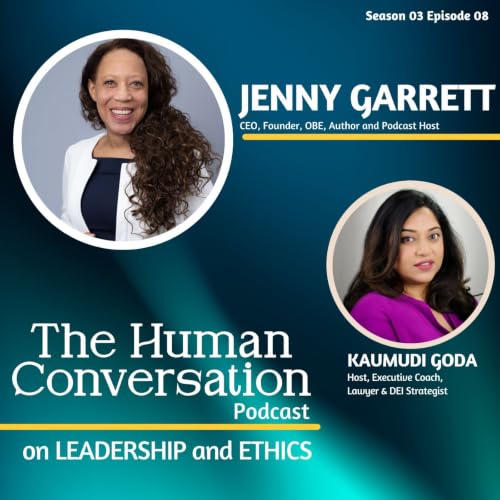
  • Human Conversation with Jenny Garrett
    Oct 5 2026
    Get To Know Our Guest:Jenny GarrettJenny Garrett OBE began life in social housing in North West London, with an early commitment that where you start should never limit where you arrive. Two decades on, she is the founder and CEO of Jenny Garrett Global, the award-winning leadership consultancy she started in 2006 and still leads. Her belief is simple: potential is everywhere, but opportunity is not, and the work of leadership is to close that gap. It is a promise borne out by results, with 35%+ of participants promoted during her programmes and 98% recommending them.Jenny’s work spans three connected pillars: Inclusive, Entrepreneurial and AI-Ready Leadership. She is the author of the bestselling “Rocking Your Role” and “Equality vs Equity,” and, with her daughter Leah-Sunshine Garrett, co-author of AI for Equity (Emerald Publishing) and co-host of the podcast of the same name. She holds an OBE for services to entrepreneurship and women in business, and is a Companion of the Institute of Leadership and Management, its highest honour. HIGHLIGHTS & TAKEAWAYS:DR. KG: Jenny, you're a very well known and beloved figure, but for the sake of the audiences who are listening to you for the first time, can you share a little bit about yourself and your journey in life so far?JENNY: My journey has always been ultimately about empowering people. As a result, I've not just created my business providing leadership development, but also created other opportunities such as a social enterprise called Rocking Your Teens that has taken three and a half thousand young people through our doors over the last 13 years. And also something called the Diverse Executive Coach Directory, where we have about 60 coaches who we promote so that people can know that there are choices out there to have coaches all over the world.DR. KG: Jenny, you started in marketing, then it's coaching, then leadership training, leadership programs, writing, work with teenagers, assembling a large diverse group of coaches specifically to address the lack of diversity that might be available to people. So many different and impressive accomplishments, work that is impactful and is needed in the world. But what is a red thread that ties all of it together for you?JENNY: I think it's two things. I think it's about fairness. I really care about fairness. And I really want everyone to have the same opportunity for success. So I think fairness is part of it. But also empowerment. It's not just making sure everyone has the same opportunity, but making sure everyone knows inside that they might be different, but equally as good as everyone else. I really want people to understand that your difference is powerful. We don't have to be the same as everyone else. And actually that difference is your uniqueness is what makes you really special. And it's finding the spaces in which you can really flourish. I think there's a saying, if you ask a fish to ride a bicycle, it will always be unsuccessful, you know? And it's about finding those spaces where actually, you know, put the fish in water, it's amazing. And finding those spaces for us all to flourish.DR. KG: Fairness, equity, inclusion, these values that shine through so powerfully in what you said just now. What are those values rooted in? Where does that primal cry come from that you want to bring this to the world?JENNY: I come from a line of very strong women. My grandmother, absolutely, my grandmother came to the UK and started a life for all of us with my grandfather, but she was definitely the strong matriarch. And then my mum, who was the first in our family to get a degree actually, you know, in this line, she studied in her thirties to become a school teacher. And that very much empowered my brother and I and showed us what was possible. I feel like these women have had to fight hard for what they've been able to achieve and they've done it. But I guess I would love it to be easier for others. They've had to really recognize their own potential when other people didn't see it. And I want to be me and my company. I want to be that for others. I want to hold a mirror up to them and say, look, this is what I see and this is what is possible for you.JENNY: I think my grandmother, she had such a big heart. I think she absolutely showed me what's possible, even with very little. And then my mum sort of breaking boundaries and breaking barriers too. I would also say I have a daughter who's nearly 25. And there's definitely something about becoming a parent that made me want to step up. I suddenly saw myself as a role model. I knew that when she was looking at me she was seeing what was possible and that meant that I need to step out of my comfort zone so that she could too. So it's the women in my life that definitely create that line through that desire to make a difference.DR. KG: Accomplished people who fight hard and do amazing, miraculous things that challenge the notion of what is possible ...
    Mostra di più Mostra meno
    43 min
  • Human Conversation with Dr. Vance Cooper
    Sep 8 2026
    Get To Know Our Guest:Dr. Vance CooperDr. Vance Cooper is a leadership development consultant and mental health advocate with 10 years of experience in acute inpatient mental health. With a Ph.D. in Corporate Leadership, he helps people prioritize mental and emotional well-being by equipping them with tools to unlock unrealized leadership potential, without compromising authenticity. His workshops and keynotes blend compassion with clarity, challenging audiences to lead themselves with the same care they extend to others. HIGHLIGHTS & TAKEAWAYS:DR. KG: From your work in the healthcare space, specifically around mental well-being and mental health and how that builds so beautifully into your current work, which is helping individuals find their purpose, find their values, and specifically helping younger people do this, whether it's in terms of their career preparation and planning or simply just finding their place in the world: Is there a red thread that ties all of it together for you? What's the driving force behind all that you do?DR. VANCE: My mission is ultimately to help extraordinary people unlock unrealized leadership potential without compromising authenticity. So from my view, everybody is an extraordinary being. We all have unique talents, we all have a purpose, and we all have a reason that we put on this earth, and we all have a special gift. And so my goal is always to help people recognize their unique talents and gifts and how they are able to walk in their leadership gift.DR. VANCE: My goal is to help everyone recognize that they are a leader in their unique space and in their unique talent and the younger I can breathe or speak that message into a person, I think the better off they will be in the long run.DR. KG: When did a young Dr. Vance Cooper working in the healthcare say, hey, you know what? That specifically is what my calling is. I'm gonna get working on that.DR. VANCE: I was looking to study leadership, but I don't know if I really necessarily looked at myself as a leader, at least from the perspective that I have currently. And so while I was studying the theories, I simultaneously was going through this self-discovery process where I really was, I really had to do a deep self-assessment and just kind of recognizing my own unique gifts and my own unique talents and just recognizing that studying leadership doesn't make necessarily make you a leader.DR. VANCE: I've always had a connection where I wanted to give back. I want to give back to people who are coming after me and being able to help pave the way and help them recognize that the things that I'm accomplishing are very real for them as well.DR. VANCE: I want young people especially to recognize that they should never stop dreaming and that there's all different types of paths that they can take whether they decide to go to trade school, whether they decide to go to higher education, whether they just decide to go directly into the workforce, whether they decide to start working and then maybe later on in life as they get older, they decide that they want to go back to school. There's multiple different paths that people can take to be able to reach their goal. But the important thing is for you to never stop dreaming and to really focus on what you want.DR. VANCE: One of the things that I sincerely want to do is help young people recognize that they should be in order for them to reach their maximum fulfillment and for them to reach their, like their maximum potential, they should be going after what they want.DR. KG: From my own practice, it is sometimes the intergenerational trauma, it is the cultural heritage, it is the historical context. There's so many reasons why at the earliest, I believe it's as young as eight or even six when children already begin to absorb the flag posts, the milestones that, “hey, this is what is possible, this is what is not. Here's what's expected of you.” And that subliminal messaging really goes deeply towards shaping our expectations of ourselves, of life, of the world, the lens with which we see the world and experience it.DR. KG: Can you tell me a little bit from the perspective of your work, what the terms ethics and integrity mean to you?DR. VANCE: When I think about ethics and integrity, I think about character. I think about trust. For me, I think that character is one of the most important aspects of leadership because if people aren't able to trust you, it's going to be very hard for people to follow you.DR. VANCE: Good character is definitely a part of being acting in an ethical manner with integrity. One of the things about it is that when you are somebody who has people following you, once it's been determined that the people cannot trust you, trust is something that, it's almost like it's your currency. Once people feel like you've misled them or you've given them a reason to break that trust, it's very hard to get that trust or to earn that trust back from the ...
    Mostra di più Mostra meno
    1 ora e 1 min
adbl_web_anon_alc_button_suppression_t1
Ancora nessuna recensione