The 981 Project Podcast copertina

The 981 Project Podcast

The 981 Project Podcast

Di: Tamela Rich
Ascolta gratuitamente

Offerte di stagione | 0,99 €/mese per i primi 3 mesi

A seguire 9,99 €/mese – si applicano condizioni. Puoi disdire mensilmente.
Join Tamela Rich for dispatches from all 981 miles of the Ohio River: people, places, history, culture, and more.

the981project.comTamela Rich
Mondiale Scienze sociali Scrittura e commenti di viaggio
  • Slaveholders, Sheriffs, and Saviors on the Indiana-Kentucky border
    Aug 16 2026
    It’s been a few months since I gave you an update on this project. Bottom line: I’ve been writing the book that this newsletter has helped me research. I spent much of July drafting chapters for Along The Ohio: Stories the River Still Carries, and then a week at the Appalachian Writers Workshop studying with Charles Dodd White.From there, I spent nearly a week in Indiana and Illinois. Boy, did I learn a lot.When Madison was platted in 1809-1810 it filled the gap between two already-mature ports: Cincinnati upstream about 70 miles, and Louisville about 46 downstream. It became Indiana’s third-largest city and a major hog-processing/steamboat hub within a few decades.Indiana is, of course a Midwestern state, and as part of the Northwest Territory, slavery was not permitted there. However, an old Ordinance signed and stored back east was secondary to the labor needs settlers faced on the frontier. Not only that, people were too busy scratching out a living than to fund territory-wide enforcement. These two factors combined to give Indiana’s southern counties a unique culture born of cross-river proximity to Kentucky, a slave state until 1865.Today’s visitors see Madison’s charms through Victorian architecture, a vibrant riverfront, and a range of cute shops and upscale eateries, but the town embraces its divided Antebellum heritage too.While our Hollywood-induced cultural memory is that planters lived on their plantations, that wasn’t the case here. Many of them lived in Madison — a proper river port with services and society — while holding the people they enslaved across the water in Kentucky. So “free Indiana” butting up against “slave Kentucky” wasn’t a clean line; slaveholders were commuting from Indiana to their own enslaved workforce every day, sometimes bringing workers along to help in the house and gardens in Madison, but sending them back across the river to prove that they weren’t practicing slavery in a free state.White family lines crossed that same slave-free boundary just as messily. Take Robert Right Rea, a slave catcher who was also, simultaneously, the sitting Jefferson County sheriff. He was the “major obstacle” faced by Underground Railroad conductor Robert Elliott, a teamster living about ten miles north of Madison. The twist: Rea and Elliott were cousins by marriage — Rea was a cousin of Elliott’s own wife. So the two Jefferson County men working on opposite sides of the slavery laws that permitted enslavers to capture “fugitive slaves” even in free states were literally family. I can only imagine the frosty interactions around the extended family’s holiday dinner tables.Reminds me of those Looney Tunes characters Sam Sheepdog and Ralph Wolf.Sheriff Rea's double-identity as a slave catcher brought him into contact with a prominent abolitionist in Jefferson County, John H. Tibbets, who wrote in his own memoir that Rae (which he spelled Ray) "was known all over Kentucky and was always applied to when a slave got away." Later in Tibbets’ account he tells of an enslaved man in Kentucky who was trusted by his owner to conduct business on the Ohio side of the river. He never tried to escape. Unbeknownst to the enslaver, the worker was also helping fugitives make river crossings at night.One evening, the sheriff caught the worker in the act and induced him to try running away with the group of fugitives so that Rae could “catch” all of them and collect a reward. This backfired when the old man’s enslaver said Rae had tricked his worker and therefore refused to pay the bounty.A few years later, Rae turned up drowned in the Ohio River below Madison. The river that carried so many people to freedom on his watch, in the end, carried him too.Information about abolitionists’ activities before the Civil War is particularly difficult to substantiate unless something they did involved legal procedures. UGRR conductors weren’t prone to keeping statistics and diaries of their work.One reason people moved through this stretch of the Ohio traces back to the Revolutionary War. In 1781, Virginia (before Kentucky was a state)rewarded George Rogers Clark and the soldiers of his Illinois campaign with 150,000 acres directly across the river from Louisville — land that became Clark’s Grant, the first American settlement northwest of the Ohio. Privates got 108 acres each; officers, more. It put hundreds of Virginia veterans, and often the people they enslaved, within an easy ride of Indiana soil that Virginia’s own Northwest Ordinance had declared free.By 1820, Madison had a large free Black community in its Georgetown neighborhood. Some were brought to free soil from slave states — often by Quakers, sometimes by their enslaver-veterans — and manumitted.The story that interests me from among the many UGRR conductors in Madison is of Chapman Harris. Enslaved status passed through the mother under the law of the time, so being born to a free ...
    Mostra di più Mostra meno
    14 min
  • Trivia Time: How Did Pittsburgh Turn Flood Relief into a Blueprint for Feeding America?
    Nov 21 2025
    Read Part One of Flood to Food Banks here.By the spring of 1937, the Ohio River had retreated to its banks, but the questions it left behind were harder to contain. Across the valley, local officials and federal administrators began asking what might happen if the same machinery that fed the stranded could be used to feed the poor.That question found its first real test in Pittsburgh, a city still defined by its mills and smoke. In the months after the flood, the Red Cross and the Works Progress Administration (WPA) turned their emergency kitchens into an experiment. Instead of closing when the waters receded, they stayed open—serving families displaced not by water, but by chronic unemployment. The effort became known informally as the Pittsburgh “trial project.”The idea spread quickly. Relief experiments cropped up in other cities—St. Louis, Cincinnati, Louisville—each adapting WPA labor and surplus commodities in its own way. None were as formally structured as Pittsburgh’s, but all were feeling their way toward a similar question: how do you feed people once the emergency ends?But Pittsburgh stood out for its scale and precision. Backed by federal administrators who had cut their teeth on flood relief, the city developed a system for inventorying, storing, and distributing food that could function even when emergency funds dried up.At its core, the project asked whether public welfare could operate with the efficiency of disaster relief. WPA clerks cataloged household needs; local grocers became distribution partners; surplus commodities from the U.S. Department of Agriculture—flour, beans, lard, canned fruit—were tracked, stored, and rationed according to family size. The Red Cross supplied social workers, and city officials provided warehouses and trucks. Together they built a prototype for what would later be called food security logistics.The trial wasn’t perfect. Federal funding ebbed with each budget cycle, and the social stigma of “relief food” remained. But the administrative bones of the system—the inventories, supply chains, and coordination among civic and charitable agencies—became a model. The project didn’t design the Surplus Commodities Program, but it mirrored the same principles—standardized inventories, warehouse distribution, and coordinated logistics—that federal policymakers would embrace by 1939.The Great Flood’s legacy, it turned out, wasn’t only the levees that kept rivers in check—it was the blueprint for a nation learning to feed itself in good times and bad.And here’s a picture of Secretary of Labor, Frances Perkins, with Pittsburgh steelworkers in 1933.Now that you’ve read about the Pittsburgh “trial project” and its sister cities, test what you know about how these experiments evolved into the modern food-bank system in this month’s quiz.Note to my fantastic new subscribers:It’s the rare person who can answer all ten trivia questions without any prep. I couldn’t answer them without a significant amount of research, either! Do your best and enjoy learning something new. QUESTIONS:Each question has one correct answer, found in the footnotes.1. What made Pittsburgh the ideal testing ground for the “trial project?”A. It had strong labor unions and civic coordinationB. It had an existing network of flood-relief warehouses and staffC. It was home to one of the nation’s largest steelworker populationsD. It was the operational capital of the New Deal’s relief agencies in the East2. Which New Deal administrator was known for saying, “People don’t eat in the long run—they eat every day?”A. Harold IckesB. Eleanor RooseveltC. Harry HopkinsD. Henry Wallace3. Which prominent women helped shape Pittsburgh’s approach to relief work?A. Frances PerkinsB. Eleanor RooseveltC. Mary McLeod BethuneD. All of the above4. What immediate challenge did Pittsburgh face once the floodwaters receded?A. Contaminated food suppliesB. Unemployment in the millsC. Housing shortages in the suburbsD. Labor strikes in city services5. Which local partner helped the WPA convert emergency kitchens into year-round distribution centers?A. The Heinz CompanyB. The City Department of Public WelfareC. Carnegie SteelD. The Allegheny Conference on Community Development6. What role did the Red Cross play in Pittsburgh’s trial project?A. Operated soup kitchens independentlyB. Supplied social workers and coordinated volunteersC. Focused solely on medical careD. Distributed industrial food waste to the poor7. What was unique about Pittsburgh’s data collection?A. It used punch-card tabulators from local millsB. WPA clerks tracked every meal and household servedC. It relied on volunteer recordkeepers from churchesD. All records were destroyed after the project ended8. What type of food filled Pittsburgh’s relief warehouses?A. Locally grown produce and dairyB. Imported European goodsC. USDA surplus commoditiesD. Restaurant leftovers donated by civic ...
    Mostra di più Mostra meno
    19 min
  • How did a 1937 Flood Became the Blueprint for Food Banks?
    Nov 13 2025
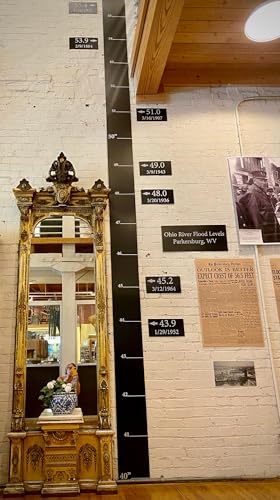
    This is Part One of “Flood to Food Banks,” a three-part exploration of how the Ohio River became America’s testing ground for social uplift.With American hunger back in the national headlines, I’ve been thinking about how this story of hunger relief began. I was surprised to learn it wasn’t with pantries and food drives, but with the Ohio River’s most devastating flood at the start of Franklin Delano Roosevelt’s second term. My own research on the topic started several years ago, when I visited the Blennerhassett Museum of Regional History in Parkersburg, West Virginia, during the summer of 2021. However, at the time, I wasn’t looking for the origins of the modern food bank system—I hadn’t even thought about it. It was just part of my general reconnaissance of the region and its many historical facets.I bought an admission ticket and stepped into the first-floor gallery, where a black gauge climbs the white brick wall, ending past the landing of the second story balcony. It was like a ruler of reckoning showing flood levels from 1884, through 1964. If you look at the picture below, the scale begins at forty feet, because that’s the elevation of the museum floor above the river’s normal height. I tilted my head up, then back a little farther, squinting to see the highest line of its record crest: 55.4 feet, January 26, 1937. The number is tidy, and the mark is exact, but the mind resists it without context, so here’s mine. At five-foot-one, I calculated it would take nearly eleven of me stacked head to toe to reach 55.4 feet. And yes, if you look closely in the mirror beside the gauge, you can see me in the reflection—small against a wall that once marked catastrophe.Now, imagine the whole town underwater to understand what fifty-five feet really means in human terms. What began here as an act of rescue in 1937—feeding, housing, and clothing the displaced—would teach government and charity alike how to manage hunger, and other human needs, long after the waters receded. It didn’t invent the modern food bank, but it changed how the nation understood feeding as logistics — a mindset federal agencies would soon build into national food programs.Even before the river crested, the Red Cross was on the ground, issuing rations and setting up shelters in churches and schools. When the flood reached its peak, President Roosevelt declared a national emergency—one of the first in response to a natural disaster—and released ten million dollars for relief. In today’s dollars, we’re talking $220 – $250 million. His order unlocked every corner of the New Deal: Works Progress Administration crews (WPA), Civilian Conservation Corps (CCC), the Army Corps of Engineers, and the Red Cross all moving in a single rhythm. Harry Hopkins, Roosevelt’s trusted advisor and briefly his Secretary of Commerce, oversaw the WPA’s seven divisions, from heavy construction to public service, education, and the women’s sewing and nursing projects that reached into every county. The WPA had begun as a jobs program employing more than 8.5 million people for an average monthly salary of about $41. Under Hopkins, the seven divisions moved as one—not only repairing infrastructure, but also delivering food, sewing blankets, and keeping disease at bay. Within a week of the crest, field kitchens were serving thousands of meals a day—a wartime scale of feeding in a peacetime disaster. The flood proved that compassion, when well organized, could act on a scale it had never attempted in peacetime.Back at my tour of the Blennerhassat Museum, I walked into another exhibit hall featuring a wooden skiff resting beneath a photograph of a long-ago packet boat. It’s small, flat-bottomed, and open to the air—the kind of boat that Parkersburg’s police and firemen rowed to deliver food and evacuate families, scraping across flooded porches and telephone wires along the way. For weeks, the city was an archipelago of rooftops and rescue routes, as were sister cities for all 981 miles of the river. But police and fire crews weren’t the only ones rowing skiffs. Younger men from the Civilian Conservation Corps were pulled from their usual duties—planting trees, building bridges, and breaking the ground—literally—on the Blue Ridge Parkway. My grandfather was a “CC man,” as they called themselves, but wasn’t serving at the time of the flood. Had he been, he would have rowed a skiff through flooded streets, delivering food and medicine, and disinfecting the mud with lime and kerosene to prevent disease—plus anything else the relief effort required of him.So yes, before America could build a system to feed its hungry, it had to learn how to feed its stranded. The Ohio River flood didn’t just reshape levees and zoning maps—it rewired the nation’s sense of how care could be organized.By the spring of 1937, the Ohio was back in its banks, but the idea it unleashed kept flowing east. Relief ...
    Mostra di più Mostra meno
    9 min
adbl_web_anon_alc_button_suppression_t1
Ancora nessuna recensione