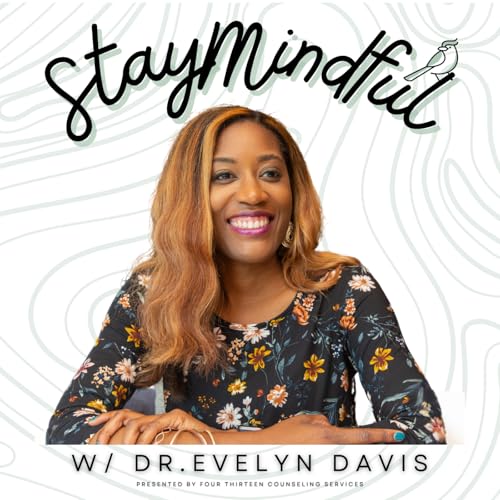
Stay Mindful with Dr. Evelyn Davis copertina

Stay Mindful with Dr. Evelyn Davis

Stay Mindful with Dr. Evelyn Davis

Di: Dr. Evelyn Davis LCSW
Ascolta gratuitamente

Offerte di stagione | 0,99 €/mese per i primi 3 mesi

A seguire 9,99 €/mese – si applicano condizioni. Puoi disdire mensilmente.

Welcome to StayMindful with Dr. Evelyn Davis, a podcast dedicated to inspiring conversations around mental health, social work, self-growth, and encouragement. Hosted by Dr. Evelyn Davis, LCSW, this podcast is a space to pause, reflect, and grow—one mindful moment at a time. Whether you're a social worker, a mental health professional, or simply someone looking for thoughtful encouragement, you’ll find insight, support, and empowerment here. Join us each week for honest conversations, expert advice, and inspiring perspectives to help you thrive!

2026 Dr. Evelyn Davis, LCSW
Igiene e vita sana Psicologia Psicologia e salute mentale
  • Being Mindful in America: Cultural Humility, Bias, and Grace in Difficult Conversations
    Oct 19 2026

    In this episode of Stay Mindful with Dr. Evelyn Davis, Dr. Davis explores racial bias, media framing, cultural humility, and how our own experiences influence the way we interpret difficult stories. Using current cases involving Karmelo Anthony, Nolan Wells, and Addison Hunnicutt, along with historical examples of racialized media coverage, she examines what research tells us about the ways Black defendants and White victims have been portrayed in American media.

    This conversation isn't about choosing sides. It's about becoming more aware of the lens through which we view other people—and learning how to make room for compassion even when we disagree.

    Resources / Show Notes:

    Research

    Research referenced in this episode on racial representation, media framing, and perceptions of news coverage:

    Carr, S., & Soroka, S. (2025). Depictions of Black Americans in U.S. television news, 1990–2020. Journalism.
    https://doi.org/10.1177/14648849251386724

    Dixon, T. L. (2008). Who is the victim here? The psychological effects of overrepresenting White victims and Black perpetrators on television news. Journalism, 9(5), 582–605.
    https://doi.org/10.1177/1464884908094160

    Equal Justice Initiative & Global Strategy Group. (2021). Innocent until proven guilty? A look at media coverage of criminal defendants in the U.S.

    Pew Research Center. (2023). Black Americans' experiences with news.

    Current Events Discussed:

    Karmelo Anthony and Austin Metcalf — Discussed in relation to media framing, context, compassion, and assumptions about victims and defendants.

    Addison Hunnicutt — Discussed as an example of how context and race may influence how we interpret someone's actions.

    Nolan Wells — Discussed in relation to public attention, unanswered questions, and how we respond to stories involving race.

    Mason Schermerhorn and the Apalachee High School Shooting — Discussed as an example of how imagery can influence perceptions of victims and suspects.

    Concepts Discussed:

    Cultural humility • Implicit bias • Racial bias • Media framing • Representation • Humanization and criminalization • Compassion • Mindfulness • Self-awareness

    Reflection Questions:

    What do I actually know—not what I've seen or heard from somebody else?

    What am I assuming, and where did those assumptions come from?

    If the identities of the people involved were reversed, would I feel differently?

    Companion Mini Episode:

    Practicing Cultural Humility: A Reflection Exercise

    Using the **5 Rs of Cultural Humility—Reflection, Respect, Regard, Relevance, and Resiliency—we'll continue the conversation with a guided reflection on our assumptions and biases.

    Interested in starting a podcast?

    Check it out using my partner link:
    Try Riverside

    Disclaimer

    This episode is for educational and reflective purposes and is not a substitute for therapy or individualized mental health treatment. If you need additional support, consider connecting with a licensed mental health professional in your area.

    Mostra di più Mostra meno
    27 min
  • Mini Episode: Digital Reset- A Mindful Social Media Reflection
    Oct 12 2026

    In this companion mini episode of Stay Mindful, Dr. Evelyn Davis continues the conversation about social media and mental health by focusing on what happens within us when something online triggers an emotional response. Through a practical reflection exercise, we'll explore how to create space between our thoughts, emotions, and actions—and make more intentional choices about how we respond.

    Resources / Show Notes

    Social media can quickly shift our thoughts, emotions, and reactions. In this Stay Mindful mini episode, Dr. Evelyn Davis explores social media and mental health, cognitive defusion, emotional regulation, and DBT Opposite Action to help you pause before reacting online. This practical digital reset offers strategies for recognizing unhelpful thoughts, managing emotional reactions, and becoming more intentional about how you respond—in the comment section and beyond.

    Concepts Discussed

    Cognitive Defusion — Acceptance and Commitment Therapy (ACT)
    Creating distance from thoughts so they can be recognized as thoughts rather than automatically treated as facts or commands.

    Opposite Action — Dialectical Behavior Therapy (DBT)
    An emotion-regulation strategy that can help us recognize emotional urges and intentionally choose a more effective response when following the urge would be unhelpful.

    Digital Reset Questions

    When you notice yourself becoming activated online, ask:

    1. What am I thinking?
    2. What am I feeling?
    3. What is this feeling urging me to do?
    4. What action would actually be helpful right now?

    Companion Main Episode

    Everybody Has an Opinion... Now What? Protecting Your Mental Health in the Age of Social Media

    A conversation about social media, parasocial relationships, comment sections, compassion, and the impact our digital interactions can have on mental health.

    Additional Resources

    Blake, M. ACT, CBT, & DBT workbook: 180 exercises for emotional regulation, distress tolerance, cognitive restructuring, and more.

    Interested in starting a podcast?

    Check it out using my partner link:

    Try Riverside

    Disclaimer

    This episode is for educational and reflective purposes and is not a substitute for therapy or individualized mental health treatment. If you need additional support, consider connecting with a licensed mental health professional in your area.

    Mostra di più Mostra meno
    15 min
  • Everybody Has an Opinion...Protecting Your Mental Health in the Age of Social Media
    Oct 5 2026

    Social media can help us connect, but what happens when online conversations start affecting our mental health—or when access to celebrities and public figures begins to feel like a personal relationship? In this episode of Stay Mindful with Dr. Evelyn Davis, we explore social media and mental health, parasocial relationships, negative comments, online communication, cyberbullying, digital boundaries, and mindful social media use. Using recent WNBA social media conversations and personal reflection, Dr. Davis considers how we can share our opinions, disagree with others, and participate in comment sections without forgetting that there is a real person on the other side of the screen.

    Resources / Show Notes:

    In This Episode:

    • Social media and mental health
    • Parasocial relationships and social media
    • Negative comments and their emotional impact
    • Online communication and comment sections
    • Cyberbullying and harassment
    • Digital boundaries and protecting your mental health
    • WNBA social media conversations
    • Compassion and mindful communication

    Research:

    Ai, Y., & von Mühlenen, A. (2025).

    An experimental online study on the impact of negative social media comments on anxiety and mood. Scientific Reports, 15, 26642.

    The experimental study included 128 adults and found that exposure to negative social media comments increased anxiety and decreased mood compared with neutral or positive comments.

    Hoffner, C. A., & Bond, B. J. (2022).

    Parasocial relationships, social media, & well-being. Current Opinion in Psychology, 45, 101306.

    The review describes parasocial relationships as nonreciprocal socio-emotional connections with media figures. The research also emphasizes that these relationships are not inherently harmful; they can support connection, coping, identity exploration, and community while also presenting potential risks to well-being.

    Podcasts Mentioned:

    Therapy for Black Girls — Session 470: Parasocial Relationships

    Dr. Joy Harden Bradford is joined by Dr. Maia Niguel Hoskin for a discussion of one-sided bonds with celebrities, influencers, and other media figures, including how to recognize when these connections may no longer be serving us.

    Questions For Reflection:

    • How do I usually feel after spending time on social media?
    • Am I communicating online or simply reacting?
    • Would I say this the same way if the person were standing in front of me?
    • Does following someone make me feel entitled to parts of their life they haven't shared?
    • What boundary could improve my relationship with social media?

    Companion Mini Episode:

    Digital Reset: A Mindful Social Media Reflection

    A practical reflection on your relationship with social media, including strategies for noticing unhelpful thoughts, managing emotional reactions, and becoming more intentional about how you interact online.

    Interested in starting a podcast?

    Check it out using my partner link:

    Try Riverside

    Disclaimer

    This episode is for educational and reflective purposes and is not a substitute for therapy or individualized mental health treatment. If you need additional support, consider connecting with a licensed mental health professional in your area.

    Mostra di più Mostra meno
    20 min
adbl_web_anon_alc_button_suppression_t1
Ancora nessuna recensione