Episodi

  • The Largest Waterfall in the Solar System Isnt on Earth
    Nov 24 2026
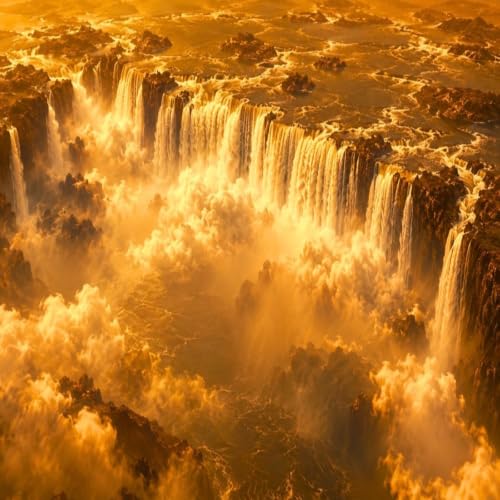
    Mars once had something almost impossible to imagine today: enormous rivers, ancient seas, and catastrophic floods powerful enough to reshape entire regions of the planet.

    In this Snoozy Space documentary, we explore the largest waterfall in the Solar System, a colossal waterfall that once existed on Mars at the edge of Echus Chasma. The drop may have reached roughly 4 kilometers, or about 2.5 miles, while the resulting floods carved the immense channels of Kasei Valles across the Martian surface.

    🌌 But where did all that water come from?

    We travel back billions of years to a wetter and more dynamic Mars, exploring the ancient Eridania Basin, enormous bodies of water, volcanic activity, hydrothermal environments, and the catastrophic floods that transformed the planet.

    We also examine how Mars changed from a potentially habitable world into the frozen desert we see today. The loss of its global magnetic field, atmospheric erosion, declining internal heat, and the disappearance of stable surface water all played important roles in that transformation.

    🔭 Modern missions have allowed scientists to reconstruct parts of this lost world. Mars Reconnaissance Orbiter has photographed ancient channels from orbit, while Curiosity and Perseverance have investigated ancient lakebeds, river deltas, sediments, and organic molecules on the surface.

    One of the most fascinating locations is the Eridania Basin, where spacecraft observations have revealed thick mineral deposits associated with ancient hydrothermal activity. These environments are particularly interesting because hydrothermal systems on Earth are considered possible settings for the emergence of early life.

    The waterfall is gone.
    The water is gone.
    But the geological evidence remains.

    Ancient channels, mineral deposits, sedimentary rocks, and enormous scars across the Martian landscape preserve a record of a planet that once looked remarkably different.

    🌙 Tonight, join Snoozy Space for a calm journey through ancient Mars and discover how a world that once moved oceans of water eventually became the cold, dry planet we know today.

    If you enjoy relaxing, factual space documentaries about planets, moons, ancient worlds, and the mysteries of our Solar System, consider leaving a like and subscribing to Snoozy Space. It helps support more late-night journeys into the universe.


    Become a supporter of this podcast: https://www.spreaker.com/podcast/snoozy-space--7447041/support.

    This episode includes AI-generated content.
    Mostra di più Mostra meno
    1 ora e 55 min
  • The Broken Moon of Uranus Where a Night Lasts 42 Years: Titania
    Nov 23 2026
    Titania is one of the most mysterious moons orbiting Uranus, a frozen world shaped by ancient impacts, enormous fractures, and a geological history that may extend deep beneath its icy surface. 🌌

    In this Snoozy Space documentary, we journey to Titania, a moon roughly 980 miles wide whose surface contains the immense 927-mile-long Messina Chasma and the enormous 203-mile-wide Gertrude crater. Voyager 2 photographed only about 40% of Titania during its brief 1986 encounter, leaving much of this distant world unexplored.

    Beneath the ice, scientists have considered the possibility of a subsurface ocean reaching up to 30 miles deep, potentially sustained by heat from radioactive elements inside the moon. If such an ocean exists today, Titania could belong to the growing family of icy worlds where liquid water may persist far beyond the warmth of the Sun. 💧

    Titania also experiences one of the most extraordinary seasonal cycles in the Solar System. Because Uranus is tilted almost completely onto its side, each pole can spend approximately 42 years in continuous darkness before returning to sunlight.
    From William Herschel's discovery of Titania in 1787 to Voyager 2's fleeting encounter in 1986, our understanding of this distant moon has been built from remarkably limited observations. A future Uranus mission could finally reveal what remains hidden.
    Join Snoozy Space as we explore Titania as it truly is: ancient, fractured, distant, and still largely unknown. 🌙

    If you enjoyed this journey, consider leaving a like and subscribing to Snoozy Space for more calm, factual explorations of the most fascinating worlds in our Solar System.


    Become a supporter of this podcast: https://www.spreaker.com/podcast/snoozy-space--7447041/support.

    This episode includes AI-generated content.
    Mostra di più Mostra meno
    1 ora e 50 min
  • We Found a New Earth Right Next to Us (Why We Can Never Visit)
    Nov 22 2026
    What if one of the most promising Earth-sized worlds we have discovered is only 100 light-years away? 🌌

    TOI 700 d is a rocky exoplanet orbiting within the habitable zone of a nearby red dwarf star. About the size of Earth, this distant world completes an orbit every 37 days and may have conditions capable of supporting liquid water. But its environment could be profoundly different from anything we experience on Earth.
    In this Snoozy Space documentary, we journey across 100 light-years to explore what scientists actually know about TOI 700 d. We examine its discovery by NASA’s Transiting Exoplanet Survey Satellite, its unusual orbit, possible atmosphere, climate simulations, potential oceans, tidal locking, and the strange weather that could develop across a world with permanent day and night. 🔭

    We also explore a deeper question behind the search for habitable exoplanets: what does “Earth-like” really mean? TOI 700 d shows that a potentially habitable planet does not need to resemble Earth in every detail. Around red dwarf stars, entirely different planetary environments may still provide conditions where life could emerge.

    Yet there is one enormous barrier. At roughly 100 light-years away, TOI 700 d remains far beyond the reach of present-day spacecraft. The light reaching our telescopes today began traveling toward Earth about a century ago, meaning we always observe this planet as it existed in the past.

    Settle in for a calm late-night journey through exoplanet science, astronomy, planetary climates, and humanity’s search for another Earth. 🌙
    If you enjoy relaxing space documentaries and thoughtful journeys through the universe, consider liking the video and subscribing to Snoozy Space for more.

    Sleep well, and keep looking up. ✨


    Become a supporter of this podcast: https://www.spreaker.com/podcast/snoozy-space--7447041/support.

    This episode includes AI-generated content.
    Mostra di più Mostra meno
    1 ora e 52 min
  • The Moon Where Time Stopped 4 Billion Years Ago: Umbriel
    Nov 21 2026
    What if one of the oldest worlds in our solar system has barely changed for billions of years? 🌌

    In this episode of Snoozy Space, we travel to Umbriel, one of Uranus’s largest moons and one of the darkest major moons known in the Solar System. Its ancient surface, heavily cratered terrain, and mysterious bright feature called Wunda preserve clues about a world that may have remained remarkably stable for nearly 4 billion years.

    Umbriel was visited only briefly by Voyager 2 during its 1986 encounter with Uranus, leaving much of the moon unexplored. More than 40 years later, major questions remain. What makes Umbriel so dark? What created the strange bright ring inside Wunda? What lies beneath its ancient crust? And how much of its geological history is still hidden from us? 🔭
    We’ll explore Umbriel’s ancient craters, its unusual composition, its relationship with Uranus and the other major moons, its extreme seasons, and the possibility of a future Uranus mission returning to study this distant world in much greater detail.

    Umbriel does not need dramatic eruptions or constantly changing landscapes to tell a story. Its story is written in what has remained.

    🌑 This is Snoozy Space, where we slow down and explore the strange, ancient worlds beyond Earth.

    If you enjoy calm space documentaries, planetary science, mysterious moons, and the deeper history of our Solar System, like the video and subscribe to Snoozy Space for more late-night journeys through the cosmos.


    Become a supporter of this podcast: https://www.spreaker.com/podcast/snoozy-space--7447041/support.

    This episode includes AI-generated content.
    Mostra di più Mostra meno
    1 ora e 55 min
  • What Happens in Your First 10 Seconds on Venus
    Nov 20 2026
    What would happen if you stepped onto Venus and had only 10 seconds to experience its surface?

    In this Snoozy Space documentary, we follow those first 10 seconds through the extreme conditions of Venus, using measurements returned by the Venera landers and what modern planetary science tells us about the planet’s atmosphere, pressure, temperature, and hostile surface environment. 🌌

    Venus is often called Earth’s twin because of its similar size and rocky composition, yet its surface is radically different. Temperatures reach around 867°F, atmospheric pressure approaches 92 times that of Earth at sea level, and the atmosphere is dominated by carbon dioxide beneath clouds of sulfuric acid.

    We explore what happens to the human body during those first moments, why consciousness would disappear within seconds, and how Venus can destroy complex machinery while appearing almost motionless from its surface.
    But the story goes far beyond survival.

    The Venera missions revealed the rocks, sounds, and conditions of another world. Their landers lasted between 23 minutes and 127 minutes before succumbing to the environment. Their remains still rest somewhere beneath Venus's clouds.

    We also look at the deeper meaning of Venus: a planet that may once have had oceans, possibly maintained habitable conditions for billions of years, and then followed a radically different climate history from Earth.

    🌕 From the first moment of contact to the final seconds, this is a journey into one of the most extreme worlds in the Solar System.

    If you enjoy calm, factual space documentaries about planets, exoplanets, planetary science, and the mysteries of our cosmic neighborhood, subscribe to Snoozy Space and join us for more late-night journeys through the universe. ✨


    Become a supporter of this podcast: https://www.spreaker.com/podcast/snoozy-space--7447041/support.

    This episode includes AI-generated content.
    Mostra di più Mostra meno
    1 ora e 55 min
  • The Strange Planet Where Ice Burns But Never Melts: Gliese 436 b
    Nov 19 2026
    What happens when a planet stays frozen at temperatures hot enough to melt lead?
    About 30 light-years away, Gliese 436 b is one of the strangest known exoplanets ever studied. With temperatures reaching around 822°F (439°C), a year lasting just 2.6 Earth days, and a vast hydrogen tail stretching millions of miles behind it, this distant world challenges some of our most familiar ideas about water, ice, atmosphere, and planetary evolution. 🌌

    Gliese 436 b is believed to contain a large amount of water locked into exotic high-pressure ice phases, including Ice VII and Ice X. Here, pressure becomes powerful enough to keep water solid even under extreme heat, creating conditions unlike anything found naturally on Earth's surface.

    But the mystery goes deeper. Observations have found far less methane than planetary chemistry models predict, while carbon monoxide appears unexpectedly abundant. Its orbit is also more elliptical than tidal physics would normally allow for a planet this close to its star. Somewhere within that system, there may still be an explanation waiting to be found.
    Astronomers have pieced together this world using radial velocity measurements, transit observations, infrared spectroscopy, ultraviolet observations, and atmospheric studies from space telescopes. No spacecraft has visited Gliese 436 b. Everything we know comes from light traveling across interstellar space.

    In this Snoozy Space documentary, we explore the strange interior of Gliese 436 b, its disappearing hydrogen atmosphere, its exotic forms of water, its unresolved methane mystery, its unusual orbit, and what this world may teach us about the countless planets still waiting to be understood. 🔭

    Settle in, turn down the lights, and join us on a journey to one of the most unusual worlds in the known galaxy.

    🌌 If you enjoy calm, factual space documentaries and strange worlds beyond our Solar System, please like the video and subscribe to Snoozy Space for more late-night journeys through the universe.


    Become a supporter of this podcast: https://www.spreaker.com/podcast/snoozy-space--7447041/support.

    This episode includes AI-generated content.
    Mostra di più Mostra meno
    1 ora e 51 min
  • The Stolen Moon Trapped in Neptunes Death Spira: Triton
    Nov 18 2026
    Triton is one of the strangest moons in the Solar System. Captured by Neptune billions of years ago, this icy world now travels backward around the planet on a retrograde orbit, slowly spiraling inward toward a final encounter with Neptune. 🌌

    In this Snoozy Space documentary, we explore the mystery of Triton’s origin, its possible capture from the Kuiper Belt, and the violent consequences that may have followed. Neptune may once have possessed an entirely different family of large moons, but Triton’s arrival could have disrupted that ancient system and left behind the smaller moons we see today.

    We also examine the strange clues hidden within Neptune’s inner moons, including mineral evidence that may preserve material from much larger shattered bodies. From the fractured history of Proteus and Larissa to the unusual orbit of Nereid, the Neptune system contains evidence of a dramatic past that unfolded billions of years ago. 🔭

    But Triton’s story does not end with its capture.

    Its orbit is still decaying. Over roughly 3.6 billion years, tidal forces are expected to carry Triton toward Neptune’s Roche limit, where the planet’s gravity could eventually tear the moon apart. The result could be a spectacular new ring system, or Triton could descend into Neptune’s atmosphere.

    This journey takes us through planetary formation, Kuiper Belt worlds, orbital capture, tidal forces, Neptune’s mysterious moons, Triton’s strange surface, and the immense timescale of planetary destruction.

    If you enjoy calm, atmospheric space documentaries that explore the deeper history of our Solar System, subscribe to Snoozy Space and join us for more long-form journeys through the worlds beyond Earth. 🌙

    Like the video if you enjoyed this exploration, and subscribe to Snoozy Space for more late-night space stories.


    Become a supporter of this podcast: https://www.spreaker.com/podcast/snoozy-space--7447041/support.

    This episode includes AI-generated content.
    Mostra di più Mostra meno
    1 ora e 52 min
  • The Ghost Planet Wandering Without a Sun: WISE 0855
    Nov 17 2026
    🌌 7.4 light-years from Earth, a strange world is drifting through space with no sun, no planetary system, and no sunrise or sunset.

    WISE 0855 is one of the coldest planetary-mass objects ever discovered beyond our Solar System. With an estimated temperature of around 8°F (-13°C), it is colder than many places on Earth, yet its atmosphere contains something unexpected: water clouds forming in complete darkness. ☁️

    Discovered in 2014 by astronomer Kevin Luhman using infrared observations from the Wide-field Infrared Survey Explorer, WISE 0855 challenged the way we think about planets, brown dwarfs, and worlds that exist without a star.

    The James Webb Space Telescope later revealed an even more detailed picture. Its observations showed water-rich clouds, patchy atmospheric structure, and a complex environment shaped by internal heat rather than sunlight. Beneath those clouds may lie layers of extreme pressure, metallic hydrogen, and a dense interior that has been slowly cooling for billions of years.

    But the biggest mystery remains: what exactly is WISE 0855?

    Could it be a rogue planet, ejected from a planetary system long ago? Did it form more like a star, directly from collapsing gas? And how many other cold, invisible worlds could be drifting through the space around nearby stars?

    WISE 0855 may be only one example of a much larger population. 🌑

    In this Snoozy Space documentary, we explore the discovery of WISE 0855, its water clouds, its extreme atmosphere, its possible origins, its journey through interstellar space, and what rogue planets could mean for our understanding of planets, habitability, and life in the universe.

    This is a story about a world that never needed a star to exist.

    🌌 If you enjoy calm, detailed space documentaries, take a moment to like the video and subscribe to Snoozy Space for more journeys into the strange and hidden corners of the cosmos.


    Become a supporter of this podcast: https://www.spreaker.com/podcast/snoozy-space--7447041/support.

    This episode includes AI-generated content.
    Mostra di più Mostra meno
    1 ora e 55 min