Episodi

  • Why is it so hard to get rid of single-use plastic? With I'm Plastic Free
    Nov 5 2026

    Plastic is embedded in almost every everyday consumer product. It packages our cosmetics, holds our cleaning sprays, and lines our personal care items. It is light, waterproof, and cheap, making it the default choice for fast-moving consumer goods.

    However, the vast majority of these plastic-wrapped products are designed to be used for just minutes, leaving behind a legacy of waste and microplastics that lasts for centuries.

    This week’s episode, the first of our arc dedicated to plastic as a systemic issue, dives into a crisis that goes far beyond overflowing landfills: a crisis that is now showing up inside our own bodies in the form of microplastics. How do we finally start to deal with the problem at the source, rather than relying on band-aid solutions such as recycling?

    Co-host Giulia Bottaro sits down with Simona Paganetto, founder of I'm Plastic Free, to discuss how product design is shifting, why consumer demand for plastic-free alternatives is skyrocketing, and why reducing our dependence on disposable plastic is not the responsibility of consumers alone.

    Multinational brands scaled rapidly by taking advantage of cheap, linear plastic packaging while externalising the costs of waste management and cleanup onto taxpayers and local communities. But the market dynamics are shifting: as microplastics become a recognised human health concern, brand reputation is on the line. Consumers are demanding greater material transparency and actively switching to products with zero-waste packaging.

    Swapping everyday items for plastic-free, circular alternatives cuts down on landfill waste and prevents microplastics at the source. This is crucial because while recycling managed plastic waste plays a role, less than 10% of global plastic is actually recycled; and recycling does not solve microplastic shedding.

    True progress relies on upstream design choices: rethinking how consumer products are formulated, packaged, and distributed before they ever reach the store shelf. Meanwhile, if we have the means to make plastic-free choices as consumers or business owners, there are a plethora of solutions already available on the market.

    If you'd like to support our work, you can make a small donation at https://buymeacoffee.com/shakennotburned. And if you haven't already, subscribe to our newsletter and follow us on LinkedIn, TikTok and Instagram – and why not spread the word with your friends and colleagues?

    Mostra di più Mostra meno
    30 min
  • Why changing how we farm isn't enough
    Oct 29 2026

    A summer of extreme heat and drought cut forecast European grain production by 16.7 million tonnes — worth around €3.2 billion at current prices.

    It is a stark reminder of how quickly climate shocks can expose vulnerabilities in food supply. But when crops fail or farmers struggle, the question often becomes: how can farmers do things differently?

    The answer from our agriculture series is: they can’t — at least, not alone.

    In our last three episodes, we focused on agriculture, looking at the tools and technologies transforming the field. We heard from Philipp Lukas (Future Biogas) on how farm economics can change when crop rotations, energy and new revenue streams connect, Richard Zaltzman (EIT Food) on the markets, processing, finance and infrastructure that can make different choices viable, and Ivo Degn (Re:Source) on what a regenerative food system looks like when there is no single model that will work everywhere.

    In this week’s episode, co-hosts Felicia Jackson and Giulia Bottaro bring those conversations together.

    Farmers make choices, but those choices are shaped by markets, contracts, finance, processing, infrastructure, policy and demand. So the question is not simply why farming isn’t changing, but what has to be in place for different choices to make sense.

    The conversation also explores the tension between efficiency and resilience: what capabilities do we want to retain even when they look inefficient in normal times, and who should pay for them?

    Because transforming agriculture is not simply about changing farming practices but changing the system around it. It means asking who benefits, who pays and who carries the risk — and how we build a food system in which different choices can actually work.

    If you'd like to support our work, you can make a small donation at https://buymeacoffee.com/shakennotburned. And if you haven't already, subscribe to our newsletter and follow us on LinkedIn, TikTok and Instagram – and why not spread the word with your friends and colleagues?

    Mostra di più Mostra meno
    41 min
  • Building a regenerative food system with Re:source
    Oct 22 2026

    We know that agriculture needs to change. But what if changing what happens on individual farms doesn’t change the food system around them?

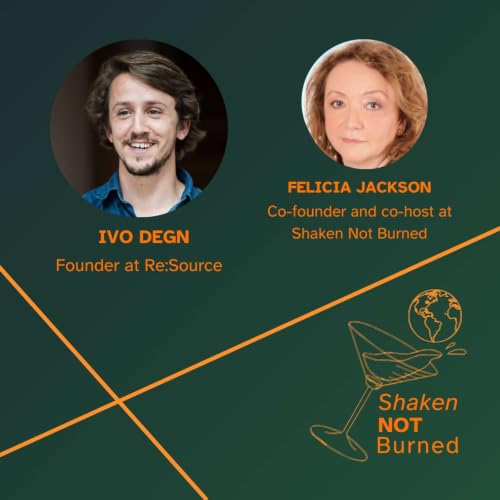
    This week, Felicia talks to Ivo Degn, co-founder of Climate Farmers and founder of Re:Source, about why agricultural change depends on more than farming practice alone, and what a regenerative food system actually looks like. They discuss measurement, place, markets, infrastructure and the tension between efficiency and resilience.

    Ivo also makes an unexpected case for the global commodity food system: its ability to move supply around is a major strength. But more resilient regional systems may require local capacity that looks inefficient when everything is working normally.

    The conversation ends with a practical question: what has to exist in a place for different choices to become possible — and last?

    This is the third interview in our agriculture arc. We started with Philipp Lukas and the connections between farm economics, energy and crop rotations; then Richard Zaltzman looked at the markets and infrastructure that make different choices viable. Next week, Giulia and Felicia step back and ask what the three conversations add up to — and what transforming agriculture actually requires.

    If you'd like to support our work, you can make a small donation at https://buymeacoffee.com/shakennotburned. And if you haven't already, subscribe to our newsletter and follow us on LinkedIn, TikTok and Instagram – and why not spread the word with your friends and colleagues?

    Mostra di più Mostra meno
    49 min
  • What makes changing farming possible? With EIT Food
    Oct 15 2026

    We often talk about changing farming as though the main question is what farmers should do differently. But a farm sits inside a much bigger system.

    In this week’s episode, Shaken Not Burned co-host Felicia talks to Richard Zaltzman, chief executive of Europe's food innovation community EIT Food, about the impact of that system. It starts with the idea of a landscape: not just a collection of farms, but the buyers, processors, financiers, insurers and other businesses that shape what farmers can actually do.

    They discuss the problem of matching future supply with demand, sharing risk, creating markets for crops that are useful in a rotation but hard to sell, and why local processing and other forms of market infrastructure matter. Richard also argues that some of the investment needed for agricultural transition may sit outside the farm gate, in the infrastructure connecting production to markets.

    And if every place is different, what does it actually mean to scale change?

    This is the second episode in our agriculture arc. Last week, we spoke to Philipp Lukas at Future Biogas about the economics of farming. Next week, we talk to Ivo Degn at Re:Source to take that question one stage further: if changing individual farms doesn’t add up to changing the food system, where does transformation actually have to happen?

    If you'd like to support our work, you can make a small donation at https://buymeacoffee.com/shakennotburned. And if you haven't already, subscribe to our newsletter and follow us on LinkedIn, TikTok and Instagram – and why not spread the word with your friends and colleagues?

    Mostra di più Mostra meno
    41 min
  • Changing the economics of farming with Future Biogas
    Oct 8 2026
    Food security is back on the agenda. In recent years, disrupted supply chains, war, extreme weather and volatile energy and fertiliser prices have all shown how quickly problems elsewhere can affect what food is available, where it comes from and what it costs.At the same time, there are growing concerns about the condition of the system producing that food: climate risk, declining soil health, water stress, emissions and biodiversity loss. Unfortunately, that’s where the conversation often narrows: we identify problems with the food system and then very quickly arrive at a list of things that farmers should do differently.It’s almost as though the main challenge is persuading farmers to do something different. But wanting to change and being able to change are not the same thing. Farmers need to cut emissions, improve soils, use fewer inputs, protect biodiversity and become more resilient to a changing climate. Depending on who you ask, they may also need to grow different crops, adopt new technologies or change the way they manage their land.How much can a farmer actually change if everything around the farm – markets, infrastructure, finance, supply chains and policy – continues to reward the existing system? In this week’s episode, the first one in our arc focused on agriculture, Felicia talks to Philipp Lukas, founder and chief executive of Future Biogas, which currently operates 11 large biogas plants across eastern England. It recently opened what it describes as the UK's first unsubsidised biomethane plant, where its agreement with AstraZeneca gives that gas a commercial buyer, while the crops feeding the plant are grown as part of local farm rotations and the nutrients are returned to the land. The company sits in an unusual place between farming and energy. Its anaerobic digestion plants take crops grown as part of farm rotations and turn them into biomethane for the gas grid, while returning nutrients to the land. What makes Future Biogas interesting is not simply the technology, but the connections it creates between things we usually treat separately. Biomethane isn't an answer to all of farming's problems. But it is an example of what can happen when something that is good for the soil also has a customer, when waste becomes an input, and when a farm can earn money from its connection to another part of the economy. That matters because many of the things we now want from farming – healthier soils, lower emissions and greater resilience – involve cost or risk somewhere along the way.The discussion covers how anaerobic digestion can give farmers a new market for crops grown in rotation, return nutrients to the land and produce biomethane for the gas grid — and what this tells us about a bigger question: if we want farmers to make different choices, do we also need to change the economics around those choices?If you'd like to support our work, you can make a small donation at https://buymeacoffee.com/shakennotburned. And if you haven't already, subscribe to our newsletter and follow us on LinkedIn, TikTok and Instagram – and why not spread the word with your friends and colleagues?
    Mostra di più Mostra meno
    57 min
  • The price of uncertainty: who pays when risk becomes reality?
    Oct 1 2026

    Insurance is supposed to protect us from risk. But what happens when the risks themselves are changing?

    Risk doesn't disappear because we fail to recognise or price it. Decisions that make sense individually — pumping more groundwater during a drought, building another housing development, keeping water prices low — can accumulate until environmental change becomes economic loss.

    Insurance is one of the places where that loss becomes visible. Insurers pay some of the bill; the rest falls on households, businesses and governments. As risks increase, premiums can rise, terms can tighten and some things can become difficult to insure at all. But the outcome isn't fixed: insurers look not only at the physical event, but at what's exposed to it and how vulnerable it is. We may not be able to stop a flood or an earthquake, but building standards, flood protection, healthier ecosystems and other forms of resilience can change how much damage they cause.

    That matters because insurance can be more than a way of paying for damage afterwards. It can signal where risk is building, encourage measures that reduce vulnerability and, through insurers' role as investors, help finance some of the resilience that makes future economic activity possible.

    In the final episode of our insurance arc, Felicia and Giulia bring together conversations we had in the previous three episodes with Robert Johnston of Clark University, Regula Hess of WWF, and Rachel Delhaise of Convex to explore what insurance can tell us about the changing relationship between environmental and economic risk.

    From water and the insurance protection gap to rising premiums, resilience and the limits of insurability, they ask a deceptively simple question: do we invest in reducing risk now, or pay for the damage later?

    If you enjoyed this episode, subscribe to our newsletter and follow us on LinkedIn, TikTok and Instagram – and why not spread the word with your friends and colleagues?

    Mostra di più Mostra meno
    30 min
  • How do you make the future insurable? With Convex Insurance
    Sep 24 2026

    What makes something insurable — and what happens when the risks change?This week on Shaken Not Burned, Felicia talks to Rachel Delhaise, group head of sustainability at Convex Insurance, about how insurers deal with a changing and uncertain climate.

    As climate risks grow, insurance can become more expensive or harder to find. But that doesn’t necessarily mean the risk has simply become uninsurable. Better climate science and modelling can change how risk is understood and priced; resilience can reduce potential losses; and new financial structures can change how risk and cost are shared.

    Rachel explains why insurers want to insure, how insurance can act as a signal that underlying risks need to be addressed, and how insurers can use their investment capital to help build resilience, creating what she calls a cycle of insurability.

    Climate change is altering the hazards we face, but it doesn't determine everything that happens when they hit. Where and how we build, what we protect and where we invest can change the outcome.

    And underwriting and investment aren't the only ways insurers can contribute. They can also support the science that helps us understand what is changing and what we might do about it. Convex, for example, funds the Convex Seascape Survey, a five-year global research programme investigating the huge but poorly understood store of carbon in seabed sediments — including what happens when those sediments are disturbed and whether protecting them could help keep that carbon locked away. We previously spoke to the programme's lead scientist Callum Roberts about what they're discovering and why it matters. Listen to that conversation here

    This is the third episode in our arc on the changing economics of risk. In the first, our conversation with Dr Robert Johnston explored how risk can build through decisions that make sense individually but add up to something much more damaging — and why failing to recognise the full cost doesn't make it disappear. Last week, Regula Hess of WWF joined us to look at what happens when that risk becomes loss, the insurance protection gap, and who pays when insurance covers only part of the bill.

    Next, Felicia and Giulia bring the conversations together to ask what they tell us about where risk comes from, who ultimately pays for it, and what we can do to change the outcome.

    If you enjoyed this episode, subscribe to our newsletter and follow us on LinkedIn, TikTok and Instagram – and why not spread the word with your friends and colleagues?

    Mostra di più Mostra meno
    42 min
  • When insurance isn’t enough: WWF and the insurance protection gap
    Sep 17 2026

    When disaster strikes, insurance may pay some of the bill. But who pays the rest?

    This week on Shaken Not Burned, Felicia Jackson talks to Regula Hess, deputy head of WWF Switzerland, about the growing insurance protection gap — and why it matters far beyond the insurance industry.

    When losses aren't insured, they don't disappear. They fall on households, businesses and governments, affecting everything from mortgages and investment to public finances and the speed at which communities recover.

    But WWF argues that simply expanding insurance isn't enough. Insurance can spread the cost of disasters; it can't stop the underlying risk from growing. That means reducing risk too — including protecting the forests, wetlands and other natural systems that can reduce damage before it happens.

    Regula describes insurance as an early warning system: when risks become unaffordable or increasingly difficult to insure, perhaps we should pay attention to what that is telling us.

    There is, of course, an obvious question. If preventing damage makes so much sense, why aren't we doing more of it? Part of the answer is that prevention is difficult to see. Yet research cited by Regula found that every dollar invested in climate resilience and preparedness can save communities up to $13 in damages, clean-up and wider economic costs. Which is why her description of insurance as an early warning system stayed with us.

    When insurance becomes unaffordable, or risks become too large or unpredictable to insure, it is telling us something. Not simply that there's a problem with insurance, but that the underlying risk is getting out of hand. Perhaps the real protection gap isn't just between what we lose and what insurance pays — it's between the risks we're creating and what we're doing to prevent them.

    This episode is the second in our latest Shaken Not Burned arc on the changing economics of risk.

    Last week, our conversation with Dr Robert Johnston explored how water risk can build through decisions that might make sense individually, but can add up to something much more damaging. And why failing to recognise the full cost of those decisions doesn't make the cost disappear.

    As part of the series, we will also speak to Rachel Delhaise from Convex about the insurance market itself and what happens when a changing climate makes the past a less reliable guide to the future.

    Finally, co-hosts Felicia and Giulia will put the conversations together and ask what they tell us about where risk comes from, where the costs eventually end up, and what choices we still have before they do.

    If you enjoyed this episode, subscribe to our newsletter and follow us on LinkedIn, TikTok and Instagram – and why not spread the word with your friends and colleagues?

    Mostra di più Mostra meno
    44 min