Shaken Not Burned copertina

Shaken Not Burned

Shaken Not Burned

Di: Felicia Jackson and Giulia Bottaro
Ascolta gratuitamente

Offerte di stagione | 0,99 €/mese per i primi 3 mesi

A seguire 9,99 €/mese – si applicano condizioni. Puoi disdire mensilmente.
A proposito di questo titolo

Shaken Not Burned is the podcast that helps you make sense of sustainability. We unpack the big debates shaping climate, business, food, and society: debunking myths, clarifying trade-offs, and sharing ideas you can actually use to think, decide, and act in a changing world.

© 2026 Shaken Not Burned
Economia Politica e governo
  • Why is it so hard to get rid of single-use plastic? With I'm Plastic Free
    Nov 5 2026

    Plastic is embedded in almost every everyday consumer product. It packages our cosmetics, holds our cleaning sprays, and lines our personal care items. It is light, waterproof, and cheap, making it the default choice for fast-moving consumer goods.

    However, the vast majority of these plastic-wrapped products are designed to be used for just minutes, leaving behind a legacy of waste and microplastics that lasts for centuries.

    This week’s episode, the first of our arc dedicated to plastic as a systemic issue, dives into a crisis that goes far beyond overflowing landfills: a crisis that is now showing up inside our own bodies in the form of microplastics. How do we finally start to deal with the problem at the source, rather than relying on band-aid solutions such as recycling?

    Co-host Giulia Bottaro sits down with Simona Paganetto, founder of I'm Plastic Free, to discuss how product design is shifting, why consumer demand for plastic-free alternatives is skyrocketing, and why reducing our dependence on disposable plastic is not the responsibility of consumers alone.

    Multinational brands scaled rapidly by taking advantage of cheap, linear plastic packaging while externalising the costs of waste management and cleanup onto taxpayers and local communities. But the market dynamics are shifting: as microplastics become a recognised human health concern, brand reputation is on the line. Consumers are demanding greater material transparency and actively switching to products with zero-waste packaging.

    Swapping everyday items for plastic-free, circular alternatives cuts down on landfill waste and prevents microplastics at the source. This is crucial because while recycling managed plastic waste plays a role, less than 10% of global plastic is actually recycled; and recycling does not solve microplastic shedding.

    True progress relies on upstream design choices: rethinking how consumer products are formulated, packaged, and distributed before they ever reach the store shelf. Meanwhile, if we have the means to make plastic-free choices as consumers or business owners, there are a plethora of solutions already available on the market.

    If you'd like to support our work, you can make a small donation at https://buymeacoffee.com/shakennotburned. And if you haven't already, subscribe to our newsletter and follow us on LinkedIn, TikTok and Instagram – and why not spread the word with your friends and colleagues?

    Mostra di più Mostra meno
    30 min
  • Why changing how we farm isn't enough
    Oct 29 2026

    A summer of extreme heat and drought cut forecast European grain production by 16.7 million tonnes — worth around €3.2 billion at current prices.

    It is a stark reminder of how quickly climate shocks can expose vulnerabilities in food supply. But when crops fail or farmers struggle, the question often becomes: how can farmers do things differently?

    The answer from our agriculture series is: they can’t — at least, not alone.

    In our last three episodes, we focused on agriculture, looking at the tools and technologies transforming the field. We heard from Philipp Lukas (Future Biogas) on how farm economics can change when crop rotations, energy and new revenue streams connect, Richard Zaltzman (EIT Food) on the markets, processing, finance and infrastructure that can make different choices viable, and Ivo Degn (Re:Source) on what a regenerative food system looks like when there is no single model that will work everywhere.

    In this week’s episode, co-hosts Felicia Jackson and Giulia Bottaro bring those conversations together.

    Farmers make choices, but those choices are shaped by markets, contracts, finance, processing, infrastructure, policy and demand. So the question is not simply why farming isn’t changing, but what has to be in place for different choices to make sense.

    The conversation also explores the tension between efficiency and resilience: what capabilities do we want to retain even when they look inefficient in normal times, and who should pay for them?

    Because transforming agriculture is not simply about changing farming practices but changing the system around it. It means asking who benefits, who pays and who carries the risk — and how we build a food system in which different choices can actually work.

    If you'd like to support our work, you can make a small donation at https://buymeacoffee.com/shakennotburned. And if you haven't already, subscribe to our newsletter and follow us on LinkedIn, TikTok and Instagram – and why not spread the word with your friends and colleagues?

    Mostra di più Mostra meno
    41 min
  • Building a regenerative food system with Re:source
    Oct 22 2026

    We know that agriculture needs to change. But what if changing what happens on individual farms doesn’t change the food system around them?

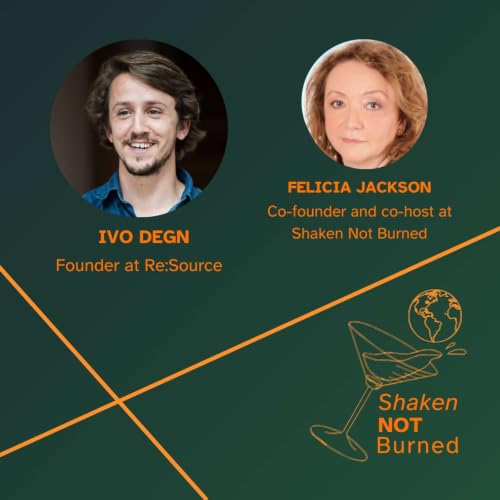
    This week, Felicia talks to Ivo Degn, co-founder of Climate Farmers and founder of Re:Source, about why agricultural change depends on more than farming practice alone, and what a regenerative food system actually looks like. They discuss measurement, place, markets, infrastructure and the tension between efficiency and resilience.

    Ivo also makes an unexpected case for the global commodity food system: its ability to move supply around is a major strength. But more resilient regional systems may require local capacity that looks inefficient when everything is working normally.

    The conversation ends with a practical question: what has to exist in a place for different choices to become possible — and last?

    This is the third interview in our agriculture arc. We started with Philipp Lukas and the connections between farm economics, energy and crop rotations; then Richard Zaltzman looked at the markets and infrastructure that make different choices viable. Next week, Giulia and Felicia step back and ask what the three conversations add up to — and what transforming agriculture actually requires.

    If you'd like to support our work, you can make a small donation at https://buymeacoffee.com/shakennotburned. And if you haven't already, subscribe to our newsletter and follow us on LinkedIn, TikTok and Instagram – and why not spread the word with your friends and colleagues?

    Mostra di più Mostra meno
    49 min
adbl_web_anon_alc_button_suppression_t1
Ancora nessuna recensione