Episodi

  • We Got Exactly What We Asked For!
    Sep 24 2026

    Send us Fan Mail

    An article about beef’s long push for eating quality got me fired up about pork. I started with a sharp critique of the industry—then realized I was handing the work of change to everyone else.

    In this bonus episode from The Patio, I look at what The Other White Meat accomplished, the lean pig we deliberately created, and the choices that could make pork worth seeking out for its own eating quality. I was part of that pursuit of leanness. Now I think we need to invest in marbling, color, and a better experience on the plate.

    Change takes decades. We’d better get started.


    Be Safe Out There.

    Mostra di più Mostra meno
    10 min
  • The Customer Is Not Always Right!
    Sep 22 2026

    Send us Fan Mail

    Karl Shlagel joined me from the cab of a tractor while spraying pumpkins on his family’s fourth-generation farm near Waldorf, Maryland. The connection occasionally fought us, the tractor kept moving, and the conversation zigged and zagged—which made it feel right at home on the Patio.

    Karl’s family grows fruits and vegetables that they sell wholesale, at farmers markets, through an on-farm store, and directly to consumers. While much of agriculture talks about what consumers want, Karl meets them face-to-face, and he has learned that we cannot assume we know what they value, what they can afford, or what they are willing to buy.

    We talk about growing the farm business so another generation can return, why profitable farms are the best form of farmland preservation, and the institutional knowledge that can disappear when succession planning comes too late. Karl also explains why Southern Maryland’s attachment to tobacco may have prevented agriculture from adapting sooner.

    The conversation moves into food safety, wildlife pressure, direct marketing, Farm Bureau leadership, and the difficult balance between respecting those who built an organization and creating room for new people and new ideas.

    Karl is candid, opinionated, and willing to challenge one of the most dangerous phrases in any business: “This is what we’ve always done.”

    This is a raw conversation recorded in the middle of a working day; exactly the kind of conversation the Patio was built for.

    Be Safe Out There.

    Mostra di più Mostra meno
    1 ora e 15 min
  • Did It Make Money?
    Sep 15 2026

    Send us Fan Mail

    Farmers have never had more information available to them. But more data does not automatically lead to better decisions.

    Dale Durchholz has spent nearly five decades studying agricultural markets, analyzing data, and helping farmers make decisions when certainty is impossible. Dale joins Jim on the Patio to discuss what makes data trustworthy, why farmers sometimes accept bullish numbers while rejecting bearish ones, and what a career in the markets has taught him about being right, being wrong, and managing emotion.

    Their conversation moves beyond USDA reports and price projections into farmer responsibility, marketing decisions, diversification, and the importance of building mental security into both a farm business and a life.

    Because the question is not simply whether a decision proved perfect. Sometimes the better question is: Did it make money?

    Until next time, be safe out there.

    Mostra di più Mostra meno
    1 ora e 16 min
  • Why People Should Care
    Sep 8 2026

    Send us Fan Mail

    Sean Arians and I have known each other for years through Ag Twitter, farming, and our work in agriculture. But it took a conversation while I was traveling to Philmont Scout Ranch for us to discover another connection: Sean had experienced Philmont as both a Scout and an adult leader.

    We begin with Philmont, resilience, and the leadership lessons learned when a group must reach the finish line together. From there, the conversation moves through community, knowing when to say no so someone else can say yes, making room for younger leaders and women in agriculture, Sean’s path through farming and the agricultural industry, and his newest challenge: becoming a pilot.

    We eventually arrive at a larger question. Why should people care about agriculture? Sean argues that agriculture touches far more lives, careers, businesses, and communities than most people recognize. Our responsibility is to

    Be safe out there.

    Mostra di più Mostra meno
    1 ora e 21 min
  • When Is Enough Enough? | John Kowalchuk
    Sep 1 2026

    Send us Fan Mail

    Jim expected a conversation about the differences between farming in Canada and the United States. Instead, he and central Alberta farmer John Kowalchuk kept finding the things farmers have in common.

    They talk about the financial pressure facing agriculture, the perpetual optimism that can make farmers resilient and sometimes get them into trouble, and what happens during those long hours alone in the tractor when productive thinking can turn into simply being stuck in your own head.

    The conversation eventually moves to John's years of sharing farm life on social media. Why show the broken combine along with the good crop? What responsibility comes with having an audience? Can the people following you become accountability partners? And when thousands of followers are possible, what does meaningful influence actually look like?

    John also explains the story behind #RegularFarmer and why being comfortable as a "regular farmer" can be harder than it sounds. That leads Jim and John into competition between farmers, farm size, success, retirement, and a question that doesn't get asked very often in agriculture:

    When is enough enough?

    Different countries. Different crops. Different governments and currencies.

    But maybe a regular farmer in Alberta isn't all that different from a regular farmer in northeast Indiana.

    Be Safe Out There!

    Mostra di più Mostra meno
    1 ora e 24 min
  • Be Safe Out There - Cory Ritter
    Aug 25 2026

    Send us Fan Mail

    Cory Ritter and I go back to the early days of Ag Twitter and something called Cory Corn. Today, Cory farms near Blue Mound, Illinois, and works as Midwest Regional Sales Manager for Huma.

    We started this conversation pondering what farmers are getting wrong, why comfort can keep us from changing, what Cory Corn taught him about social media, and how being a farmer influences the way Cory approaches sales.

    Then the conversation turned.

    Our conversation happened on the one-year anniversary of the grain-bin accident that killed Cory's father and farming partner, Tom. Cory talks openly about the accident, the questions he still carries, nearly walking away from farming, and the neighbors who showed up with more than a dozen combines to help his family harvest their crop.

    We also talk about what happens when farm succession comes without warning, why families need to have uncomfortable conversations before they are forced to, and what Cory has changed on his own farm after losing his dad.

    This conversation goes places neither of us expected. Cory wrestles openly with anger, responsibility, the risks we convince ourselves we can handle, the people who show up when everything changes, and the unfinished work of figuring out how to move forward. Along the way, both Cory and I shed tears. Some of these things are difficult to put into words.

    Cory leaves us with a simple message worth remembering as harvest approaches:

    Be safe out there.

    Mostra di più Mostra meno
    1 ora e 22 min
  • EPISODE 100: The Other Side of the Patio
    Aug 18 2026

    Send us Fan Mail

    For 99 episodes, I've been the one asking the questions.

    For Episode 100, I switched chairs.

    When I started planning this episode, I knew I didn't want to do the typical retrospective of favorite guests, favorite moments, or lessons learned. I wanted to do something different.

    So I invited three previous Patio Pondering guests back to the patio and asked them to interview me.

    Grant Hood, Andy Vance, and Amber Hoopengardner Foote each came with their own questions. Just like my typical guests, I didn't know what they were going to ask.

    And they took the conversations in three very different directions.

    We talked about how Patio Pondering has changed over 100 episodes, what I've learned about asking questions and listening to the answers, agriculture, careers, opportunities, relationships, and how some of my own thinking has changed along the way.

    This isn't really a retrospective of the first 100 episodes.

    It's three conversations about what happened along the way.

    Welcome to Episode 100 and The Other Side of the Patio.

    Mostra di più Mostra meno
    2 ore e 12 min
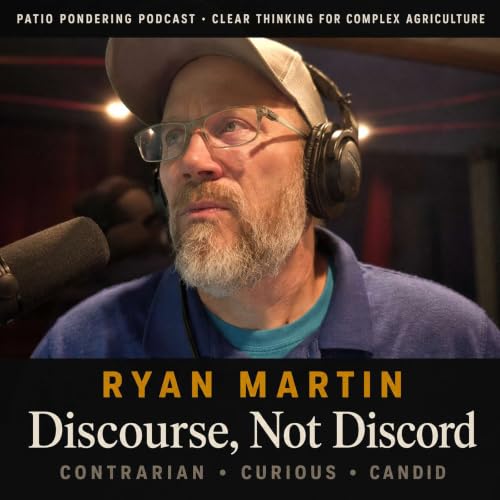
  • Discourse, Not Discord with Ryan Martin
    Aug 11 2026

    Send us Fan Mail

    Ryan Martin has never been particularly afraid to say what he thinks, even when his opinion runs against conventional wisdom.

    Ryan is a meteorologist, grain originator, farmer, seed salesman, and one of the two people who encouraged me to start the Patio Pondering Podcast. So, with Episode 100 right around the corner, it seemed appropriate to finally invite him onto the patio for Episode 99.

    What followed wasn't really a conversation about weather.

    We talked about why agriculture struggles with uncertainty, our fear of being wrong, what failure actually means, how farming has changed Ryan's perspective, and why relationships may matter more than we sometimes admit. We wandered into farmers advertising themselves, the changing scale of agriculture, opportunities for the next generation, and whether we spend too much time protecting the status quo.

    But one idea kept resurfacing: listening.

    Ryan believes good conversations require us to hear what someone is actually saying, even when we disagree. Near the end, he put it another way: agriculture needs more discourse, not discord.

    That's probably a pretty good description of what we try to do here on the patio.

    Join Ryan Martin and me for a conversation about agriculture, relationships, uncomfortable questions, and the value of occasionally being willing to admit we might be wrong.

    Mostra di più Mostra meno
    1 ora e 18 min