Episodi

  • Human Physical Intelligence vs. Artificial Compute
    Aug 17 2026
    Line edited by AI for show notes, article format, or transcript publishing. The Adoption Gap: Why Tech Misunderstands Human Friction People in tech often fail to understand adoption friction—why some people hesitate around AI while others embrace it. Having spent my career as a physical therapist, athletic trainer, and personal trainer, my clinical perspective is rooted entirely in human development and human systems. I've spent my life studying the intelligence of the human condition, but I realized early on that many people pay little attention to their physical bodies until they experience pain. Pain, Adaptation, and the Limits of Medicalization: Witnessing my father's chronic pain showed me how easily someone can become trapped in an identity of suffering—living through a diagnosis rather than organic reality. In healthcare, if you seek out enough doctors, someone will always find a structural flaw to treat. Statistically, about 30% of asymptomatic individuals walking around today have disc herniations on an MRI without any pain complaints. As long as we adapt and move, our natural intelligence works around structural variations. Movement is how we physically adapt. Optimization vs. Replacement: Entering the AI Landscape My background in movement and rehabilitation was always about bridging broken states to optimized states. When AI entered the cultural conversation, my interest was not about monetization, but about how "intelligence" was being defined. Tech initially pitched AI as a healthcare revolution before abruptly pivoting to marketing and large language models. Drawing on my background in human systems and integrated mathematics, I saw the parallel immediately: computing relies on binary logic, whereas human intelligence integrates non-verbal symbols, physical vectors, and somatosensory feedback. Kinetic Learning and the Language of Movement: Human learning is deeply physical. As a dancer, I learned not by analyzing verbal instructions, but by embodying rhythm and tone. Premier dancers are kinetic, physical learners. The human body possesses an innate capacity to convert complex rhythmic and physical inputs into movement without needing analytical breakdown. Tech Leaders and the Stunting of Physical Intelligence: The current enthusiasm for AI among engineers often stems from a lack of physical embodiment. Many modern tech leaders grew up trapped in cognitive, left-brain analysis, resulting in stunted physical intelligence. Instead of building compute to match the vast complexity of organic human design, tech developers reduce human function down to narrow computational fractions. When observing figures like Bill Gates, Elon Musk, or Sam Altman, their high cognitive intelligence exists alongside a clear disconnect from physical embodiment and interoception. Their products reflect this limitation, pushing ideologies that treat human friction as a flaw to be engineered away rather than an essential variable for growth. The High Cost of Bypassing the Body: When we fail to invest in organic human intelligence, we default to digital externalization, handing over critical thinking to machine learning analytics. We see extreme examples among tech elites who attempt to bypass aging with biometric gadgets and drastic interventions while remaining disconnected from their basic biological ecology. Historically, 80% of human communication is non-verbal, and our foundational health operates within that non-verbal, somatic baseline. By forcing human existence to conform strictly to linear, left-brain productivity metrics, we stop moving, we stop playing, and we perform thin layers of cognitive intelligence that aren't even ours. Reclaiming Organic Systems: The Cell as an LLM Every cell in your body contains a biological "large language model," with your organ systems operating as integrated processing networks. We have yet to fully understand or integrate our right-brain intelligence, let alone our full somatic design. Automating or replacing these organic networks with artificial interfaces—like connecting brain tissue directly to synthetic compute—overlooks the systemic reality of the whole organism. Community Health and Small Health Practices: As legacy healthcare systems collapse under top-down corporate weight, the solution is not waiting for institutional failure. The path forward lies in small health practices, private clinicians, social workers, and community health networks. By reclaiming physical movement, natural intelligence, and human systems integration, we ground well-being back where it belongs: in the human body and the local community. Human Systems & AI Ethics: Human Systems Integration, Human Architecture, AI Ethics, AI Adoption Friction, Natural Intelligence vs Artificial Intelligence, Relational Intelligence, Human Friction, Somatosensory Intelligence, Kinetic Learning Clinical & Movement Science: Physical Therapy, Doctor of Physical Therapy, Athletic Training, Human ...
    Mostra di più Mostra meno
    30 min
  • Be A Human in US Healthcare Today
    Aug 20 2026

    Line edited by Gemini for show notes, article format, and transcript publishing.because my ADHD and Systems thinking Polymath tendencies have a hard time expressing bite sized chunks.

    I have been diving into The Reality of the US Healthcare Illusions for decades but this August I am reflecting on where the human side of health systems is at risk of getting very lost inside the AI adoption processes going on. What I have found is that the more I dive into how Big Tech is thinking about the needs of humans, the more I am realizing these people making major decisions just seriously do not understand humans outside of the left hemisphere of our brains.

    This can be a sobering exercise and I am not really sure I have the emotional capacity to complete the intended 90 days if dismantling syntax I wanted to introduce into the ethos here and on my this show's Substack.

    Why?

    Because Coming from a background in human performance, sports therapy, and physical therapy, I actually am both intrigued and in love with the max potential of humans. In my studies and my life, I was granted access to every educational and professional opportunity. Like many Gen X women, I entered the workforce assuming parity with my male peers.

    However, entering motherhood revealed the profound structural biases built into American healthcare and corporate life. Three months of saved leave—even while navigating postpartum depression—was structurally inadequate. That personal turning point exposed the stark gaps in women's health and shifted my trajectory permanently.

    Pain, Trauma, and the Gaps in Big Health In the late 1990s, while treating chronic pain patients alongside pioneers like Dr. John Sarno, the intersections of my personal life and career converged. I recognized that traditional allopathic models were fundamentally failing women.

    My mother's experience with ovarian cancer—and her ultimate passing due to systemic care mismanagement and clinical detachment—highlighted how gender bias, cultural marginalization, and institutional stress dictate health outcomes. Legacy hospital systems, trapped in 7-to-14-minute transactional appointments, routinely mistake metric management for human care.

    The Upstream Escape: Cash Practice and Community Health To fill these systemic gaps, I was forced to move upstream, stepping away from the New York metropolitan corporate mindset to build cash-based boutique models, peer mentorship networks, and integrative wellness practices.

    Many high-performing clinicians leave legacy institutions during their professional prime not to retreat, but to build sustainable environments where care is guided by the social determinants of health rather than industrial quotas. Traditional healthcare models failed my family, and without proactive alternatives, they will continue to fail future generations.

    AI, Big Tech, and the Misunderstanding of Machine Learning Today, as AI transforms healthcare, the dominant narratives are controlled by Big Health and Big Tech, both framing artificial intelligence strictly around margin expansion and operational speed.

    Clinicians must understand the underlying principles: Machine Learning (ML) in technology maps directly to motor learning in human neurology. AI encompasses voice recognition, large language models, and predictive algorithms, yet decision-makers in Big Tech continue to apply linear logic to non-linear biological and social organisms. Delegating complex human friction to automated infrastructure will not fix systems that were broken by design.

    Allopathic Hegemony and the Power of Community Care Understanding modern health dysfunction requires examining its history, as detailed in The Social Transformation of American Medicine. Allopathic medicine historically fragmented the human body into isolated specialties, suppressing community-based care models that drive true public health.

    As the institutional medical complex faces systemic strain—evidenced by clinician burnout, insurance friction, and mass coverage drops—the response cannot be adopting white-labeled tech stacks or fleeing into luxury concierge medicine.

    The Path Forward for Independent Clinicians The future of sustainable care does not belong to corporate healthcare conglomerates or social media algorithms. It belongs to independent clinicians, allied health professionals, and small community health practices.

    I end this episode talking about how we can change the narratives around AI and preserve human systems that promote our health. By taking control of how AI is integrated at the grassroots level, practitioners can protect human-to-human relational intelligence, build resilient practice models, and maintain true ethical stewardship over patient care. xoxo- Dr Lissette Alvarez-Holland

    Mostra di più Mostra meno
    36 min
  • Bypassing Human Friction for Artificial Control
    May 21 2026
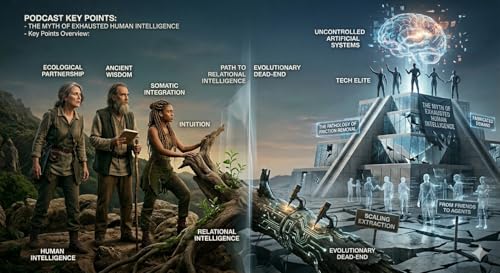
    Key Points Overview
    • The Refusal of Evolutionary Integration: Evolutionary dead-ends historically occurred when hominids prioritized dominance and self-deification over ecological partnership. Silicon Valley is repeating this trajectory by attempting to engineer a technology that bypasses our biological and spiritual ecology.

    • The Pathology of Friction Removal: Technological evolution over the last two decades has been an ongoing effort to codify and institutionalize individual social discomfort. Major platforms were explicitly built to redefine human connection into controllable, digital interfaces to avoid the friction of real psychological maturity.

    • The Linguistic Shift from Humans to Agents: The evolution of the digital landscape has deliberately shifted vocabulary from organic concepts like "friends" to artificial entities like "agents." This vocabulary tracks a corresponding removal of relational intelligence and authentic human presence.

    • Fabricated Demand and Psych-Ops Economics: By merging technical logic with hyper-capitalism, tech monopolies abandoned the traditional parameters of supply and demand. Instead, they weaponized psychological operations and advertising playbooks to fabricate human deficits, scaling extraction under the banner of "innovation."

    • The Myth of Exhausted Human Intelligence: The tech elite operates on the arrogant assumption that humanity has exhausted its understanding of its own internal technologies (intuition, somatic integration, ancient wisdom). This premise justifies the reckless rollout of uncontrolled artificial systems before our own psychological and governance models have matured.

    Own a health clinic or care business and confused about this AI in Human risks and Healthcare talk???

    I write a Substack and have another podcast focused on exploring the future of healthcare work, human sustainability, and how health leaders get to redesign and redefine community health in the AI era. Subscribe HERE.

    Mostra di più Mostra meno
    53 min
  • Why Allied Health (Not AI or Tech Platforms) Will Restore Trust in Healthcare
    Aug 3 2026
    Welcome back to Episode 105. This is a short 10 min episode where I am throwing out some ideas and asking for some feedback. Feel free to comment on my Linked in or Substack. I've really been considering putting out a daily show—whether live or pre-recorded—about how we navigate this new era. Make no mistake, this is an era defined by the mass adoption of AI and health tech. My thoughts on this began over the weekend when much to my heartbreak, I saw two gambling invitations on my feeds and then was reminded what is going on with the mass exodus of nursing. I can't be the only one to see a lot of gamification starting up as a good way to "engage" people. This is completely under the radar of public health's challenges with mental addictions. The concern I have is that most addictions start with tiny, tiny dopamine hits, and gamification of online group challenges do that. The resistence is being hit young and in sneaky fun ways that do not need you to have a big mindful snort of a drug while sitting inside a casino. This is now the US losing the plot between entertainment and normalizing full out mental illnesses and sociopathies. It got me thinking of my children and the evolving alliance between corporate health and tech. I really hate the money side will actually ignore why we have open nursing slots at all, as we enter the nurse shift bidding wars. As I sit here examining the shifting definitions of health—specifically here in the US—I keep coming back to one truth: our digital footprint is all we have left. It is our modern hieroglyphics. I'm thinking deeply about how we can proactively influence the data being scraped, harvested, and gathered right now. Recently, I've been helping professionals navigate brand protection and IP. But protecting your IP isn't enough anymore. We need boots on the ground—soldiers, if you will—getting out here and just being openly, unapologetically human. People are rapidly losing the ability to tell what's real and what's synthetic. This isn't about starting a war with technology; it's about introducing a variable that the system did not anticipate coming: genuine human presence. When I look at where healthcare is heading, it's clear there is a systemic, societal illness at play. We are watching human systems break down. Yesterday on LinkedIn, I posted about a disturbing trend where new platforms have nurses literally bidding against each other for shifts—bragging that they are the "Uber of nursing." Is this really what we want? We are introducing gamification and bidding dynamics into healthcare in a society that already struggles massively with addiction. It's gambling, plain and simple. If you don't know my background, human systems have always been my passion. Years ago, I opened one of the first cash-based boutique physical therapy practices in the nation, housed inside an integrative yoga therapy center. I didn't do it to be "first." I did it because no traditional clinic—where I worked as a physical therapist and certified athletic trainer—understood what I was trying to say about active women, stress, and the mind-body connection. Early on in New York City, I was treating patients sent directly from Dr. John Sarno, author of Healing Back Pain, who pioneered the mind-body approach to chronic pain. I was working with Broadway dancers in Manhattan, learning from elite facilities like Kessler (where Christopher Reeve rehabilitated), and serving as a lead student athletic trainer back at Hofstra University in 1994. From young dancers to collegiate athletes, the lesson was always the same: performance, recovery, and longevity require keeping the athlete's mind in the game. Eventually, I saw the stark split—the total bifurcation—between traditional medicine and true health. Because I saw where the industry was going, and because I was a woman who wanted to raise my kids in my 20s and maintain true autonomy over my career, I built a portfolio career. Traditional medicine in this country wasn't built to support that level of independence or holistic thinking. Looking at where we are today, I'm not trying to "save" corporate medicine. Medicine in the U.S. is severely broken, and its core incentives were misaligned from the start. But community health? Community health has a massive opportunity right now. Trust in institutional medicine has completely collapsed—compounded by political division, pandemic burnout, and the atrocious way hospital systems treated their own frontline workers. Now, corporate health tech is testing the waters with gamified nursing shift bids. Make no mistake: if they can do it to nursing, they will bring it to physical therapy, rehab, and outpatient clinics next. We're already seeing venture-backed platforms like Hinge Health and Sword Health enter the space, rolling out automated pelvic floor programs, direct-to-consumer blood panels, and at-home hormone kits. Here is the bottom line: allopathic physicians don't have ...
    Mostra di più Mostra meno
    9 min
  • We Didn't Forget to Design the System. They Just Never Designed It For Us.
    May 21 2026
    Full Summary (with Timestamps where available) (00:00:00 – 00:00:25) — Opening and Reframe: AI Care and the Systems We Forgot to Design Dr. Lisa opens as founder of MindBody Enterprises and situates the episode's focus: AI care and what happens when AI is being layered onto systems that were never properly built in the first place. She names this as the central problem — not AI itself, but the broken infrastructure it is being inserted into. (00:00:25 – 00:02:10) — Who She Is and Why She Pivoted: From Clinician to Systems Architect She reintroduces herself for new listeners: a clinician who moved into leadership development after seeing that the root problem wasn't individual patient outcomes — it was the systemic conditions preventing women in the care economy from doing their work sustainably. She closes the Belly Guru chapter and opens MindBody Enterprises specifically because she saw the design gap: not in what women were building, but in the fact that the larger system was never building for them. (00:02:10 – 00:04:15) — Third Wave Feminism and the Design Gap This is one of the episode's most pointed passages. She speaks directly to Gen X women who fought their way into institutions — got the career, got the paycheck, got the seat at the table — and then discovered it wasn't working. Not because they failed, but because they were trying to operate within a system designed around a different body, a different cycle, a different set of values. The system wasn't designed for them. Third-wave feminism got women in the room. Nobody redesigned the room. (00:04:15 – 00:06:30) — The Care Economy Was Always Being Designed — Just Not By the People in Charge She pushes back on the narrative that the care economy was forgotten or neglected by design. It wasn't forgotten — it was deliberately excluded. Women, community health workers, doulas, midwives, yoga therapists, peer providers: they have been designing and running systems of care for decades. The oligarchs of the 1920s — and their contemporary equivalents — were never building for those systems. They were building against them. She names the current political administration's nostalgia for the gilded age and the extractive economics of the 1800s as the most visible expression of this dynamic. (00:06:30 – 00:08:00) — What "Scaling" Actually Means for Women in Care She redefines scale for her audience. Scaling is not building a multi-million dollar enterprise. Scaling is optimizing your household, your small clinic, your nonprofit, your community. Women have been doing this for generations — in grandmothering, in volunteer work, in the horizontal networks of care that hold communities together. The problem is not that they haven't been scaling. The problem is that the larger system refuses to assign that work economic value. And they are now trying to plug AI into that same undervalued infrastructure and call it innovation. (00:08:00 – 00:10:30) — Bio-Spiritual Ecology, Ecological Economics, and the Curvy Hustle She names her frameworks explicitly: Bio-Spiritual Ecology, Ecological Economics, and the Curvy Hustle. These are not abstract concepts — they are the operational and philosophical architecture for building community health infrastructure that is regenerative rather than extractive. She traces the lineage from the Belly Guru's yoga for MS patients, to the Mind Over Body Pain work, to the Goddess Mastermind, to MindBody Enterprises — each iteration deepening her understanding of what it takes to build economic models that don't require women to choose between their values and their survival. (00:10:30 – 00:13:00) — Where She Works Now: The Intersection of Human Design, Community Health, and Technology Integration She names her current positioning clearly: her work sits at the intersection of human design, community health infrastructure, and what it actually takes to integrate technology without degrading people in the process. She gives the Oracle layoff — 20,000–30,000 employees waking up to a termination email at 6 AM — as the starkest current example of what happens when institutions treat technology as a replacement for human systems rather than an enhancement of them. That is not efficiency. That is extraction wearing the costume of innovation. (00:13:00 – 00:15:30) — The EMR Parallel: We Have Seen This Exact Playbook Before This section is clinically precise and historically grounded. She takes listeners back to 2011, sitting in a lunch meeting being trained on how to get five-star patient experience ratings using the Disney method — while drowning in paper charts, underfunded, and being told there was no budget for expanding maternal care access to the maternity floor. The EMR rollout was being sold as an efficiency tool while simultaneously adding documentation burden to clinicians who were already out of time. AI is being sold the same way today. The playbook is ...
    Mostra di più Mostra meno
    42 min
  • Beyond the Band-Aid: Bio-Spiritual Ecology and the New Syntax of the Care Economy
    1 ora
  • Allow Me To Reintroduce Myself
    Apr 1 2026
    Show Transcript: Approx 25 Min Total Episode. Watch on You Tube Lissette Holland Hey, hey, hey, Dr. Lisa here. So excited. After a two-year hiatus, for those of you who are new to owning her health, thank you very much for being here. Those of you who are not new and carrying over and watching this again, it's been two years, actually two and a half years. for this owning, you know, for my Owning Her Health podcast. And I wanted to come out today. This is a very intentional day, March 25th, 2026. I wanted to record it live because that's always when my energy, that's the best way for me to record these podcasts, the interactions, the conversations. So why are we returning now? Well, I wanted to one, reintroduce myself in this and explain that. So for those of you who don't know me, I'm a former clinician and I kind of came on the scene as the belly guru, but really through my mentoring, the belly guru was fairly local. It was a radical at the time 2005 coming in with a direct access boutique practice by by I wasn't even a doctor of physical therapy at that point. It was just a regular licensed physical therapist because the doctor didn't even come in till about 2000. We did not bring up the profession to a doctorate I think till about 2010 nine somewhere in there and then I did, I upgraded and went back to school and filled in all the gaps. But prior to that I came into the world of allied health through athletic training. (02:17.998) BLue Ocean Markets My undergrad was in that I have a bachelor's in that sports medicine was working with Division one athletes, semi professional high performance work, a good 10 years in New York City orthopedics worked for top hospitals Mount Sinai, Saint Luke's Roosevelt. I did the gamut of you know, pediatric, through geriatric, through my career. And when I saw what was going on with the economics up in New York, I decided to move out. And my intention was to move to a direct access state, which means that I did not need a doctor's prescription before I could do my practice, before I could use my licensure, which is how it should be. Which is how community health should be. And so I was very intent in finding a direct access state and North Carolina was one of them. And so we moved down to the Charlotte Metro area in 2004, we opened up the Belly Guru in 2005. It was meant to take a 180 degree pivot into women's health because of my own experience despite all I knew and all my awards and my top recommendations of by everybody I worked with and all of my good accolades and you know I went through maternity very naive and I realized the stuff my mother had been going through at the time. I didn't know this, but by the time I actually opened up a radical ( for the Charlotte Market of 2005) integrative community-based, physical therapy office, under a theme of yoga therapy. I knew I was in the Bible, but I did not realize that the second top banking town in America was so behind the number one banking town in terms of thinking of yoga as like a demonic kind of thing. So that was an interesting know your audience moment, but I was naive and I'm glad I was because I didn't realize how revolutionary I was. It ended up me being 10 years in direct access cash-based wellness practice, integrative, making myself the gatekeeper, really flattening the hierarchy of medicine and taking it into a horizontal with the other professions that I brought into my center. (04:42.504) I did not know that I couldn't do it. And therefore I could. And so I became a mentor, a peer mentor, quite organically when everyone else started waking up to the fact that you could just say the heck with what the insurance company was doing in terms of gatekeeping, the heck with the fact that doctors might have found you competitive and been owning your clinics and orthopedics, physician-owned practices, where you didn't have the control over your profession. And I just did it, naively and therefore first and fast. And that's a lot of what I feel now with the AI movement. There were no rules against certain things. So therefore I could do it until someone would stop me. If I Had Had AI Back Then Unfortunately, AI right now is very, very dangerous to take that same mentality as entrepreneurship. So there's a lot to say. I opened up a My Body Brand Academy. It was a brand academy for my peers. I was focused from the women's health aspect to a women's empowerment aspect, which was what the core work of my center was. It was lifestyle, it was coaching. was all the things that I didn't realize were in 10 years gonna be the way the rest of my peers would finally welcome. I didn't know how long it was gonna take. I knew it was a trend, that's why I went on it. I just didn't know that they were gonna do such a radical thing and it was gonna end up being economics. so economics, health policy, health politics, economics, the academia, all of that is very intertwined. And I'm gonna be bringing that into my show ...
    Mostra di più Mostra meno
    26 min
  • The Woman That Knows The Process is Your Purpose!
    Jun 14 2024

    Empowering Complex Women Entrepreneurs: A Journey with Dr. Monique J. Caruth

    Are you a Complex woman over 35, juggling the complexities of professional life, personal evolutions, caregiving, and entrepreneurial aspirations? This episode is your blueprint for success.

    This episode is sponsored by Mind Body Brand Academy: Your DIY self launch basics for moving from clinical to though leading conversations online!

    Dive into an inspiring conversation with Dr. Monique J. Caruth, a trailblazer in physical therapy and a visionary entrepreneur from the vibrant Caribbean twin-islands of Trinidad and Tobago.

    Dr. Caruth's journey began in 2008 after earning her graduate degree from Howard University. Since then, she has become a dynamic leader in physical therapy, a successful entrepreneur, and a passionate advocate for career development and inclusion. From her early days working for various organizations to her bold leap into founding the Caruth Staffing Agency, Dr. Caruth's story is one of resilience, innovation, and unwavering commitment.

    As the CEO of Caruth Staffing Agency, Dr. Caruth connects top talent with opportunities in the home health staffing industry, building a reputation for excellence and integrity. Her influence extends beyond her business, serving on the Maryland APTA Board of Directors and the National APTA Home Health Academy Executive Board. Now, she co-hosts the popular @thealexandmo podcast, sharing her invaluable insights on career development, entrepreneurship, and personal growth.

    In this episode, Dr. Caruth delves into her wealth of experience, offering actionable advice and inspiring stories to help you navigate your own path to success. Whether you're a health professional, coach, high-ticket consultant, or caregiver, her insights will resonate deeply and provide the motivation you need to pursue your passions and achieve your goals.

    Don't miss this chance to learn from a leader who understands the unique challenges and opportunities faced by neurodiverse women. Download this episode now and let Dr. Monique J. Caruth guide you on your journey to entrepreneurial success and personal fulfillment.

    Follow Dr. Monique J. Caruth on social media for more inspiration and updates:


    • - Twitter, Instagram, Facebook: @drmoniquecaruth

    • - LinkedIn: [Dr. Monique J. Caruth]https://www.linkedin.com/in/drmoniquejcaruth/

    Tune in and transform your entrepreneurial journey with insights that empower, inspire, and drive success!

    Mostra di più Mostra meno
    1 ora e 4 min