Owning HER Health podcast copertina

Owning HER Health podcast

Owning HER Health podcast

Di: Dr Lisa Holland DPT AT WHNC CAP
Ascolta gratuitamente

Offerte di stagione | 0,99 €/mese per i primi 3 mesi

A seguire 9,99 €/mese – si applicano condizioni. Puoi disdire mensilmente.
Lissette Alvarez Holland (aka Dr. Lisa,) has been helping women enjoy the human experience of their curvier hustle and divine design for over two decades. After her move into peer leadership and relational development she is bringing her body intelligence and ecological economy frameworks front and center. Listen in to a variety of ways allied health pros, health adjacent care services and civics will become the new infrastructure of community health. Listen in to prepare now for taking advantage of even more opportunities being created in women's health, safer AI, and community care and avoid recreating the bottleneck mistakes of sick care centered medicine.2016 Belly Guru LLC, 2021 Mind Body Enterprises Igiene e vita sana Medicina alternativa e complementare Spiritualità
  • Human Physical Intelligence vs. Artificial Compute
    Aug 17 2026
    Line edited by AI for show notes, article format, or transcript publishing. The Adoption Gap: Why Tech Misunderstands Human Friction People in tech often fail to understand adoption friction—why some people hesitate around AI while others embrace it. Having spent my career as a physical therapist, athletic trainer, and personal trainer, my clinical perspective is rooted entirely in human development and human systems. I've spent my life studying the intelligence of the human condition, but I realized early on that many people pay little attention to their physical bodies until they experience pain. Pain, Adaptation, and the Limits of Medicalization: Witnessing my father's chronic pain showed me how easily someone can become trapped in an identity of suffering—living through a diagnosis rather than organic reality. In healthcare, if you seek out enough doctors, someone will always find a structural flaw to treat. Statistically, about 30% of asymptomatic individuals walking around today have disc herniations on an MRI without any pain complaints. As long as we adapt and move, our natural intelligence works around structural variations. Movement is how we physically adapt. Optimization vs. Replacement: Entering the AI Landscape My background in movement and rehabilitation was always about bridging broken states to optimized states. When AI entered the cultural conversation, my interest was not about monetization, but about how "intelligence" was being defined. Tech initially pitched AI as a healthcare revolution before abruptly pivoting to marketing and large language models. Drawing on my background in human systems and integrated mathematics, I saw the parallel immediately: computing relies on binary logic, whereas human intelligence integrates non-verbal symbols, physical vectors, and somatosensory feedback. Kinetic Learning and the Language of Movement: Human learning is deeply physical. As a dancer, I learned not by analyzing verbal instructions, but by embodying rhythm and tone. Premier dancers are kinetic, physical learners. The human body possesses an innate capacity to convert complex rhythmic and physical inputs into movement without needing analytical breakdown. Tech Leaders and the Stunting of Physical Intelligence: The current enthusiasm for AI among engineers often stems from a lack of physical embodiment. Many modern tech leaders grew up trapped in cognitive, left-brain analysis, resulting in stunted physical intelligence. Instead of building compute to match the vast complexity of organic human design, tech developers reduce human function down to narrow computational fractions. When observing figures like Bill Gates, Elon Musk, or Sam Altman, their high cognitive intelligence exists alongside a clear disconnect from physical embodiment and interoception. Their products reflect this limitation, pushing ideologies that treat human friction as a flaw to be engineered away rather than an essential variable for growth. The High Cost of Bypassing the Body: When we fail to invest in organic human intelligence, we default to digital externalization, handing over critical thinking to machine learning analytics. We see extreme examples among tech elites who attempt to bypass aging with biometric gadgets and drastic interventions while remaining disconnected from their basic biological ecology. Historically, 80% of human communication is non-verbal, and our foundational health operates within that non-verbal, somatic baseline. By forcing human existence to conform strictly to linear, left-brain productivity metrics, we stop moving, we stop playing, and we perform thin layers of cognitive intelligence that aren't even ours. Reclaiming Organic Systems: The Cell as an LLM Every cell in your body contains a biological "large language model," with your organ systems operating as integrated processing networks. We have yet to fully understand or integrate our right-brain intelligence, let alone our full somatic design. Automating or replacing these organic networks with artificial interfaces—like connecting brain tissue directly to synthetic compute—overlooks the systemic reality of the whole organism. Community Health and Small Health Practices: As legacy healthcare systems collapse under top-down corporate weight, the solution is not waiting for institutional failure. The path forward lies in small health practices, private clinicians, social workers, and community health networks. By reclaiming physical movement, natural intelligence, and human systems integration, we ground well-being back where it belongs: in the human body and the local community. Human Systems & AI Ethics: Human Systems Integration, Human Architecture, AI Ethics, AI Adoption Friction, Natural Intelligence vs Artificial Intelligence, Relational Intelligence, Human Friction, Somatosensory Intelligence, Kinetic Learning Clinical & Movement Science: Physical Therapy, Doctor of Physical Therapy, Athletic Training, Human ...
    Mostra di più Mostra meno
    30 min
  • Be A Human in US Healthcare Today
    Aug 20 2026

    Line edited by Gemini for show notes, article format, and transcript publishing.because my ADHD and Systems thinking Polymath tendencies have a hard time expressing bite sized chunks.

    I have been diving into The Reality of the US Healthcare Illusions for decades but this August I am reflecting on where the human side of health systems is at risk of getting very lost inside the AI adoption processes going on. What I have found is that the more I dive into how Big Tech is thinking about the needs of humans, the more I am realizing these people making major decisions just seriously do not understand humans outside of the left hemisphere of our brains.

    This can be a sobering exercise and I am not really sure I have the emotional capacity to complete the intended 90 days if dismantling syntax I wanted to introduce into the ethos here and on my this show's Substack.

    Why?

    Because Coming from a background in human performance, sports therapy, and physical therapy, I actually am both intrigued and in love with the max potential of humans. In my studies and my life, I was granted access to every educational and professional opportunity. Like many Gen X women, I entered the workforce assuming parity with my male peers.

    However, entering motherhood revealed the profound structural biases built into American healthcare and corporate life. Three months of saved leave—even while navigating postpartum depression—was structurally inadequate. That personal turning point exposed the stark gaps in women's health and shifted my trajectory permanently.

    Pain, Trauma, and the Gaps in Big Health In the late 1990s, while treating chronic pain patients alongside pioneers like Dr. John Sarno, the intersections of my personal life and career converged. I recognized that traditional allopathic models were fundamentally failing women.

    My mother's experience with ovarian cancer—and her ultimate passing due to systemic care mismanagement and clinical detachment—highlighted how gender bias, cultural marginalization, and institutional stress dictate health outcomes. Legacy hospital systems, trapped in 7-to-14-minute transactional appointments, routinely mistake metric management for human care.

    The Upstream Escape: Cash Practice and Community Health To fill these systemic gaps, I was forced to move upstream, stepping away from the New York metropolitan corporate mindset to build cash-based boutique models, peer mentorship networks, and integrative wellness practices.

    Many high-performing clinicians leave legacy institutions during their professional prime not to retreat, but to build sustainable environments where care is guided by the social determinants of health rather than industrial quotas. Traditional healthcare models failed my family, and without proactive alternatives, they will continue to fail future generations.

    AI, Big Tech, and the Misunderstanding of Machine Learning Today, as AI transforms healthcare, the dominant narratives are controlled by Big Health and Big Tech, both framing artificial intelligence strictly around margin expansion and operational speed.

    Clinicians must understand the underlying principles: Machine Learning (ML) in technology maps directly to motor learning in human neurology. AI encompasses voice recognition, large language models, and predictive algorithms, yet decision-makers in Big Tech continue to apply linear logic to non-linear biological and social organisms. Delegating complex human friction to automated infrastructure will not fix systems that were broken by design.

    Allopathic Hegemony and the Power of Community Care Understanding modern health dysfunction requires examining its history, as detailed in The Social Transformation of American Medicine. Allopathic medicine historically fragmented the human body into isolated specialties, suppressing community-based care models that drive true public health.

    As the institutional medical complex faces systemic strain—evidenced by clinician burnout, insurance friction, and mass coverage drops—the response cannot be adopting white-labeled tech stacks or fleeing into luxury concierge medicine.

    The Path Forward for Independent Clinicians The future of sustainable care does not belong to corporate healthcare conglomerates or social media algorithms. It belongs to independent clinicians, allied health professionals, and small community health practices.

    I end this episode talking about how we can change the narratives around AI and preserve human systems that promote our health. By taking control of how AI is integrated at the grassroots level, practitioners can protect human-to-human relational intelligence, build resilient practice models, and maintain true ethical stewardship over patient care. xoxo- Dr Lissette Alvarez-Holland

    Mostra di più Mostra meno
    36 min
  • Bypassing Human Friction for Artificial Control
    May 21 2026
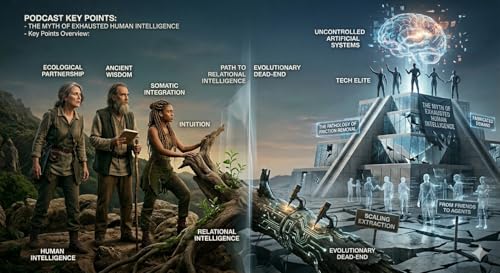
    Key Points Overview
    • The Refusal of Evolutionary Integration: Evolutionary dead-ends historically occurred when hominids prioritized dominance and self-deification over ecological partnership. Silicon Valley is repeating this trajectory by attempting to engineer a technology that bypasses our biological and spiritual ecology.

    • The Pathology of Friction Removal: Technological evolution over the last two decades has been an ongoing effort to codify and institutionalize individual social discomfort. Major platforms were explicitly built to redefine human connection into controllable, digital interfaces to avoid the friction of real psychological maturity.

    • The Linguistic Shift from Humans to Agents: The evolution of the digital landscape has deliberately shifted vocabulary from organic concepts like "friends" to artificial entities like "agents." This vocabulary tracks a corresponding removal of relational intelligence and authentic human presence.

    • Fabricated Demand and Psych-Ops Economics: By merging technical logic with hyper-capitalism, tech monopolies abandoned the traditional parameters of supply and demand. Instead, they weaponized psychological operations and advertising playbooks to fabricate human deficits, scaling extraction under the banner of "innovation."

    • The Myth of Exhausted Human Intelligence: The tech elite operates on the arrogant assumption that humanity has exhausted its understanding of its own internal technologies (intuition, somatic integration, ancient wisdom). This premise justifies the reckless rollout of uncontrolled artificial systems before our own psychological and governance models have matured.

    Own a health clinic or care business and confused about this AI in Human risks and Healthcare talk???

    I write a Substack and have another podcast focused on exploring the future of healthcare work, human sustainability, and how health leaders get to redesign and redefine community health in the AI era. Subscribe HERE.

    Mostra di più Mostra meno
    53 min
adbl_web_anon_alc_button_suppression_t1
Ancora nessuna recensione