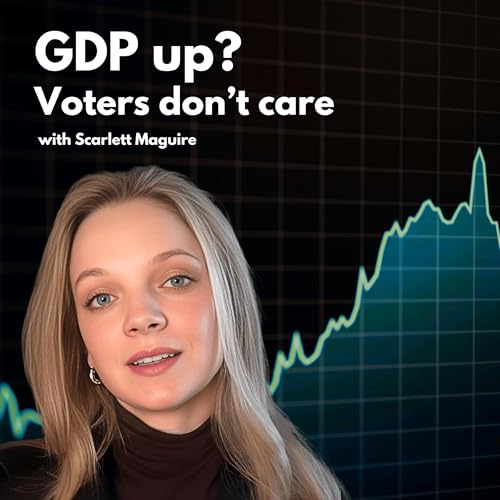
• Voters don't care about GDP. They just want lower bills.
    Feb 19 2026

    Politicians keep telling us the economy is improving. GDP is growing. Inflation is falling. So why does it still feel like we’re getting poorer?

    In this episode of Mouthy Money, we dig into the widening gap between headline economic data and everyday reality. Polling expert Scarlett Maguire, founder of Merlin Strategy, explains why voters don’t associate economic growth with improvements in their own lives - and why energy bills, housing costs, food prices and tax matter far more than GDP figures.

    We explore why anger at regulators and utility companies is rising, why demands for direct Government intervention are growing and how this disconnect is fuelling political instability on both the left and the right.

    Even if growth returns, will people actually feel better off?

    *Chapters*

    00:00 GDP Growth vs Cost of Living Crisis (UK Economy Explained)

    01:15 Who Is Scarlett Maguire? Political Polling & Economic Research

    02:10 Why UK Voters Don’t Care About GDP Growth

    04:30 What “Cost of Living” Really Means (Housing, Energy, Food, Tax)

    07:20 Inflation Falling – Why Prices Still Feel High

    09:05 Has the Pandemic Made Britain Poorer?12:40 Economic Anxiety and the Rise of Populism

    15:10 The Misery Index: Inflation + Unemployment Explained

    17:45 Why UK Energy Bills Are So High

    20:50 Ofgem, Price Caps and Energy Market Regulation

    23:35 Should the Government Cut Energy Bills?

    25:15 Why Brits Don’t Invest (Savings, Pensions, Risk)

    28:05 Are We Heading for UK Economic Recovery?

    31:00 Youth Unemployment and the Housing Crisis

    33:30 What Happens If Growth Returns – Will Voters Feel It?

    MOUTHY MONEY

    *Our substack* mouthymoney.substack.co.uk

    *Get in touch* ⁠⁠editors@mouthymoney.co.uk ⁠⁠

    DISCLAIMER

    This video is produced for general informational purposes only. It should not be construed as investment, legal, tax, mortgage or other forms of financial advice. If in any doubt about the themes expressed, consider consulting with a regulated financial professional for your own personal situation. Past performance is no guarantee of future results. Investments can go down as well as up and you may get back less than you started with. Investments are speculative and can be affected by volatility. Never invest more than you can afford to lose. For more information visit ⁠⁠⁠www.fca.org.uk/investsmart⁠. Please note, video captions are auto-generated and may not be 100% accurate.

    Mostra di più Mostra meno
    33 min
  • Dragon’s Den £50K Deal: Can This App Help You Pay Off Your Mortgage Faster?
    Feb 16 2026

    After securing £50,000 on BBC Dragon’s Den, fintech founder Jinesh Vohra joins us to discuss a question facing millions of homeowners: should you be paying off your mortgage early?

    In this episode, we explore the fundamentals of mortgage overpayments, how interest is front-loaded in the early years of a loan, and whether it makes more sense to reduce debt or focus on long-term investing — particularly in today’s UK interest rate environment.

    Jinesh explains how his app, Sprive, helps homeowners chip away at their mortgage using cashback, spare cash automation and smarter refinancing. We also go behind the scenes of Dragon’s Den — what the Dragons look for in a fintech business, and why trust is critical in UK finance.

    If you’re thinking about building wealth, managing debt strategically, or balancing mortgage overpayments with long-term investing, this episode will help you think more clearly about your options.

    We cover:

    • The case for (and against) paying off your mortgage early
    • How amortisation works and why early overpayments matter
    • Mortgage freedom vs long-term investing
    • Financial trust in fintech
    • What really happens on Dragon’s Den

    MOUTHY MONEY

    *Our substack* mouthymoney.substack.co.uk

    *Get in touch* ⁠⁠editors@mouthymoney.co.uk ⁠⁠

    DISCLAIMER

    _This video is produced for general informational purposes only. It should not be construed as investment, legal, tax, mortgage or other forms of financial advice. If in any doubt about the themes expressed, consider consulting with a regulated financial professional for your own personal situation. Past performance is no guarantee of future results. Investments can go down as well as up and you may get back less than you started with. Investments are speculative and can be affected by volatility. Never invest more than you can afford to lose. For more information visit ⁠⁠⁠www.fca.org.uk/investsmart⁠. Please note, video captions are auto-generated and may not be 100% accurate._

    Mostra di più Mostra meno
    32 min
  • The Hidden Financial Penalty of Being Single
    Feb 6 2026

    Solo living leaves people with far less disposable income, lower investing rates and weaker financial safety nets.

    But why does being single cost so much more? In this episode of Mouthy Money, we count the costs of the “single person financial penalty”.

    With insights from Hargreaves Lansdown’s Helen Morrissey, we look at what singles (and couples) can do to protect their financial futures.

    *On this episode*

    ▉ Singles have far less disposable income because costs can’t be shared.

    ▉ Thin monthly margins make saving and investing feel risky.

    ▉ Lower savings mean less protection against redundancy or illness.

    ▉ Talking about money improves financial resilience — even if you’re single.

    ▉ Divorce, separation, and bereavement can suddenly trigger the same penalty.

    ▉ Relying on a partner’s pension is risky if circumstances change.

    ▉ Cohabiting without legal protections can lead to major financial losses.

    ▉ Everyone should plan for retirement as an individual first.

    *Let us know what you think?* Does the single person financial penalty affect you?

    *Chapters*

    00:00 – The single person financial penalty explained

    01:40 – Why living alone costs so much more

    03:15 – Disposable income gap: £23 vs £280

    05:20 – Safety nets, job loss, and financial vulnerability

    07:20 – Why singles invest less (and fear risk more)

    10:20 – UK savers vs investors: pensions and misconceptions

    13:55 – Breakups, divorce, and becoming single later in life

    16:05 – Pension complacency and cohabitation risks

    18:15 – How to plan like a financially independent adult

    MOUTHY MONEY

    *Our substack* mouthymoney.substack.co.uk

    *Get in touch* ⁠⁠editors@mouthymoney.co.uk ⁠⁠

    DISCLAIMER

    This video is produced for general informational purposes only. It should not be construed as investment, legal, tax, mortgage or other forms of financial advice. If in any doubt about the themes expressed, consider consulting with a regulated financial professional for your own personal situation. Past performance is no guarantee of future results. Investments can go down as well as up and you may get back less than you started with. Investments are speculative and can be affected by volatility. Never invest more than you can afford to lose. For more information visit ⁠⁠⁠www.fca.org.uk/investsmart⁠. Please note, video captions are auto-generated and may not be 100% accurate.

    Mostra di più Mostra meno
    20 min
  • The FIRE Movement isn’t all its cracked up to be
    Jan 30 2026

    The FIRE Movement (Financial Independence Retire Early) is focused on helping you quit your day job as fast as possible. But is that even a desirable outcome?

    From people who regret the financial pain that FIRE demands, to those who miss their careers it might be time to rethink its goals.

    Fidelity’s Andrew Oxlade joins the podcast to discuss FIRE and his alternative: CHILL. He thinks people should focus on finding work that gives them joy and purpose, while also planning their finances sensibly for the long-term.

    Let us know what you think? Are you a hardcore FIRE fan or is it too much like hard work? Let us know below.

    On this episode

    ▉The FIRE movement encourages extreme saving for early retirement.

    ▉ Time is a crucial factor in investment success.

    ▉ Balancing present enjoyment with future savings is essential.

    ▉ Challenging the notion that retirement is the ultimate goal.

    ▉ Career happiness can lead to a longer, more fulfilling life.

    ▉ The anti-FIRE movement promotes finding joy in work.

    ▉ Investing early maximizes the benefits of compounding.

    ▉ Pensions and ISAs offer different advantages for savings.

    ▉ Cultural attitudes towards work and retirement need to evolve.

    ▉ Flexibility in work can enhance life satisfaction.

    Chapters

    00:00 Introduction to the FIRE Movement

    02:23 Understanding the FIRE Movement

    09:02 The Role of Time in Financial Planning

    11:22 Challenges of the FIRE Movement in the UK

    12:49 Critique of the FIRE Philosophy

    16:46 Alternative Perspectives on Career and Retirement

    23:42 Personal Reflections on Retirement Goals

    MOUTHY MONEY

    Get in touch ⁠⁠editors@mouthymoney.co.uk ⁠⁠

    DISCLAIMER

    This video is produced for general informational purposes only. It should not be construed as investment, legal, tax, mortgage or other forms of financial advice. If in any doubt about the themes expressed, consider consulting with a regulated financial professional for your own personal situation. Past performance is no guarantee of future results. Investments can go down as well as up and you may get back less than you started with. Investments are speculative and can be affected by volatility. Never invest more than you can afford to lose. For more information visit ⁠⁠⁠www.fca.org.uk/investsmart⁠. Please note, video captions are auto-generated and may not be 100% accurate.
    FIRE movement, financial independence, retire early, investing, retirement planning, personal finance, savings, financial goals, work-life balance, longevity

    Mostra di più Mostra meno
    34 min
  • Should the Bank of England Prepare for Aliens? (Seriously) | Mouthy Money Podcast
    Jan 24 2026

    What would happen to the global financial system if governments disclosed evidence of extraterrestrial life?

    In this episode of the Mouthy Money podcast, Edmund Greaves and Chris Tuite explore a surprisingly serious question sparked by a real report from a former Bank of England analyst.

    The discussion considers the idea of an “ontological shock”. A moment so disruptive it forces society to rethink reality itself and why alien disclosure could trigger the biggest financial crisis in history.

    From market panic and bank runs to the collapse of entire industries, the pair examine how advanced alien technology could instantly rewrite the rules of energy, defence, AI and even capitalism itself.

    Using aliens as an extreme thought experiment, the episode considers how central banks manage risk, why not all threats can be planned for, and where preparation turns into over-engineering.

    Along the way, they draw parallels with COVID, black swan events, climate risk and technological disruption - asking what this means for investors, institutions, and ordinary savers.

    Serious, speculative and deliberately provocative, this episode isn’t really about aliens. It’s about risk, uncertainty, and how fragile the systems we rely on really are.

    Read editor Edmund Greaves's full article here:

    https://www.mouthymoney.co.uk/investing/should-the-bank-of-england-prepare-for-aliens-a-thought-experiment-in-extreme-risk/

    Chapters

    00:00 – Should the Bank of England prepare for aliens?

    01:55 – The real report that sparked this discussion

    04:00 – What is an “ontological shock”?

    06:50 – Would alien disclosure trigger a financial crisis?

    11:30 – Technology, energy, and instant market winners & losers

    16:30 – Panic, bank runs, and insider information

    20:00 – Can you prepare for unknown unknowns?

    24:40 – Are we over-managing risk in finance?

    26:45 – What this really means for investors

    29:00 – Final thoughts: aliens as a risk thought experiment

    CONNECT WITH US

    Thank you for watching our video! If you enjoyed this, please give it a LIKE, SHARE it with your friends, and SUBSCRIBE to our channel for more about money.

    Discover more at https://www.mouthymoney.co.uk and subscribe to our weekly newsletter too.

    Have questions or suggestions? Drop them in the comments below - we’d love to hear from you! Or contact us at ⁠⁠editors@mouthymoney.co.uk ⁠⁠

    DISCLAIMER

    This video is produced for general informational purposes only. It should not be construed as investment, legal, tax, mortgage or other forms of financial advice. If in any doubt about the themes expressed, consider consulting with a regulated financial professional for your own personal situation. Past performance is no guarantee of future results. Investments can go down as well as up and you may get back less than you started with. Investments are speculative and can be affected by volatility. Never invest more than you can afford to lose. For more information visit ⁠⁠⁠www.fca.org.uk/investsmart⁠

    Please note, video captions are auto-generated and may not be 100% accurate.

    Mostra di più Mostra meno
    28 min
  • Investing Stakes: We’re Investing £500 Of Our Own Money - Join Us On The Journey | New Monthly Series with Stratiphy
    Jan 21 2026

    Welcome to Investing Stakes. Our new monthly series where Edmund Greaves and Chris Tuite invest £500 of their own money and track the results in public over a five-year horizon, in partnership with Stratiphy.

    In Episode 1, Ed and Chris set out their strategies (momentum vs moving averages), choose sectors and debate the big themes shaping markets - including AI, healthcare innovation, defence spending and energy - with Stratiphy Chief Investment Officer Chris Ling.

    What you’ll get in this series (monthly):

    • Our latest performance: what’s up, what’s down, and why

    • The decisions we’re making next (and what we’re avoiding)

    • Clear explanations of investing fundamentals and market context

    • A closer look at systematic/quant approaches (signals, backtests, and portfolio changes)

    In this episode:

    • The market backdrop and what’s driving volatility

    • Tech vs no-tech: the core disagreement

    • Why we’re doing “skin in the game” investing publicly

    • How Stratiphy strategies work (momentum, moving averages, MACD)

    • ISA vs GIA considerations (and why it matters)

    About Stratiphy

    Stratiphy is an investing app that helps everyday investors build and track systematic strategies using tools such as signals and backtesting.

    Learn more about Stratiphy here: https://www.stratiphy.io/

    This series is produced in partnership with Stratiphy.

    Important: This content is for information and discussion only and is not financial advice. Capital is at risk and past performance is not a reliable indicator of future results.

    Chapters

    00:00 Introduction to Investing Stakes

    01:17 The Importance of Skin in the Game

    05:39 Introducing Chris Ling from Stratify

    07:38 Current Market Landscape and Geopolitical Concerns

    14:02 Understanding Stratify's Unique Investment Strategies

    21:48 Hosts' Investment Plans and Sectors of Interest

    28:03 The Energy Debate: Investment Perspectives

    31:15 Financial Services: A Resurgence on the Horizon?

    34:49 Industrials and Defense: Investing in Uncertainty

    40:38 Tech Stocks: Overvalued or Here to Stay?

    50:24 Investment Projections: Looking Ahead

    All views expressed are those of the presenters and guests and do not constitute financial advice. Your capital is at risk, investments can go down as well as up. Past performance is not indicative of future results.

    CONNECT WITH US

    Thank you for watching our video! If you enjoyed this, please give it a LIKE, SHARE it with your friends, and SUBSCRIBE to our channel for more about money.

    Discover more at https://www.mouthymoney.co.uk and subscribe to our weekly newsletter too.

    Have questions or suggestions? Drop them in the comments below - we’d love to hear from you! Or contact us at ⁠⁠editors@mouthymoney.co.uk ⁠⁠

    DISCLAIMER

    This video is produced for general informational purposes only. It should not be construed as investment, legal, tax, mortgage or other forms of financial advice. If in any doubt about the themes expressed, consider consulting with a regulated financial professional for your own personal situation. Past performance is no guarantee of future results. Investments can go down as well as up and you may get back less than you started with. Investments are speculative and can be affected by volatility. Never invest more than you can afford to lose. For more information visit ⁠⁠⁠www.fca.org.uk/investsmart⁠

    Please note, video captions are auto-generated and may not be 100% accurate.

    Mostra di più Mostra meno
    54 min
  • 1.8 million remortgages coming this year: mortgage market expert Paul Thomas explains why rates are falling
    Jan 14 2026

    Are you one of the 1.8 million homeowners planning to remortgage this year?

    In our latest podcast, Paul Thomas shares insights on the 2026 mortgage market and what rate cuts might mean for you.

    With some bullish forecasts, could we see rates drop as low as 2.75%?

    Paul explains:

    -There is a consensus that mortgage rates may decrease this year.

    -Economic indicators like inflation and employment significantly impact mortgage rates.

    -Homeowners should not panic about recent low property sales in their area.

    -Remortgaging can be beneficial, but timing and market conditions matter.

    -It's essential to explore multiple mortgage options before making a decision.

    -Staying with the same lender can simplify the remortgaging process.

    -Don't leave remortgaging decisions until the last minute.

    -The housing market may improve as economic conditions stabilize.

    -Understanding the mortgage market dynamics is crucial for homeowners.

    -There are reasons to be hopeful for better mortgage rates in the near future.

    Chapters

    00:00 Introduction to the Mortgage Market Discussion

    02:57 Current Trends in Mortgage Rates

    05:32 The Impact of Economic Indicators on Mortgages

    08:30 Understanding Remortgaging and Its Challenges

    11:05 Navigating the Mortgage Market: Tips for Homeowners

    13:46 Future Outlook for Mortgage Rates and Housing Market

    16:45 Practical Steps for Remortgaging

    19:28 Final Thoughts and Conclusion

    CONNECT WITH US

    Thank you for watching our video! If you enjoyed this, please give it a LIKE, SHARE it with your friends, and SUBSCRIBE to our channel for more about money.

    Discover more at https://www.mouthymoney.co.uk and subscribe to our weekly newsletter too.

    Have questions or suggestions? Drop them in the comments below - we’d love to hear from you! Or contact us at ⁠⁠editors@mouthymoney.co.uk ⁠⁠

    DISCLAIMER

    This video is produced for general informational purposes only. It should not be construed as investment, legal, tax, mortgage or other forms of financial advice. If in any doubt about the themes expressed, consider consulting with a regulated financial professional for your own personal situation. Past performance is no guarantee of future results. Investments can go down as well as up and you may get back less than you started with. Investments are speculative and can be affected by volatility. Never invest more than you can afford to lose. For more information visit ⁠⁠⁠www.fca.org.uk/investsmart⁠

    Please note, video captions are auto-generated and may not be 100% accurate.

    Mostra di più Mostra meno
    33 min
  • Financial survival kit: here are the basic things you need for a money emergency
    Jan 8 2026

    Having a financial survival kit is critical in a world that is becoming less safe and the future direction of economies becomes more uncertain. So what should you have in it?

    In this week’s episode, Ed and Chris consider some of the basics you need for a financial survival kit, plus one other that most people forget: life insurance and income protection.

    The guys welcome onto the show Cavendish Online’s Ollie Popham to look at how life insurance and income protection work and how it can form a key part of your financial emergency preparedness.

    Income protection in particular is poorly understood but can be extraordinarily beneficial for those who might not even think they need it. This is especially the case for those of us who think we’ll never fall ill or be unable to work - something that affects way more people than you might imagine.

    Ed urges everyone to at least try going through the process to see what cover they might be able to get and how much it would cost. The price of such products might surprise you, especially if you’re young, fit and otherwise healthy now.

    If you’d like to learn more about Cavendish Online and the brokering they offer for protection products, check out their website: https://www.cavendishonline.co.uk/

    Chapters

    00:00 Introduction and New Beginnings

    02:48 The Concept of Financial Survival Kits

    05:30 The Importance of Insurance in Financial Planning

    08:07 Understanding Life and Income Protection Insurance

    11:09 Navigating the Costs of Income Protection

    13:44 The Role of Cavendish Online in Insurance

    16:44 Personal Experiences with Insurance

    19:15 The Value of Comprehensive Coverage

    22:04 Final Thoughts and Recommendations

    CONNECT WITH US

    Thank you for watching our video! If you enjoyed this, please give it a LIKE, SHARE it with your friends, and SUBSCRIBE to our channel for more about money.

    Discover more at https://www.mouthymoney.co.uk and subscribe to our weekly newsletter too.

    Have questions or suggestions? Drop them in the comments below - we’d love to hear from you! Or contact us at ⁠⁠editors@mouthymoney.co.uk ⁠⁠

    DISCLAIMER

    This video is produced for general informational purposes only. It should not be construed as investment, legal, tax, mortgage or other forms of financial advice. If in any doubt about the themes expressed, consider consulting with a regulated financial professional for your own personal situation. Past performance is no guarantee of future results. Investments can go down as well as up and you may get back less than you started with. Investments are speculative and can be affected by volatility. Never invest more than you can afford to lose. For more information visit ⁠⁠⁠www.fca.org.uk/investsmart⁠

    Please note, video captions are auto-generated and may not be 100% accurate.

    Mostra di più Mostra meno
    31 min