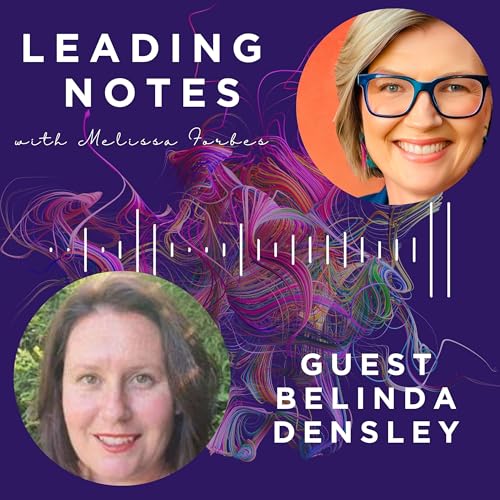
Leading Notes Podcast copertina

Leading Notes Podcast

Leading Notes Podcast

Di: Melissa Forbes
Ascolta gratuitamente

A proposito di questo titolo

Make music that matters.Copyright 2024 All rights reserved. Igiene e vita sana Musica Psicologia Psicologia e salute mentale Scienze sociali
  • 15. The hidden work of singing group facilitation, with Dr Belinda Densley
    Apr 30 2026
    Dr Belinda Densley has spent more than 30 years facilitating community singing groups in Geelong, Victoria, and over that time she came to understand that the work was never really about the voice. It was about the mechanics of heart, soul, and mind. That realisation led her through a Masters in Counselling and Psychotherapy and ultimately to a recently completed PhD, in which she developed a grounded theory of group singing facilitation she calls Creating Song Magic. In this episode, Belinda unpacks that theory, exploring the four core dimensions of the facilitator's role: advocating for people's right to sing, curating repertoire that creates meaningful experiences, welcoming and sustaining harmonious expression in the room, and contributing to the transformation of communities. She also speaks candidly about the "hidden work" that singing facilitators do — work that has remained largely invisible, under-resourced, and poorly defined, even within music and community health sectors. We talk about what it means to reframe the singing facilitator as a community health resource, the importance of boundary-setting and reflective practice, and why Belinda believes trauma-informed relational skills should be foundational to any future training for facilitators. She also shares a deeply moving story about a love-and-loss singing session that rippled far beyond the room. Key Topics Discussed The burning question behind Belinda's PhDWhy the singing facilitator role has remained hidden The four categories of Creating Song Magic: advocating, curating, welcoming and sustaining harmonious expression, and transforming communitiesThe difference between participatory, circle-based singing and performance-oriented models like pub choirThe facilitator as a community health resource and the consequences of that role remaining unrecognised and underfundedBoundary-setting in facilitation, and how clarity within the facilitator translates to clarity for participantsThe case for trauma-informed, relational training for singing facilitators Sharing research findings through a five-part podcast series as an accessible alternative to academic publishingThe systemic barriers community singing groups face in accessing physical spacesThe role of autonomous health-seeking behaviour in group singing participation Notable Quotes "The work was never really about the mechanics of the voice — it was about the mechanics of heart, soul, and mind." "You have the fundamental human right to sing. You can sing." "We're not asking, are we trying to get the notes to be accurate? We're trying to create the harmony that's beyond musical — a harmony of beingness, a harmony within community." "People fell in love with the singing group and sometimes misplace that love for the facilitator. Getting clear on what your role is does so much of the work. The confusion really stops existing if you're not confused yourself." "I don't advertise — people that come to me come via someone already in the group. There's already an expectation that there's going to be a wellbeing effect from coming." "This thing that just happened today has caused so much therapeutic growth that is beyond the capacity of me as one individual." "Singing with another allows so much possibility in — for love, actually, for love." "There's no reason everyone in Australia can't be in a singing group once a week." Resources Creating Song Magic — Belinda Densley's grounded theory of group singing facilitation (PhD research, Federation University Australia)Belinda's podcast documenting participant experiences of her singing groups Acabellas About Guest Dr Belinda Densley is a singing facilitator, counsellor, and researcher based in Geelong, Victoria, Australia. For more than 30 years, she has facilitated community singing groups grounded in the belief that singing is a fundamental human right and a powerful vehicle for wellbeing, connection, and community transformation. Belinda holds a Masters in Counselling and Psychotherapy and a PhD from Federation University Australia, where her research focused on the process of group singing facilitation itself. Her grounded theory, Creating Song Magic, is the first study of its kind to illuminate the complex, relational, and largely invisible work that skilled singing facilitators perform. She also teaches postgraduate counselling students and mentors emerging facilitators. Alongside her research, Belinda has disseminated her PhD findings through an accessible five-part podcast series, reflecting her commitment to making practitioner knowledge available beyond academic audiences. Connect with Belinda https://acabellas.com.au/contact/ Episode Highlights 02:00 — The burning question: what mechanisms beneath the wellbeing effects of group singing led Belinda to pursue a PhD? 03:00 — Why the singing facilitator role sits "in the middle of a lot of different areas" and has remained underexplored 05:30 — Singing as a "with" ...
    Mostra di più Mostra meno
    40 min
  • 14. Music, Youth Justice, and the Power of Belonging, with Dr Alexis Kallio
    Mar 31 2026
    What happens when a researcher brings together music education and criminology to advocate for the rights of some of society's most marginalised young people? In this episode, I speak with Dr Alexis Kallio, an interdisciplinary researcher whose work sits at a unique and important intersection—one that is challenging how institutions think about music, punishment, and what young people truly need to thrive. Alexis shares how her background in both music education and criminology led her to focus on music programs in youth justice settings, and what she has learned from collaborating with Western Australian hip-hop artist Optimus (Scott Griffiths) on the Banksia Beats program at Banksia Hill Youth Detention Centre. She reflects on what it means to meet young people as musicians rather than as students, why ownership and trust are so transformative in carceral settings, and why trauma-informed practice is relevant for every musician working with young people, not just those in detention. Throughout, Alexis makes a compelling case that music is not a luxury or a reward—it is a fundamental right for every child. Key Topics Discussed How Alexis's degrees in both music education and criminology shaped her research focus on youth justice settingsThe Banksia Beats program at Banksia Hill Youth Detention Centre and what makes it effectiveWhy meeting young people as musicians—rather than as teacher and student—is central to building trustThe importance of agency, ownership, and strengths-based approaches in music programs for incarcerated youthTrauma-informed practice and why it matters across all music education contextsWhy there is no one-size-fits-all pedagogical approach: responding to the individual in the roomThe concept of "hungry listening" (Dylan Robinson) and what it means for musicians working in community settingsAlexis's national symposium on music, crime and social change and the community it has createdThe Policing Australian Popular Music project and its work with Queensland Police ServiceThe case for music and music education as a fundamental right for every child Notable Quotes "At the end of the day, these are children." "In a space where young people have ownership over literally nothing—they can't even choose the temperature of their shower—to have ownership over something with expensive music equipment, and have that as yours, can be a really powerful sense of pride." "There is no one right way, because there's no one child." "Music is all about connection. And connection is all about music." "I'd like music and music education to be a right for every child, regardless of their background or circumstance—something that is seen as essential to their lives now, but also their growth." "Young people's voices are sometimes articulated more clearly through their music than through any words they'll say to a social worker or a psychologist." Resources Mentioned Hungry Listening by Dylan Robinson About Guest Dr Alexis Kallio is an interdisciplinary researcher at Griffith University whose work explores how music education and creative practices create opportunities for equity and justice, particularly for young people experiencing vulnerability or marginalisation. Drawing on expertise in both music education and criminology, Alexis examines how educators and musicians navigate questions of power, values, and meaning in their work. Her research bridges grassroots community practice with institutional frameworks, asking critical questions about how creative spaces can be structured to support positive youth development. She has taught across studio, school, university, and community settings in both Australia and Finland. Connect with Alexis Episode Highlights 05:00 Why Alexis sees all young people—regardless of setting—as deserving the same child-centred approach to music13:30 What makes the Banksia Beats program so effective, and why musical expertise matters15:45 The profound impact of ownership and trust in a detention centre music studio22:00 Why music is uniquely positioned to develop both individual identity and social connection simultaneously26:00 Dylan Robinson's concept of "hungry listening" and what it means to truly listen to young people29:00 The national symposium on music, crime and social change—and finding your people33:30 Alexis's submission to the youth justice inquiry and her challenge to the idea of incarceration as a solution36:30 The Policing Australian Popular Music project and working with Queensland Police Service
    Mostra di più Mostra meno
    42 min
  • 13. Coming to our senses: How creativity helps us trust our own experience, with Dr Carla van Laar
    Feb 28 2026
    Coming to our senses: How creativity helps us trust our own experience, with Dr Carla van Laar Show Notes In this episode, I speak with Dr. Carla Van Laar, a creative and experiential therapist, painter, and passionate advocate for the creative revolution in mental health and wellbeing. With over 30 years' experience using the arts for health and wellbeing, Carla is the founding director of the Creative Mental Health Forum and convener of the Psychotherapy and Counselling Federation of Australia's (PACFA) College of Creative and Experiential Therapies. Carla shares her compelling vision for how creativity can act as a reality check in a world that constantly asks us to outsource our sense of what's real. From her early childhood discovery of perspective in art through to her current advocacy work at a national level, Carla's journey illuminates why creative engagement is essential—not peripheral—to mental health and social wellbeing. The conversation explores the disconnect between mounting evidence for creative arts therapies and their limited implementation in Australia's health system, the need for a rethink of biomedical models to better accommdate creative therapies, and what happens when we create accessible spaces where people can connect through the arts. Key Topics Discussed Creativity as a Reality Check How creativity restores trust in first-hand experiencing in a society that asks us to outsource our sense of realityThe parallel between gaslighting dynamics and systemic forces that undermine our perceptionHow creative practice brings us into the present moment and to our senses—sight, touch, hearing, taste, and scent Creative Flow States and Wellbeing Research on the benefits of engaging in creative practice for as little as 20 minutesHow flow states create a sense of timelessness, reduce stress, improve sleep, and help us meet life's challengesNavigating obstacles to creativity: inner critics, self-judgement, attachment to product over process Personal Journey to Creative Arts Therapy How learning about perspective as a young child changed Carla's worldviewUsing creative practice to navigate uncertainty and make sense of the world through her own lensesThe convergence of fine arts, community arts practice, and creative arts therapy Systemic Advocacy and Reform Strategic positioning of creative arts therapies within the broader psychotherapy and counselling frameworkThe 2020 push during COVID to ensure creative therapists were part of mental health system reformsInclusion in national standards for the psychotherapy and counselling workforce The Evidence Gap and Implementation Challenges Why the question "does it work?" is now outdated—World Health Organisation and global health bodies have established the benefitsCreative engagement addresses isolation and loneliness, underlying causes of depression and mental ill-healthThe challenge of measuring relational, context-responsive practices using biomedical modelsLooking at return on investment differently: reduced hospital admissions, reduced burden on mental health services, suicide prevention Rethinking Service Delivery Models The limitations of applying one-hour-a-week biomedical models to creative therapiesCarla's vision for community creative health hubs where people can spend time, connect, participate, and be audiencesThe story of the Inverlock Pop-Up Art Co: what happens when creative spaces become accessibleThe gap between GP mental health care plans and accessible support Shifting Worldviews Why awareness-raising alone isn't enough—people need embodied experience to understand the benefitsThe 85-year-old veteran who went from "what's this mumbo jumbo?" to "this creative stuff actually helps me" in 12 monthsDifferent forms of evidence: the persistence of creative and cultural practices over millennia as proof of efficacyThe importance of policy makers and health professionals having their own creative experiences Notable Quotes "Creativity itself can and does restore our trust in first-hand experiencing in a world that keeps asking us to outsource our sense of reality." "Our senses—whichever ones we love the most—can all be sources of wonderful information about the world around us. And they are the original source for us of our ways of knowing and navigating the world. Creativity in that way isn't seen as an escape from reality, it can actually be a reality check." "Engaging in a creative practice of any form really brings us into the here and now. We have to be present, because that's where it's happening, right here, right now." "Connection is the most important thing. We need connection, and in fact, us, like every other living thing, we gravitate towards connection. Everything is connected, everything wants to be connected. We're no different. We need connection to thrive." "Tell me, and I'll forget. Show me, and I might remember, but involve me and I'll understand. When people experience for themselves the benefit, ...
    Mostra di più Mostra meno
    43 min
adbl_web_anon_alc_button_suppression_c
Ancora nessuna recensione