Episodi

  • Illustrating Leadership: Connection Over Loneliness
    Aug 5 2026

    In this episode of Illustrating Leadership, I had the joy of talking with Vicki Bradley, founder and CEO of Women in Leadership Empowered and Chief Executive Coach at Vicki Bradley and Company.

    Vicki's work is rooted in service, advocacy, and helping women bring their authentic voices not just to the table, but to the world. After years in corporate environments, she realized that the work she cared most about was helping women navigate complexity, trust themselves, and lead with greater confidence.

    When I asked Vicki about a leader who shaped her, she shared about Dave, a former boss who had a profound impact on how she understood leadership.

    One of the lessons he gave her was simple, but it took years for her to fully understand:

    It's lonely at the top.

    At first, Vicki did not understand what he meant. She was in his office often. They talked, strategized, and worked closely together. How could he feel lonely?

    But later, when she became president of a company, she understood.

    Leadership can be lonely because leaders often carry information they cannot share. They have responsibilities that require discretion. They want to connect deeply with their teams, but they also have to protect what is not theirs to reveal.

    That is why connection outside of the immediate team matters so much.

    Mentors.
    Advisors.
    Past bosses.
    Industry peers.
    People who can challenge, support, and help you see differently.

    Dave also taught Vicki the importance of slowing down enough to understand the people and places around her. On one business trip to Newfoundland, he did not simply take her to the location and move on. He encouraged her to experience the culture, the history, the people, and yes — even the tradition of Screech and kissing the cod.

    That lesson stayed with her.

    Leadership is not just about showing up in the room.

    It is about seeking to understand.

    It is about being present.

    It is about seeing the human being, the culture, and the context in front of you.

    Today, Vicki brings those lessons into her coaching, courses, leadership development work, and her podcast, Women in Leadership Talk. Her work reminds us that good leadership requires courage, curiosity, trust, and connection.

    And perhaps most importantly, it reminds us that even when leadership feels lonely, we do not have to lead alone.

    Connect with Vicki

    Please make sure you check out Women In Leadership Empowered's website and go say hi to Vicki on LinkedIn, Instagram, and Facebook!

    Connect with Jessica

    Learn more about how your host supports leaders by visiting her website...and definitely send a connection request on LinkedIn and let her know you listened to this podcast!

    Mostra di più Mostra meno
    31 min
  • Illustrating Leadership Lesson: Developing Your People
    Jul 22 2026

    In this episode of Illustrating Leadership, I get to sit down and chat with Sharon Justice, People Strategist and Founder of Justice Leadership.

    Sharon has spent her career on the people side of busines, first in human resources for large financial services firms, then in the college classroom helping emerging professionals prepare for the workforce, and now through her consulting practice supporting small to mid-sized business leaders.

    Her work centers on a truth many leaders eventually discover:

    You may know how to run the business, sell the product, or deliver the service.

    But the people side can still trip you up.

    When I asked Sharon about a leader who shaped her, she shared about Vonda, a leader she worked with during her corporate career.

    Sharon and Vonda approached the work very differently. Vonda brought an organizational psychology and design perspective, while Sharon brought a business, finance, metrics, and operations lens.

    Instead of seeing those differences as a problem, Vonda recognized them as a strength.

    Together, they made a better puzzle.

    That lesson stayed with Sharon: strong teams are not built by making everyone the same. They are built by understanding the different perspectives, strengths, and experiences people bring...and then learning how to use those differences well.

    Sharon also shared one of my favorite leadership phrases from this conversation:

    Be a talent exporter, not a talent hoarder.

    That is such an important reminder.

    Leadership is not about keeping people small so they stay useful to us. Leadership is about growing people, developing people, and helping them become more capable, even when that means they may eventually move into new opportunities.

    We also talked about the importance of clarity.

    Sharon uses the metaphor of making toast: too often, leaders give instructions as if everyone is standing in their kitchen, using their toaster, making toast exactly the way they would.

    But everyone comes from a different kitchen.

    Different experiences.
    Different assumptions.
    Different ways of processing.
    Different needs on different days.

    That is why clear communication matters.

    Leadership does not have to be as hard as we sometimes make it.

    But it does require awareness, compassion, clarity, and a willingness to learn how to manage the people side with more intention.

    Connect with Sharon

    Make sure you connect with Sharon on LinkedIn, Facebook, Instagram, and YouTube!

    Sharon has also gifted Illustrating Leadership listeners the The CALG Leadership Gap Scorecard, which is designed to quickly show where your leadership system is breaking down across clarity, alignment, accountability, and growth.


    It takes about two minutes and shows you exactly what to fix first. Grab your scorecard here!

    Connect with Jessica

    Learn more about how your host supports leaders by visiting her website...and definitely send a connection request on LinkedIn and let her know you listened to this podcast!

    Mostra di più Mostra meno
    25 min
  • Illustrating Leadership Lesson: Presence
    Jul 8 2026
    Some conversations are technically podcast interviews. And some conversations feel like sitting across from a dear friend, laughing before you even really begin, and then somehow finding your way into the kind of truth that makes you pause. This episode of Illustrating Leadership was one of those conversations. Today we're sitting down with Carolyn Robistow, a private practice therapist and group offer strategist, and someone who has become a very meaningful person in my life over the last year. Carolyn is thoughtful, funny, deeply insightful, and able to move from boat life to brain spotting to leadership wisdom in a way that feels both completely unexpected and exactly right. What stayed with me most from this conversation was not one specific framework or strategy, although we certainly talked about those. What stayed with me was this: Leadership is often less about having the perfect answer and more about being present enough to truly see the person in front of you. Carolyn shared about the leaders who shaped her, especially her parents. Her father, who after a serious illness went on to start a business, modeled a kind of steady, quiet presence. It was only after his funeral that Carolyn fully realized how many people he had impacted simply by showing up. He visited people in the hospital. He encouraged her cross-country team from different points along the course. He noticed people. He was there. Her mother modeled a different kind of leadership: activism, advocacy, and speaking up when something needed to be said. As a teenager, Carolyn admitted that this kind of leadership felt risky and embarrassing at times. Looking back, she could see the courage in it. Two very different examples. One common thread. Presence. The kind of presence that says: I see you. I notice what is happening. I am willing to be here with you. That is something I have heard over and over again across the seasons of Illustrating Leadership. Leadership is not confined to a title, a boardroom, a business, or a movement. Leadership shows up in the moment someone helps another person feel seen, supported, and part of something meaningful. And yet, presence sounds simple until we actually need to practice it. As leaders, parents, friends, partners, coaches, and humans, we often put pressure on ourselves to show up perfectly. We wonder if we will say the right thing. We worry about making it worse. We think we need the plan, the solution, the wise response, or the perfectly composed version of ourselves before we can enter the room. But what if presence does not require perfection? What if, sometimes, the most helpful thing we can say is: "I am here. What would help you feel supported right now?" That was one of the most powerful ideas Carolyn and I explored. Being present does not mean abandoning ourselves. It does not mean dropping everything, absorbing everyone else's emotions, or making ourselves responsible for fixing what hurts. In fact, true presence requires us to stay grounded enough in ourselves that we can actually be with someone else. Carolyn spoke about the difference between simply sharing oxygen with someone and offering attuned presence. That distinction matters. Because when we are swallowed up by our own reactions, our own fears, our own need to perform, we may be physically in the room but emotionally unavailable. We may be trying so hard to say the "right" thing that we miss the human being in front of us. That is where the conversation naturally moved into brain spotting, a modality Carolyn uses and teaches. In the simplest terms, she described brain spotting as the idea that where we look affects how we feel. Our bodies hold information. Our nervous systems respond before our analytical brains can explain what is happening. Sometimes, the work is not to think harder, but to notice what is already happening in the body. That connected so beautifully with the work I do around Positive Intelligence and saboteurs. So many of our leadership reactions are old protective patterns. The need to have the answer. The urge to over-explain. The fear of disappointing someone. The perfectionism that keeps us from acting until we are sure we can do it flawlessly. In Positive Intelligence language, we might call that the saboteur voice. It is the part of us trying to keep us safe, often using strategies we learned a long time ago. The invitation is to shift toward the sage: the wiser, calmer, more creative, more compassionate part of ourselves. And sometimes, that shift begins very simply. Feeling your feet on the floor. Noticing your shoulders. Taking a breath. Listening for the sound farthest away, then the sound closest to you. Remembering that you have a body. Carolyn offered a simple practice for leaders: find even one place in your body that feels calm, grounded, neutral, hopeful, or steady. Then gently notice where your eyes want to look when that feeling becomes more accessible. It is a way of orienting yourself ...
    Mostra di più Mostra meno
    40 min
  • Illustrating Leadership Lesson: The Relationships That Matter
    Jun 24 2026

    In this episode of Illustrating Leadership, I had the joy of talking with Shoshana Allice, a neuro-inclusive leadership coach and the founder of Decolonizing Leadership.

    Shoshana has spent nearly 30 years in leadership development, and her work has become increasingly focused on the intersection of neurodivergence and leadership. Through her own late-diagnosed neurodivergence, her family experience, and her work with clients, she has developed a deep commitment to helping people rethink what leadership can look like.

    And that is really the heart of this conversation.

    Leadership does not have to look one way.

    It does not have to sound one way.

    It does not have to fit the old model of power, control, perfection, and certainty.

    When I asked Shoshana about a leader who shaped her, she shared about Karen, a manager she worked with for nearly eight years.

    Karen created a team culture rooted in relationship. Almost every morning, the team gathered for coffee. Often, they were not talking about work. They were getting to know each other as human beings.

    What mattered to them.
    What frustrated them.
    What lit them up.
    What was happening in their lives.

    That relational foundation changed how the team worked together. They knew how to lean into one another's strengths. They knew how to collaborate. They knew how to support one another as people, not just as roles.

    For Shoshana, that leadership still stands the test of time.

    Karen saw what each person needed in order to thrive. She did not manage everyone exactly the same way. She led from the same principle, but adapted her approach to the human being in front of her.

    That is such an important distinction.

    We also talked about values, curiosity, neuroinclusion, and what it means to decolonize leadership. Shoshana described decolonizing leadership as the ongoing work of questioning the assumptions we have inherited about power, authority, control, and what a "real" leader is supposed to look like.

    Instead of power over, what if leadership became power with?

    Instead of control, what if leadership centered connection?

    Instead of maintaining the status quo, what if leadership helped more people feel seen, heard, included, and able to contribute?

    Shoshana left us with a simple but powerful tool: curiosity.

    Curiosity helps us pause before assuming.
    Curiosity helps us stay open when we are triggered.
    Curiosity helps us ask better questions.
    Curiosity helps us build more human-centered leadership.

    And maybe that is where rethinking leadership begins.

    Not with having all the answers.

    But with being willing to ask better questions.

    Connect with Shoshana

    Check out Shoshana's website and definitely send her a connection request on LinkedIn!

    Connect with Jessica

    Learn more about how your host supports leaders by visiting her website...and definitely send a connection request on LinkedIn and let her know you listened to this podcast!

    Mostra di più Mostra meno
    38 min
  • Illustrating Leadership Lesson: Creating Opportunity
    Jun 10 2026

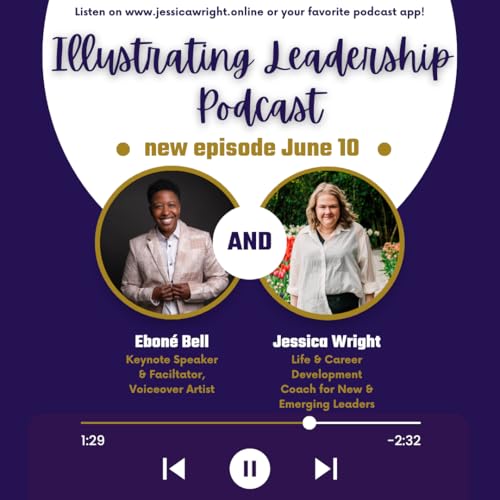
    In this episode of Illustrating Leadership, I had the joy of talking with Eboné Bell, a speaker, storyteller, facilitator, and voiceover artist whose work centers on leadership, confidence, allyship, belonging, and connection.

    And connection really is the thread.

    Eboné chose to highlight Madam C.J. Walker, an entrepreneur and community builder whose leadership continues to inspire her. What stood out most was not only Madam Walker's business success, but the way she used that success to create opportunity for others.

    She did not build only for herself.

    She built with her community in mind.

    Eboné shared how Madam C.J. Walker put her products in the hands of Black women across the country, giving them a path to financial opportunity. She listened to the women who worked with her. She gave back through scholarships and community support. She understood that leadership is not just about what we create, but who we lift as we create it.

    That idea reminded me of something my mom used to say when I was little:

    Leave the room better than you found it.

    At the time, she probably meant the actual room. Pick up the pillow. Put things away. Notice what needs care.

    But those words have become something much bigger for me.

    Leave the relationship better.
    Leave the conversation better.
    Leave the leader better.
    Leave the space better.

    That is the kind of leadership Eboné brings into her work, too. Whether she is speaking about allyship, confidence, Black history, LGBTQ+ inclusion, or leadership, her goal is to help people feel more connected and more able to act.

    Because authenticity is not just about being seen.

    It is also about creating the conditions for other people to show up more fully, too.

    As Eboné said near the end of our conversation: lead with authenticity.

    It matters.

    Connect with Eboné

    Make sure you check out Eboné's website and go say hi on LinkedIn and Instagram!

    Connect with Jessica

    Learn more about how your host supports leaders by visiting her website...and definitely send a connection request on LinkedIn and let her know you listened to this podcast!

    Mostra di più Mostra meno
    28 min
  • Illustrating Leadership Lesson: Learning Agility
    Feb 11 2026
    There are some conversations that remind me exactly why the Illustrating Leadership Podcast exists. This one with Angie McDermott did that. Angie has spent her career helping leaders, teams, and organizations grow into their potential. Her work spans global research at Procter & Gamble, leadership and organization development at Dell, running her own business, leading HR in tech, teaching at UT Austin, and now focusing on scaling her impact and legacy work. Across every role and every season, one belief has remained constant for her: Leadership is learned. Not inherited. Not granted by a title. Not reserved for a lucky few. Learned. And honestly, that might be one of the most hopeful leadership messages we can offer, especially right now. Two Leaders, Two Contexts, One Truth In this episode, Angie shared stories of two leaders who shaped her understanding of what effective leadership actually looks like. One was a CEO in a high-growth software company, an environment where everything moves fast and the pressure to perform is constant. The other was the long-time CEO of LifeWorks, a nonprofit in Austin focused on solving youth homelessness through housing, mental health, education, and workforce services. Different sectors. Different pressures. Different day-to-day realities. And yet, the leadership lesson was remarkably similar. Both leaders found ways to merge mission, people, and vision without losing their humanity. Letting Go of the "Born Leader" Myth Angie named something many of us have felt but rarely say out loud. The idea of the "born leader" does more harm than good. The leaders who make the greatest impact are not born with a fixed set of traits. They learn. They adapt. They surround themselves with people who are smarter than they are in specific areas. They stay open to feedback. They grow with the role instead of trying to perform their way through it. When leadership becomes a practice instead of a performance, everything shifts. If leadership is learned, then it is accessible. And it becomes something we are responsible for developing, not something we either have or do not. High Standards and High Care One of the things that stood out most in Angie's description of the software CEO was the balance he held. He expected a lot. He moved quickly. He held high standards. And he listened. He did not need to be the smartest person in the room. He built strong teams by asking good questions, investing in culture, and treating people with respect. Because of that, people were deeply committed to the work and to each other. It was a reminder I come back to often in leadership work. Focusing only on results might get you short-term outcomes. Focusing on people while pursuing results tends to build stronger teams, healthier cultures, and better long-term success. Knowing Who to Call Is a Leadership Skill The nonprofit leader Angie described led in an entirely different kind of pressure. Constant crisis. Limited resources. High emotional stakes. What stood out was not charisma or control. It was clarity and connection. She built genuine relationships across community partners, elected officials, donors, service providers, and the people the organization served. When challenges arose, she did not scramble alone. She knew who to call. That kind of leadership is built quietly over time. Through trust. Through consistency. Through showing up long before there is a crisis. Learning Agility Matters More Than We Think One of the most practical concepts Angie shared was learning agility. Learning agility is the ability to learn from experience and apply those lessons to new and unfamiliar situations. Research suggests it can be more predictive of leadership effectiveness than emotional intelligence or cognitive ability alone. The most important part is this. It is learnable. Leadership growth does not come from consuming more content alone. It comes from reflection. From asking better questions after things go well and after they do not. What worked? What did not? What assumptions did I make? What do I want to repeat? What do I want to do differently next time? Angie talked about building a regular practice of reflection, not as an indulgence, but as leadership training. Leadership does not require perfection. It requires learning. The Pressure to Be Right Immediately Another thread that resonated deeply was the pressure many new leaders feel to have the right answer on demand. Most leadership situations are not emergencies. We often have time to pause, gather information, reflect, and respond thoughtfully. The pressure to decide instantly can cloud judgment and create unnecessary stress. The goal is not to avoid mistakes entirely. It is to learn from them and avoid repeating the same ones in the same way. Leadership Is Will and Skill Near the end of the conversation, Angie shared something that stayed with me. Leadership is will and skill. You have influence. On your team. On your clients. On your ...
    Mostra di più Mostra meno
    31 min
  • Illustrating Leadership Lesson: Loneliness
    Feb 4 2026
    "It's lonely at the top." It is a phrase most leaders have heard and many have quietly felt. Especially for new and emerging leaders, that loneliness can feel heavy. You are the one people come to for answers. You are expected to project confidence and clarity, even when you feel unsure, overwhelmed, or exhausted. You carry confidential information you cannot fully share. You navigate decisions others never see. Over time, leadership can begin to feel isolating. But leadership does not have to be lonely. In this solo episode of the Illustrating Leadership Podcast, I explore why leadership loneliness shows up and how leaders can reconnect with others and themselves without losing authority, credibility, or trust. Why Leadership Can Feel Isolating Leadership almost always comes with a shift in dynamics. Former peers may now report to you. Conversations become more nuanced and confidential. You are expected to model steadiness even when things feel uncertain. For new and emerging leaders, there is often an added layer of imposter syndrome. The belief that you should already know more, feel more confident, or have all the right answers at all times. That pressure can lead to isolation in subtle ways, including: Second-guessing your instincts Hiding uncertainty Carrying stress internally instead of processing it Here is the truth. Loneliness does not make you a bad leader. It makes you human. Acknowledging leadership loneliness is not a weakness. It is the first step toward moving through it. Strategic Vulnerability Builds Trust, Not Weakness One of the most misunderstood leadership skills is vulnerability. Vulnerability is not oversharing. It is not emotional dumping. And it is not a lack of boundaries. Strategic vulnerability means showing up honestly and intentionally. It can sound like: "I do not have the answer yet, but I trust we will figure it out." "This is a challenging moment, and I am actively working through it." "I have been thinking about how to lead well here, and I would value your perspective." This kind of openness builds trust without undermining authority. It reminds people that leadership is human work, not a performance. Why Leaders Need a Behind-the-Scenes Support System One of the most important things leaders can do is build support outside of their team. High-performing people in every field rarely operate alone. They have coaches, mentors, advisors, and trusted partners behind the scenes. Leadership is no different. You need a space where you do not have to perform. A place where you can say what you really think, process challenges in real time, and separate what is true from what is reactive. That support might include: A leadership coach A mentor A peer in a similar role A confidential leadership community Leadership development does not end when your title changes. You do not have to carry everything inside your own head. How to Be Real and Still Grounded With Your Team Connection with your team does not require oversharing. It requires steadiness. You can acknowledge challenges while still holding direction: "This is new territory for us, and we will find our rhythm." "Here is what I am clear on, and here is what I am still exploring." "This is a busy season, and I am prioritizing sustainability." When leaders model grounded presence during uncertainty, credibility grows. Openness does not weaken leadership. It strengthens it. Create Intentional Moments of Connection Leadership relationships deepen through intentional conversation, not just updates and deliverables. Make space to ask questions like: "What has been challenging you lately?" "What is something you are proud of this week?" "How can I support you better right now?" These moments matter. They help your team feel seen and they remind you that you are not leading in a vacuum. Leadership Does Not Have to Be Lonely Loneliness may come with leadership, but it does not have to be your permanent state. You can create connection without losing authority. You can be real without being unboundaried. You can lead with both openness and strength. If leadership has felt isolating lately, let this be your reminder: You are not alone. You are allowed to ask for support. And your leadership gets stronger when you do. Your host, Jessica Wright, is a Life & Career Development Coach for Leaders and the Founder of Wright Life Coaching, LLC. You can connect with and follow her on LinkedIn.
    Mostra di più Mostra meno
    8 min
  • Illustrating Leadership Lesson: Aligning Your Inner & Outer Life
    Jan 28 2026
    Some of the most impactful leaders in our lives do not come with titles, corner offices, or formal authority. They enter our lives through relationship. They challenge us, ground us, mirror us, and sometimes even break our hearts before helping us put ourselves back together with more clarity, self-trust, and wholeness. That truth sat at the center of this episode of the Illustrating Leadership Podcast, where I had the privilege of speaking with Dr. Brenda Brummond, an intuitive business coach for female entrepreneurs. What unfolded was not just a conversation about leadership, but about evolution, forgiveness, grounding, and the balance between ambition and inner alignment. Leadership Beyond Titles When I ask guests about the best leader they have ever experienced, many people instinctively think of a boss or manager. Others immediately recall the worst leader they have had. Brenda's story reminded me that leadership often shows up in unexpected ways. She shared the story of someone she met during chiropractic school, a person who would become her closest friend, her partner, her greatest disappointment, and eventually her husband and the father of her children. It is not a neat or linear story. It is deeply human. And that is exactly what makes it such a powerful illustration of leadership. Leadership as a Mirror What stood out most in Brenda's story was not perfection. It was reflection. This person did not tell her what to think or who to be. Instead, he asked thoughtful questions. He offered grounding perspective. He reflected her back to herself during moments when she was carrying shame, anger, and confusion from earlier chapters of her life. That kind of leadership does not direct. It invites. It helps us understand our patterns, soften our narratives, and decide for ourselves who we want to become. The Pedestal Problem As Brenda's story evolved, so did the dynamic between them. She spoke openly about what happens when we place someone on a pedestal, when we give another person more wisdom, power, or authority than we give ourselves. Eventually, that pedestal collapses. Every leader is human. Every mentor has blind spots. Every relationship will disappoint us in some way. Leadership lessons do not disappear when someone falls. Often, they deepen. Grounding as a Leadership Skill One word that surfaced again and again throughout our conversation was grounding. When we experience hardship, especially early in life, it is easy to live in our heads. We spin stories about who we are, what we deserve, and how the world works. Grounding leadership brings us back into our bodies, our values, and the present moment. It does not erase pain or complexity. It gives us something solid to stand on while we navigate it. The Balance Between Wisdom and Reality A theme I see often in leadership work, and one we explored deeply in this episode, is the tension between spiritual wisdom and practical reality. On one end, there is the drive to achieve, perform, and push forward. On the other, the desire to retreat inward, disconnect, or escape the messiness of the world. Leadership does not live at either extreme. It lives in the balance between the two. Brenda described it beautifully as having one arm reaching toward possibility and desire, while the other remains anchored in safety, embodiment, and grounding. Holding both at once is where sustainable leadership lives. When the Outer World Reflects the Inner One One of the most powerful insights from this conversation was the idea that external struggles in business, money, or relationships often reflect internal ones. When something feels stuck outside of us, there is usually fear, resistance, or an unexamined belief asking for attention inside of us. Leadership growth begins with curiosity, not judgment. What is this moment trying to show me? What expectation am I holding? Whose voice is shaping how I think things should be? Letting Go of the Struggle We also talked about surrender and how misunderstood it often is. Surrender is not giving up. It is releasing resistance. It is allowing yourself to be human without shame. It is recognizing that leadership, like life, moves in cycles. Some days you feel grounded and capable. Other days you feel unsure and messy. Both belong. Leadership as an Ongoing Evolution This episode was a reminder that leadership is not a fixed identity. It evolves through relationships, ruptures, forgiveness, reflection, and growth. The leaders who make the greatest impact are not the ones who avoid failure. They are the ones willing to learn from it, integrate it, and keep showing up with humility and intention. If this conversation resonated with you, I invite you to listen to the full episode and reflect on this question: Who has been a grounding presence in your leadership journey? And just as importantly, how are you becoming that presence for yourself? Make sure you connect with Dr. Brenda on Facebook, Instagram, and ...
    Mostra di più Mostra meno
    28 min