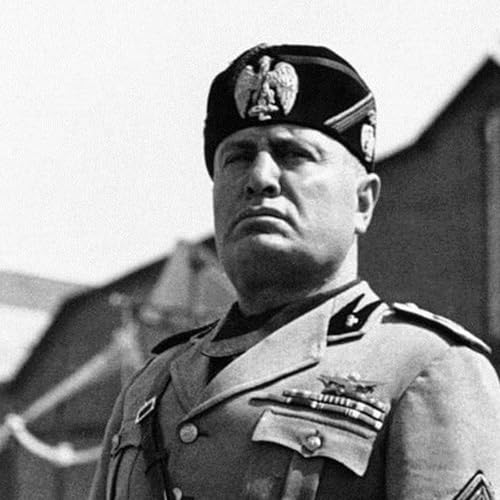
Fascism. copertina

Fascism.

Fascism.

Di: Popular Culture and Religion.
Ascolta gratuitamente

A proposito di questo titolo

Fascism is a far-right, authoritarian, and ultranationalist political ideology and movement that rose to prominence in early-20th-century Europe. Fascism is characterized by support for a dictatorial leader, centralized autocracy, militarism, forcible suppression of opposition, belief in a natural social hierarchy, subordination of individual interests for the perceived interest of the nation or race, and strong regimentation of society and the economy. Opposed to communism, democracy, liberalism, pluralism, and socialism, fascism is at the far-right of the traditional left–right spectrum. What constitutes a precise definition of fascism has been a longrunning and complex debate among scholars.

The first fascist movements emerged in Italy during World War I before spreading to other European countries, most notably Germany. Fascism also had adherents outside of Europe. Fascists saw World War I as a revolution that brought massive changes to the nature of war, society, the state, and technology. The advent of total war and the mass mobilization of society erased the distinction between civilians and combatants. A military citizenship arose, in which all citizens were involved with the military in some manner. The war resulted in the rise of a powerful state capable of mobilizing millions of people to serve on the front lines, providing logistics to support them, and having unprecedented authority to intervene in the lives of citizens.

Fascism views forms of violence—including political violence, imperialist violence, and war—as means to national rejuvenation. Fascists often advocate for the establishment of a totalitarian one-party state, and for a dirigiste economy, which is a market economy in which the state plays a strong directive role through market intervention with the principal goal of achieving national economic self-sufficiency, or "autarky". Fascism emphasizes both palingenesis—national rebirth or regeneration—and modernity when it is deemed compatible with national rebirth. In promoting the nation's regeneration, fascists seek to purge it of decadence. Fascism may also centre around an ingroup-outgroup opposition and demonization of "Others", such as various ethnicities, immigrants, nations, races, political opponents of fascist parties, religious groups, and sexual and gender minorities. In the case of Nazism, this involved racial purity and a belief in a master race. Such demonization has motivated fascist regimes to commit massacres, forced sterilizations, deportations, and genocides. During World War II, the genocidal and imperialist ambitions of the fascist regimes of the Axis powers resulted in the murder of millions of people.

Since the end of World War II in 1945, fascism has been largely disgraced, and few parties have openly described themselves as fascist; the term is often used pejoratively by political opponents. The descriptions neo-fascist or post-fascist are sometimes applied to contemporary parties with ideologies similar to, or rooted in, 20th-century fascist movements.
Copyright Popular Culture and Religion.
  • 16 - Syncretic Nature and Rejections of Binary Classifications.
    Apr 25 2026
    Syncretic Nature and Rejections of Binary Classifications.
    Fascism emerged as a syncretic political ideology that fused elements of nationalism, corporatism, anti-liberalism, and statist interventionism, drawing selectively from both socialist collectivism and conservative hierarchies while repudiating the materialism of Marxism and the individualism of classical liberalism. This blending defied binary categorizations, as fascists contended that the left-right dichotomy—rooted in 19th-century class conflicts—failed to capture the holistic, action-oriented revolution they advocated, which prioritized national unity over ideological purity. In The Doctrine of Fascism (1932), Benito Mussolini and Giovanni Gentile articulated this stance, describing fascism as neither a static party doctrine nor aligned with traditional spectrums, but as a dynamic force born from praxis that subordinated economics to the state's ethical imperatives, preserving private initiative within a corporatist framework that echoed syndicalist influences from the left while enforcing hierarchical order akin to right-wing authoritarianism.
    Scholars such as Zeev Sternhell have traced fascism's intellectual origins to an "anti-materialist revision of Marxism," where early 20th-century thinkers like Georges Sorel integrated Marxist class struggle with nationalist vitalism and anti-rationalist aesthetics, creating a hybrid that rejected egalitarian internationalism in favor of organic national communities. This revisionism manifested in fascism's economic policies, which combined welfare provisions and public works—reminiscent of social democratic measures—with private property protections and anti-union purges, as seen in Mussolini's 1927 Charter of Labour, which institutionalized class collaboration under state mediation rather than abolition or laissez-faire. Similarly, Nazi Germany's "National Socialism" invoked socialist rhetoric in its 1920 party platform, promising profit-sharing and land reform, yet subordinated these to racial hierarchy and autarky, illustrating a pragmatic eclecticism that prioritized total mobilization over doctrinal consistency.
    Fascist leaders explicitly rejected binary classifications, with Mussolini declaring in 1921 that fascism represented a "third way" transcending the "sterile" oppositions of bourgeoisie versus proletariat, aiming instead for a totalitarian synthesis where the state embodied the nation's will. This position persisted in fascist propaganda, which portrayed liberalism and communism as twin symptoms of decadence, to be supplanted by a palingenetic nationalism that integrated futurist modernism, traditionalism, and imperial expansionism. Empirical analysis of fascist governance supports this syncretism: Italy's regime nationalized key industries like IRI in 1933 while maintaining capitalist alliances, achieving GDP growth of 2-3% annually from 1922-1938 through mixed public-private initiatives, neither fully socialist expropriation nor unfettered markets.
    Critics of rigid spectral placements, including some post-war analysts, argue that fascism's rejection of binaries stemmed from its pragmatic adaptation to crises—hyperinflation in Italy (peaking at 1,200% in 1920) and Weimar Germany's 300% unemployment in 1932—necessitating eclectic policies that borrowed from wherever efficacious, rather than ideological dogma. However, mainstream academic classifications often emphasize fascism's ultranationalism and anti-egalitarianism to situate it on the "far-right," potentially underplaying its collectivist mechanisms due to post-1945 ideological alignments that equated any statism with leftism only when non-nationalist. This syncretic fluidity, fascists maintained, rendered traditional labels obsolete, positioning their movement as a totalizing alternative attuned to the "spirit of the age" rather than partisan divides.


    Wikipedia: Text is available under the Creative Commons Attribution-ShareAlike 4.0 License.

    This episode includes AI-generated content.
    Mostra di più Mostra meno
    4 min
  • 15 - Placement on the Political Spectrum.
    Apr 25 2026
    Placement on the Political Spectrum. Arguments for Left-Wing Roots and Collectivism. Benito Mussolini, founder of fascism, spent over a decade as a leading figure in the Italian Socialist Party, editing its official newspaper Avanti! from 1912 to 1914 and promoting revolutionary socialism prior to his expulsion in 1914 for supporting Italy's intervention in World War I. Despite the break, Mussolini retained socialist influences, crediting thinkers like French Marxist Georges Sorel, whose revolutionary syndicalism—emphasizing worker militancy, myth-making for mobilization, and rejection of parliamentary reform—inspired fascism's early tactics and anti-capitalist rhetoric. Sorel's ideas bridged Marxism and nationalism, providing a framework for Mussolini's shift from international class struggle to national worker solidarity, as seen in the 1919 founding of the Fasci Italiani di Combattimento. This synthesis found early expression in France through the Cercle Proudhon, founded around 1911, which integrated Proudhonian mutualism and federalism with Sorelian syndicalism and integral nationalism, contributing to national syndicalist doctrines that influenced the ideological formation of fascism. Fascism adapted left-wing syndicalism into "national syndicalism," subordinating labor organizations to the state while opposing both liberal individualism and Marxist internationalism. Giovanni Gentile, fascism's chief philosopher and co-author of The Doctrine of Fascism (1932), explicitly framed it as "a form of socialism, in fact, its most viable form," arguing for the ethical state as the embodiment of collective will over private interests. This collectivist ethos echoed socialist prioritization of the group—Mussolini's nation-state replacing the proletariat—while rejecting free-market liberalism, which fascists derided as atomizing society. Fascist economics reinforced this left-wing collectivism through corporatism, a system of state-directed syndicates that controlled production quotas, wages, prices, and resource allocation, effectively merging private ownership with public planning. By 1939, Italy's government nationalized over four-fifths of shipping and shipbuilding, dominated 80% of credit, imposed mandatory cartels, and subsidized 75% of economic output by 1934, aiming for autarky and war readiness under centralized authority. Mussolini described this as "state capitalism," paralleling Lenin's New Economic Policy, and pursued further "socialization" in the 1943 Italian Social Republic, collaborating with former communists like Nicola Bombacci to anti-capitalist ends. Proponents of fascism's left-wing classification, including historian A. James Gregor, contend it derives from radical syndicalist Marxism, sharing totalitarian collectivism with Bolshevism as "heresies of socialism" that demand individual sacrifice for state-directed unity. Richard Pipes similarly notes both ideologies' roots in socialist rejection of markets and emphasis on coercive harmony, distinguishing them from right-wing traditions of limited government. Mussolini himself affirmed in 1945, "We are the working class in struggle… against capitalism," underscoring fascism's self-perceived continuity with proletarian aims, albeit nationalized. Historical evidence further shows that portions of the working class voted for fascist parties. In Germany, the Nazis gained support from working-class voters, particularly Protestant workers in rural and small-town areas, amid economic hardship and disillusionment with socialist and communist parties. Similar patterns occurred in Italy under Mussolini, where some former socialist supporters shifted to fascism. Mainstream Views as Far-Right Nationalism. In mainstream historiography and political science, fascism is classified as a far-right ideology, distinguished by its ultranationalist fervor, authoritarian centralization of power, and rejection of both liberal individualism and socialist internationalism. This positioning emphasizes fascism's prioritization of the nation as an organic, hierarchical entity requiring rebirth (palingenesis) through dictatorial leadership and mass mobilization, as opposed to the class-based egalitarianism of leftist movements. Political scientist Cas Mudde, in delineating subtypes of the far right, categorizes fascism within the "extreme right," marked by its overt anti-democratic and nativist orientations that exceed the more electoral constraints of radical right populism. Historians such as Roger Griffin further solidify this far-right attribution by defining fascism as a "revolutionary form of ultra-nationalism" that mythologizes national renewal while scorning parliamentary democracy and Marxist materialism, traits aligning it with right-wing extremism rather than progressive or collectivist leftism. Griffin's framework, influential since the 1990s, highlights fascism's nominalist core—obsessive focus on ethnic or cultural ...
    Mostra di più Mostra meno
    9 min
  • 14 - Criticisms and Failures.
    Apr 25 2026
    Criticisms and Failures. Authoritarian Repression and Human Rights Abuses. The Fascist regime in Italy systematically suppressed political dissent through paramilitary violence in its formative years. From 1919 to 1922, squadristi groups orchestrated assaults, beatings, and murders targeting socialists, communists, and labor organizers, creating an atmosphere of terror that facilitated the movement's rise to power. Political violence in this period alone claimed around 320 lives between April 1919 and September 1920, with squadrismo escalating the scale of attacks thereafter through systematic intimidation and destruction of opposition institutions. After Benito Mussolini's appointment as prime minister in October 1922, repression became institutionalized via the exceptional laws of November 1926, which outlawed opposition parties, curtailed civil liberties, and enabled confino—administrative exile to remote islands or villages without judicial process. The OVRA (Organization for Vigilance and Repression of Anti-Fascism), formed in 1927 under Arturo Bocchini, functioned as a secret police apparatus, monitoring citizens, conducting warrantless arrests, and using coercive methods including torture to dismantle underground networks. The Special Tribunal for the Defense of the State, established in 1926, further entrenched this control by trying over 2,400 individuals for political offenses in its early years, issuing convictions that often led to lengthy imprisonments or confino. Between 1926 and 1943, the regime confined tens of thousands to penal islands and remote locales, where conditions involved forced labor, isolation, and inadequate provisions, affecting anti-fascists, ethnic minorities, and later suspected wartime saboteurs. Human rights violations extended to censorship of the press and assembly, with independent newspapers shuttered and public criticism equated to treason, punishable by OVRA raids or tribunal proceedings. Notable cases included the April 10, 1924, assassination of socialist deputy Giacomo Matteotti, widely attributed to fascist operatives despite official denials, which underscored the regime's tolerance for extrajudicial elimination of threats. During World War II, from 1940 onward, internment expanded to civilian camps for Jews, Slovenes, and Croats in occupied territories, involving mass roundups and confinement without due process, though on a scale smaller than Nazi extermination efforts. These mechanisms prioritized regime survival over individual rights, resulting in widespread arbitrary detention, physical abuse, and erosion of legal protections, as documented in survivor accounts and police records, though official statistics were often underreported to maintain the facade of a consensual dictatorship. Economic Inefficiencies and War Mobilization. The corporatist framework in fascist Italy, established through the Charter of Labour in 1927, aimed to integrate state oversight with private enterprise but fostered inefficiencies via overlapping bureaucracies, suppressed labor mobility, and preferential treatment for regime-aligned firms, distorting resource allocation and discouraging competition. Autarky initiatives, such as the 1925 Battle for Grain, compelled farmers to shift acreage to wheat at the expense of higher-value exports like olives, yielding short-term production spikes but long-term cost increases and agricultural stagnation, with overall output rising modestly from an index of 100 in 1922 to 147.8 by 1937 amid persistent inefficiencies. Industrial growth averaged about 1.6% annually from 1929 to 1939—half the rate of prior liberal periods—hampered by protectionist barriers and state-directed investments that prioritized prestige projects over productivity. In Nazi Germany, the 1936 Four-Year Plan enforced autarky through costly synthetic industries; coal-to-fuel processes, subsidized heavily, produced liquids at up to five times the price of imports while demanding disproportionate energy inputs, diverting capital from viable alternatives and yielding only partial self-sufficiency by 1939. Rearmament intensified distortions, with military outlays surging from 1% of GNP in 1933 to 8% in 1935, 13% in 1936, and over 20% by 1938, financed via off-balance-sheet Mefo bills that concealed deficits but exhausted foreign reserves and fueled inflation pressures, rendering peacetime sustainability impossible without territorial expansion. War mobilization exposed systemic frailties. Italy's entry into World War II in 1940 without full economic conversion led to rapid industrial decline, as inadequate planning and resource shortages—exacerbated by prewar autarky—prevented sustained output, culminating in regime collapse by 1943. Germany's partial mobilization until Albert Speer's 1942 appointment reflected ideological resistance to total war measures like widespread female conscription and inter-ministerial turf wars, compounded by ...
    Mostra di più Mostra meno
    9 min
Ancora nessuna recensione