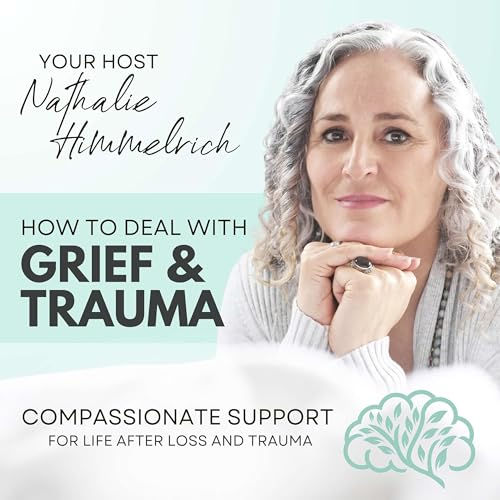
How To Deal With Grief and Trauma copertina

How To Deal With Grief and Trauma

How To Deal With Grief and Trauma

Di: Nathalie Himmelrich
Ascolta gratuitamente

3 mesi a soli 0,99 €/mese

Dopo 3 mesi, 9,99 €/mese. Si applicano termini e condizioni.

A proposito di questo titolo

You can't go through life without experiencing loss and trauma the question is how do we deal and live with the grief and pain? Join Nathalie Himmelrich, grief expert and author, talking to people who have experienced grief and trauma first-hand. If you want to be inspired by others who traveled through their grief and trauma, found that healing is possible, and came out the other end knowing they can survive and thrive in life after loss. For more info: www.nathaliehimmelrich.com

© 2026 How To Deal With Grief and Trauma
Igiene e vita sana Psicologia Psicologia e salute mentale Scienze sociali
  • 165 The Many Faces of Trauma | Before Words: Understanding Preverbal Trauma
    Jan 28 2026

    Send us a text

    Preverbal trauma can be hard to name because it often isn’t stored as a clear story. In this episode, we explore how early experiences, which occur before language development, can shape the nervous system through implicit memory and felt sense. You’ll learn why people can say “nothing happened” and still carry intense body reactions, relationship patterns, or shame responses that feel bigger than the moment. Using simple polyvagal-informed language, we’ll look at how early safety is wired through connection, and what helps when the body remembers what the mind cannot. The episode ends with a varied, trauma-neutral grounding practice using senses and gentle movement.

    In this episode, you’ll learn

    • What preverbal trauma is (and what it isn’t)
    • How early experiences are stored as implicit memory and felt sense rather than narrative
    • Why reactions can feel “irrational” when the origin happened before words
    • A simple polyvagal lens on early wiring: safety & connection vs mobilised protection vs shutdown
    • Common adult patterns linked to early nervous system adaptation (non-diagnostic)
    • Practical, gentle starting points: micro-doses of safety, co-regulation, body-first tools, repair over perfection
    • A varied grounding practice designed to be supportive for preverbal material

    Grounding practice (2–3 minutes): “Senses + Support”

    • Notice one point of contact (feet, back, hands)
    • Name two sounds
    • Rest your eyes on one neutral colour
    • Gentle shoulder roll or press feet into the floor
    • A soft phrase: “In this moment, I’m here” (or “safe enough” if it fits)

    Check the website for free resources available to both those affected by trauma and those supporting them.

    What’s next? The Wound in the Bond: Attachment & Relational Trauma

    Support the show

    💡 If today’s episode touched you, please share it with someone who might need it.

    🤝 Become a supporter of the show! Starting at $3/month & leave a review.

    Stay Connected

    • 🌐 Visit nathaliehimmelrich.com
    • 💌 Subscribe to the newsletter for resources and updates
    • 🎧 Never miss an episode—follow the podcast!
    • 💛 Socials Instagram Facebook

    Find Support Resources

    • 💜 For Grievers – Resources
      https://nathaliehimmelrich.com/grievers-support/
    • 💜 For Supporters – Supporting someone https://nathaliehimmelrich.com/supporters-resources/
    • 💜 Books – Explore books on grief and healing https://nathaliehimmelrich.com/books/
    • 💜 Support – Offers - free and paid
      https://nathaliehimmelrich.com/free-resources/
    Mostra di più Mostra meno
    17 min
  • 164 The Many Faces of Trauma | Small t, Big T and the Missing Middle
    Jan 26 2026

    Send us a text

    “Small t” and “big T” are common trauma terms meant to validate, but they can also trigger comparison, minimisation, or shame. In this episode, you’ll learn what these labels usually mean, why they sometimes backfire, and how to replace ranking with a more compassionate, nervous-system-based framework. You’ll also get a simple reframe list (cumulative, relational, chronic vs single-incident, acute) and a short grounding practice to help your system step out of comparison and back into the present.

    In this episode, you’ll learn

    • What people typically mean by big T and small t trauma
    • Why the “missing middle” matters (quiet, chronic, relational stress that still shapes the nervous system)
    • How comparison keeps people stuck: “It wasn’t bad enough” vs “I’m permanently damaged”
    • A clearer alternative to ranking: impact + support + recovery
    • Polyvagal-informed understanding of why the nervous system doesn’t rank events “on paper”
    • A short, safe-for-most grounding practice focused on validation and present-moment safety

    Gentle reminders

    • Trauma isn’t a competition, and you don’t need to justify your pain to deserve support.
    • If you feel activated or numb while listening, that’s a nervous system response; pause anytime.

    Check the website for free resources available to both those affected by trauma and those supporting them.

    What’s next

    Next episode: Before Words: Understanding Preverbal Trauma
    We’ll explore how the body can carry trauma from experiences that happened before you had language and how to work with it gently.

    Support the show

    💡 If today’s episode touched you, please share it with someone who might need it.

    🤝 Become a supporter of the show! Starting at $3/month & leave a review.

    Stay Connected

    • 🌐 Visit nathaliehimmelrich.com
    • 💌 Subscribe to the newsletter for resources and updates
    • 🎧 Never miss an episode—follow the podcast!
    • 💛 Socials Instagram Facebook

    Find Support Resources

    • 💜 For Grievers – Resources
      https://nathaliehimmelrich.com/grievers-support/
    • 💜 For Supporters – Supporting someone https://nathaliehimmelrich.com/supporters-resources/
    • 💜 Books – Explore books on grief and healing https://nathaliehimmelrich.com/books/
    • 💜 Support – Offers - free and paid
      https://nathaliehimmelrich.com/free-resources/
    Mostra di più Mostra meno
    14 min
  • 163 The Many Faces of Trauma | When the Body Learns Danger: What Trauma Is (and Isn’t)
    Jan 23 2026

    Send us a text

    Trauma isn’t only about what happened—it’s about what happened inside your nervous system when an experience was too much, too fast, too soon, or too long, without enough support, choice, or protection. In this episode, we clarify what trauma is (and isn’t), using simple, polyvagal-informed language—so you can replace shame and confusion with understanding. You’ll also be guided through a short grounding practice you can use anytime.

    In this episode, you’ll learn

    • A clear, compassionate definition of trauma that goes beyond the “one big event” narrative
    • Why two people can experience similar events and be impacted differently
    • The difference between stress and trauma (and why that matters)
    • Why trauma responses are adaptations, not character flaws
    • How trauma can be remembered as sensations, triggers, and patterns—not just a story
    • A simple polyvagal lens: safety & connection, mobilised protection (fight/flight), and shutdown protection
    • A short, trauma-neutral grounding practice to support regulation

    Gentle reminders

    • Trauma is not a competition. You don’t need to justify your pain.
    • If your body reacts while listening—tightness, racing thoughts, numbness—this is information, not failure.
    • You’re invited to pause, skip ahead, or return later. Your pace matters.

    Check the website for the free resources offered for both those affected by trauma and those supporting them.

    Coming next: Small t, Big T—and the Missing Middle
    We’ll explore why these terms can be helpful, where they can become misleading, and how to use them without comparison or shame.

    Share this episode with someone who…

    • Minimises their experience (“It wasn’t that bad…”)
    • Feels confused by their reactions (“Why am I like this?”)
    • Supports others and wants a clearer, kinder framework for understanding trauma

    Support the show

    💡 If today’s episode touched you, please share it with someone who might need it.

    🤝 Become a supporter of the show! Starting at $3/month & leave a review.

    Stay Connected

    • 🌐 Visit nathaliehimmelrich.com
    • 💌 Subscribe to the newsletter for resources and updates
    • 🎧 Never miss an episode—follow the podcast!
    • 💛 Socials Instagram Facebook

    Find Support Resources

    • 💜 For Grievers – Resources
      https://nathaliehimmelrich.com/grievers-support/
    • 💜 For Supporters – Supporting someone https://nathaliehimmelrich.com/supporters-resources/
    • 💜 Books – Explore books on grief and healing https://nathaliehimmelrich.com/books/
    • 💜 Support – Offers - free and paid
      https://nathaliehimmelrich.com/free-resources/
    Mostra di più Mostra meno
    17 min
Ancora nessuna recensione