• Sodium Packets Do Not Prevent Cramps: The Truth About Electrolytes for Runners
    Oct 20 2026
    Are expensive electrolyte packets actually helping your running performance, or are you paying a premium for something your body may not need?In this episode of The Half Marathon Training Plan Podcast, we cut through the marketing hype surrounding sodium supplements, hydration powders, and sports drinks to explore what the science really says.From sweaty summer long runs to painful muscle cramps at mile 11, we examine the difference between what runners think they need and what their bodies actually require.In this episode, you'll learn:
    • Why sweating heavily doesn't automatically mean you're losing excessive sodium.
    • What sweat rate and sweat sodium concentration actually tell us.
    • Why electrolyte supplements aren't a guaranteed solution for muscle cramps.
    • What research suggests about sodium supplementation and endurance performance.
    • Why carbohydrates can matter more than expensive electrolyte powders during longer runs.
    • How to recognize the dangers of overhydration and exercise-associated hyponatremia.
    • When ordinary food and water may be sufficient, and when a more deliberate hydration strategy makes sense.
    • Why expensive sweat testing may not be necessary for recreational runners.
    Read our complete electrolyte guide:
    Best Electrolytes for Runners: What Actually Works?Start training smarter:
    Explore HMTP Training Plans, Books & ResourcesThe bottom line: Sodium is essential, but more isn't automatically better. The smartest hydration strategy is one that considers your training duration, environmental conditions, fueling needs, and individual physiology.About this podcast:
    The Half Marathon Training Plan Podcast delivers practical, science-informed guidance to help runners train consistently, avoid common mistakes, and reach the finish line with confidence.This episode uses AI-generated narration and is intended for general educational purposes, not individualized medical advice.Train smart. Run strong. Finish proud.
    Mostra di più Mostra meno
    22 min
  • Why Long Runs Fall Apart After Mile 8 (And How to Fix It)
    Sep 8 2026

    Your long run feels great through mile 5 or 6. Then somewhere around mile 8, everything starts falling apart.

    Your legs get heavy. Your pace slips. The remaining miles suddenly feel enormous. And if you're training for your first half marathon, you may start wondering how you're ever going to make it to 13.1.

    Here's the important part: there's nothing magical about mile 8. The problem often started much earlier in the run.

    In this episode, Coach Chris and Coach Maya break down why long runs can unravel late—and what beginner runners can do to prevent it.

    You'll learn:

    • Why starting just a little too fast can come back to haunt you miles later
    • Why “banking time” early in a run often backfires
    • Why fueling before you feel depleted matters
    • Why fueling by time can make more sense than waiting for a specific mile
    • How heat and humidity can make your normal pace unsustainable
    • Why your endurance may simply still be developing
    • How to handle the mental battle when the final miles start feeling much harder
    • What to do differently on your very next long run

    Our biggest takeaway?

    Mile 8 usually isn't the problem. What happened before mile 8 is the problem.

    And you don't solve mile 8 at mile 8. You train for it.

    📖 Read the complete companion guide:
    Why Long Runs Fall Apart After Mile 8 (And How to Fix It)

    🏃 Want a structured path to 13.1?
    Instead of piecing together random workouts and running advice, start with our beginner-friendly Half Marathon Training Plan system:
    HalfMarathonTrainingPlan.com/start

    If this episode helps you with your long runs, follow the Half Marathon Training Plan Podcast so you don't miss the next one.

    Train Smart. Run Strong. Finish Proud.

    Mostra di più Mostra meno
    19 min
  • The Worst Running Advice Beginners Still Believe
    Aug 12 2026

    Running advice is everywhere. Unfortunately, a lot of it is outdated, oversimplified, or just plain wrong.

    In this episode, Coach Chris and Coach Maya separate popular running myths from evidence-based coaching to help beginner runners train smarter, avoid injuries, and enjoy the process.

    We tackle everything from "no pain, no gain" and forcing your running form to stretching myths, carbon-plated super shoes, chasing mileage, and why trying to copy elite athletes can actually hold you back.

    In this episode, you'll learn:

    • Why "no pain, no gain" is one of the worst pieces of running advice
    • Why easy runs are essential for building endurance
    • Why most beginners don't need to overhaul their running form
    • How a small cadence adjustment can improve running efficiency
    • When carbon-plated racing shoes actually make sense - and when they don't
    • Why dynamic warm-ups beat static stretching before a run
    • Why sudden long-run increases matter more than chasing weekly mileage
    • Why consistency beats perfection every time


    The truth is that successful runners aren't usually the ones chasing every new trend—they're the ones who consistently follow the fundamentals.

    Related Resources:

    • Why Running Feels Hard: The Zone 2 Secret Every Beginner Should Know
    • How to Avoid Shin Splints
    • Beginner Running Gear Checklist
    • Start Your Free Half Marathon Training Plan

    If you enjoyed this episode, please follow the podcast and leave a review. It helps more runners discover the show and supports our mission of helping beginners run 13.1 miles injury-free.

    Train Smart. Run Strong. Finish Proud.

    Mostra di più Mostra meno
    17 min
  • Why Summer Runs Feel So Much Harder (And the Hydration Mistakes to Avoid)
    Jul 27 2026

    Why does your normal easy run suddenly feel impossible when the temperature rises? If you've ever wondered why your heart rate climbs, your legs feel heavy, or your pace slows dramatically during the summer, this episode explains the science—and the simple hydration strategies that can help.

    Coach Chris and Coach Maya break down what really happens inside your body when you run in the heat, why hydration is about more than just drinking water, and how common mistakes can leave runners feeling sluggish, fatigued, or even lead to serious medical issues during longer races.

    In this episode, you'll learn:

    • ☀️ Why hot and humid weather makes every run feel harder
    • ❤️ What cardiovascular drift is—and why your heart rate climbs in the heat
    • 💧 Why drinking only when you're thirsty isn't always enough on longer runs
    • 🧂 Why sodium matters just as much as water during long or hot runs
    • ⚠️ The surprising dangers of drinking too much plain water (exercise-associated hyponatremia)
    • 🏃 Practical hydration strategies for long runs, races, and summer training
    • 🥤 When electrolyte drinks actually make sense—and when plain water is perfectly adequate

    Whether you're training for your first half marathon or simply trying to survive summer running, this episode will help you hydrate smarter, run more comfortably, and avoid some of the most common mistakes runners make.


    🚀 Start your free half marathon training plan:https://halfmarathontrainingplan.com/start/


    💧 We've recently been enjoying the sugar-free electrolyte mixes from Key Nutrients during longer summer runs. If you're looking for another hydration option, you can learn more here


    If you enjoyed this episode, please follow the podcast and leave a review—it helps more runners discover the show.

    Train Smart. Run Strong. Finish Proud.

    Mostra di più Mostra meno
    17 min
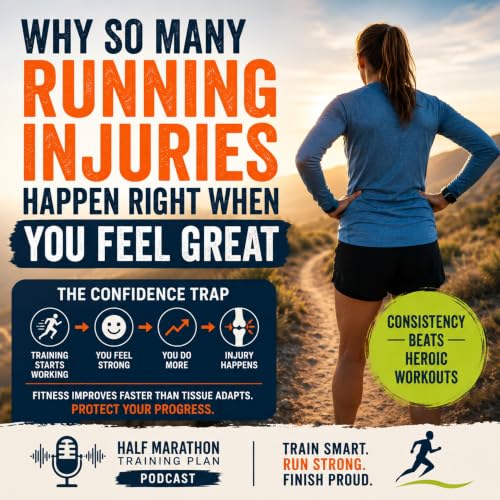
  • Why So Many Running Injuries Happen Right When You Feel Great
    Jul 6 2026

    Why do runners often get hurt right when training finally starts working?

    There is a dangerous moment in beginner running: the point where your breathing feels easier, your confidence rises, and you start thinking, “Maybe I can do a little more.”

    That is often when runners accidentally increase mileage, pace, hills, or training frequency too quickly.

    In this episode, Coach Chris and Coach Maya explain the confidence trap: why your heart and lungs often adapt faster than your tendons, bones, and connective tissue.

    You’ll learn:

    • Why feeling good does not always mean your body is ready for more
    • How small increases in mileage, speed, and hills can stack up quickly
    • Why shoes and form changes rarely fix training load mistakes
    • How confidence can lead to “too much, too soon” injuries
    • The better question to ask before adding more training

    Start Here:
    Download our free 14-week Half Marathon Training Plan and learn how to build endurance gradually while reducing your risk of common running injuries:
    https://halfmarathontrainingplan.com/start

    Related Resources

    • Achilles Pain in Runners: What Actually Works
    • How to Avoid Shin Splints
    • Heavy Legs While Running: Causes & Fixes

    This has been a production of the Half Marathon Training Plan Podcast. Visit HalfMarathonTrainingPlan.com for science-based training guidance, injury prevention articles, and beginner-friendly half marathon coaching.

    Mostra di più Mostra meno
    20 min
  • Why Every Step Feels So Hard (And How to Run More Smoothly)
    Jun 22 2026

    Do your feet sound loud when you run?

    If every step feels heavy, jarring, or harder than it should, the issue may not be your fitness. It may be the way your foot is landing.

    In this episode, Coach Chris and Coach Maya explain overstriding in simple, beginner-friendly language: why landing too far in front of your body creates a braking effect, why that can make running feel harder, and how small changes can help you run more smoothly.

    You’ll learn:

    • Why loud footsteps can be useful feedback
    • How overstriding creates invisible braking forces
    • Why your knees and shins may absorb more impact than necessary
    • Why the “180 cadence rule” is misleading for beginners
    • How shorter, quicker steps can help reduce braking without running faster

    Start Here:
    Download our free 14-week Half Marathon Training Plan and learn how to train smarter while reducing your risk of common running injuries:
    https://halfmarathontrainingplan.com/start

    Related Resources

    • How to Avoid Shin Splints
    • Beginner Running Gear Checklist

    This has been a production of the Half Marathon Training Plan Podcast. Visit HalfMarathonTrainingPlan.com for science-based training guidance, injury prevention articles, and beginner-friendly half marathon coaching.

    Mostra di più Mostra meno
    19 min
  • Achilles Pain in Runners: What Actually Works (Science-Based)
    Jun 8 2026

    Why does Achilles pain keep coming back, even after taking time off?

    For many runners, the cycle is frustratingly familiar: your Achilles starts hurting, you rest until it feels better, then the pain returns as soon as you start running again.

    In this episode, Coach Chris and Coach Maya explain what the latest sports medicine research says about Achilles tendinopathy, tendon loading, calf strength, recovery, and how to safely return to running without restarting the injury cycle.

    You'll learn:

    • Why rest alone often isn't enough
    • How tendons adapt differently than muscles
    • The role of progressive loading in recovery
    • When walking helps—and when it doesn't
    • The 24-hour rule for monitoring your progress
    • Common myths that keep runners stuck in the injury cycle

    Read the complete science-based article:
    Achilles Pain in Runners: What Actually Works

    Start Here:
    Download our free 14-week Half Marathon Training Plan and learn how to train smarter while reducing your risk of injury:
    https://halfmarathontrainingplan.com/start

    Related Resources

    • How to Avoid Shin Splints
    • Heavy Legs While Running: Causes & Fixes
    • Electrolytes for Runners

    This has been a production of the Half Marathon Training Plan Podcast. Visit HalfMarathonTrainingPlan.com for more evidence-based training guides, injury prevention articles, and beginner-friendly half marathon coaching.

    Mostra di più Mostra meno
    22 min
  • Why Running Suddenly Feels Hard (Even When You’re Training Consistently)
    May 25 2026

    Why do some runs suddenly feel terrible… even when your training hasn’t changed?

    Your legs feel heavy. Your pace falls apart. Your heart rate is unusually high. And suddenly you start wondering if you lost all your fitness overnight.

    In reality, most bad runs are not caused by lost fitness at all. They are caused by accumulated stress your body has not fully recovered from yet.

    In this episode, Coach Chris and Coach Maya break down the hidden factors that quietly make running feel harder than it should:

    • Poor sleep and nervous system fatigue
    • Life stress and recovery debt
    • Heat and dehydration
    • Chronic under-fueling
    • Why your brain sometimes forces your body into “low power mode”

    This episode is designed to help runners stop panicking during rough training weeks and better understand how recovery, stress, and adaptation actually work.

    Start Here: The Injury-Proof Running System
    Download our free 14-week training plan and learn how to build endurance without burnout or injury:
    halfmarathontrainingplan.com/start

    Related Articles:

    • Heavy Legs While Running: Causes & Fixes
    • Electrolytes for Runners

    This has been a production of the Half Marathon Training Plan Podcast. Visit HalfMarathonTrainingPlan.com for more science-based training guidance.

    Mostra di più Mostra meno
    20 min