Episodi

  • How a Veteran Founder Scaled With a Train the Trainer Model
    Nov 10 2026
    When the work customers pay for is work only you can do, every new client lands on one calendar and growth stops there.Army veteran Zachary Leyden, founder and owner of Ocean View Stables and author of Soft Is Strong, hit that wall once clients started booking faster than he could deliver. He joins Chelsea Roberts for the Success After Service series to explain The Trainer Ladder, the system that got him out from under it.Zachary served in long-range surveillance, deployed to Afghanistan, and built a horse business minutes from the San Francisco Zoo that now runs alongside a food truck, a store, tiny-house lodging, and a sip and paint experience. The scaling problem he describes will be familiar to anyone running a small federal contractor.You will hear why he stopped teaching level one students and started teaching level one instructors, and how that put his own students on payroll. He explains why leading from rank had to give way to reading the people in front of him, how he war games a multi-line operation so the pieces don’t collide, and why he never pushes a strong performer into management. One of his barn managers started out mucking stalls and asked his way up.For a GovCon firm, the translation is direct. If the capability that wins your proposals and delivers your contracts lives in one person, your pipeline, your bench, and your recompete readiness all stop at that person’s calendar. And promoting your best performer to fix it usually costs you the performer.Timestamps:00:03:18 What does a veteran actually lose in the first year out of uniform?00:05:21 What changes when you let customers book without a human in the loop?00:06:46 Why can’t a business scale when only the founder can do the work?00:08:25 What military leadership habit do veterans have to unlearn to lead civilians?00:10:21 Why does repetition beat real-time thinking when the window is short?00:16:29 How do you win the contract when the operator in charge fails?00:17:24 How do you run a multi-line small business without the pieces colliding?00:18:59 Is running your own business really harder than climbing the corporate ladder?00:21:27 How do you build a training system where your people teach the next level?00:22:57 Why don’t most people want to lead, even when they say they do?00:24:26 How does someone climb from entry level to management without being pushed?00:25:07 Should you push strong performers into management or wait for them to ask?00:26:14 What is Saved by the Saddle, and who does it serve?Resources:Follow Chelsea Roberts on LinkedInFollow Zachary Leyden on LinkedInOther Resources:Ocean View Stables Website: https://www.oceanviewstables.comLeyden Horsemanship: https://www.leydenhorsemanship.comListen now on:Apple: https://podcasts.apple.com/us/podcast/govcon-unscripted/id1766384482Spotify: https://open.spotify.com/show/1NL0kFAvmgECLTJpUZYNHyLike and follow us:YouTube: https://www.youtube.com/@GovConUnscriptedUSInstagram: https://www.instagram.com/govconunscriptedpod/Facebook: https://www.facebook.com/govconunscripted/LinkedIn: https://www.linkedin.com/showcase/govcon-unscripted/posts/Join our GovCon communities:LinkedIn: https://www.linkedin.com/groups/14618490/Facebook: https://www.facebook.com/groups/govconunscriptedcommunity
    Mostra di più Mostra meno
    30 min
  • $71B Reclassified, No New Work: The SBA Size Standards Proposal
    Nov 4 2026
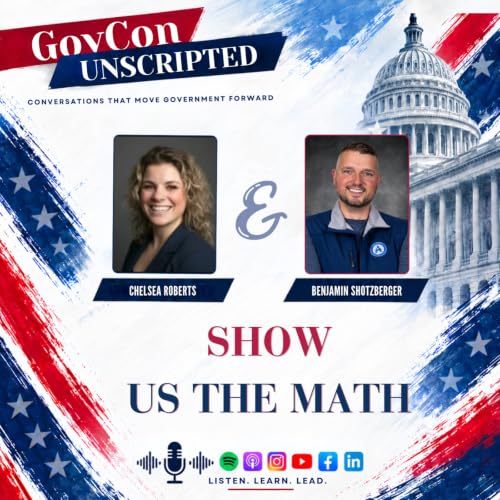
    SBA can grow its small business numbers by $71 billion without awarding a single new contract.That is The Reclassification Illusion. The scoreboard changes, the work doesn't, and the firms the program was built for are the ones who pay for it.SBA's own analysis says $71 billion in existing contracts would count as small under its size standards proposal, and none of those awards is new.Ben Shotzberger, Founder and Chief Backstop of In Foul Territory and a 10-year homeland security fed, joins Chelsea Roberts to unpack what that means for your set-aside pipeline.That is The Reclassification Illusion. Roughly 37,000 contractors become small on paper, the agency's numbers climb, and the $10 million shop that built its capture plan on today's NAICS standards now competes with a $530 million company carrying the same label.Ben has worked on both sides of the table, as a COTR inside Homeland Security and in industry at small businesses, mid-tiers, and large primes. He now leads the proposed Small Posse, a coalition of firms asking SBA to open its methodology and talk with industry before the rule moves forward.Ben and Chelsea cover why reclassification adds no new small business work, what agencies lose when small firms drop out of the market, and why the people opposing this proposal are not opposing modernization. They also get into the small business cliff, the case for a separate mid-tier or emerging category instead of stretching IT services from under $50 million to $531 million, and what a win looks like, whether that is dialogue with SBA or a challenge in court. If your next recompete sits in a set-aside, this is the conversation to hear before the November 20, 2026 comment deadline.Timestamps:00:02:38 Why did small business advocates form a single coalition when WOSB, SDVOSB, and other groups were already commenting on the SBA size standards proposal?00:04:43 Does reclassifying $71 billion in existing contracts as small create any new small business work?00:05:34 Could a household-name tech company qualify as small under the proposed size standards?00:07:19 How many viable small business prime contractors could the federal market support under the new size standards?00:08:04 Can a $10 million small business compete with a $530 million firm that also counts as small?00:08:43 What do agencies lose when small business contractors drop out of the market?00:10:09 Would newly small large firms even pursue simplified acquisition and purchase card work?00:10:41 Why does the extended SBA comment period worry small business advocates?00:11:40 Are opponents of the SBA size standards proposal against modernizing size standards?00:12:16 What does a win look like for small businesses fighting the size standards proposal?00:13:30 Should mid-tier contractors get their own size category instead of a $531 million small business standard?00:14:23 How did past SBA size standard increases affect small firms approaching their limit?00:16:53 Does the size standards proposal solve the small business cliff or push it down the road?00:17:58 Why does incubating small contractors matter for the next generation of large primes?00:23:04 Why are some contractors afraid to publicly oppose the SBA size standards proposal?00:24:55 How is the Small Posse governed, and does a two-person firm get the same vote as a large association?00:26:38 How can contractors join the Small Posse or contact the coalition?Resources:Follow Chelsea RobertsFollow Ben ShotzbergerOther Resources:Small Posse WebsiteSmall Posse email: RideWithUs@SmallPosse.orgListen now on:Apple: https://podcasts.apple.com/us/podcast/govcon-unscripted/id1766384482Spotify: https://open.spotify.com/show/1NL0kFAvmgECLTJpUZYNHy Like and follow us:YouTube: https://www.youtube.com/@GovConUnscriptedUSInstagram: https://www.instagram.com/govconunscriptedpod/Facebook: https://www.facebook.com/govconunscripted/LinkedIn: https://www.linkedin.com/showcase/govcon-unscripted/posts/ Join our GovCon communities:LinkedIn: https://www.linkedin.com/groups/14618490/Facebook: https://www.facebook.com/groups/govconunscriptedcommunity
    Mostra di più Mostra meno
    31 min
  • How GovCon Firms Get Findable on LinkedIn | The Waldo Problem
    Oct 27 2026
    Mark Amtower has marketed to the government for more than 40 years, and he calls the federal market a vast Where's Waldo picture.A Partner at Amtower & Company, he has hosted Amtower Off Center on Federal News Network for 19 years, contributed to Washington Technology for 18 years, and written 10 books, 5 on GovCon, including the new Findable.Your firm can be fully capable and still invisible to the one buying office that matters. In a market of hundreds of federal activities, being capable and being findable are two different jobs, and posting more, connecting with everyone, and giving yourself a bigger title only add to the noise.Mark's sequence is to differentiate first and connect second. Describe what you do in terms that resonate with a particular agency or type of activity, share past performance if you have it, and build educational content around that expertise. Only then should you connect with the agencies using that technology and the companies embedded inside them. He walks through his annual census of feds on LinkedIn, which by his count covers 820 federal activity pages and about 2.7 million feds. He also explains why a seat on an Army vehicle means sorting through 130 Army URLs to find the actual buying activities. He unpacks Army Directive 2026-17 and why consolidating official accounts does not make the people behind them disappear.From there, the conversation turns to how he vets every connection request, why content should educate rather than end in a pitch, and why account-based marketing matters more for small businesses as agency information gets harder to find. Mark shares how he uses Gemini to sharpen his own ideas without handing it the writing. He describes the 18- to 24-month runway he puts in front of new entrants, and why the market, not the author, decides who earns a leading voice. If you use LinkedIn for GovCon business development, this one resets where the effort goes.Timestamps:02:06 Is LinkedIn still a business platform for federal contractors, or is it turning into Facebook?03:28 How should you ask an established GovCon voice to connect with you on LinkedIn?06:57 How do you tell whether a GovCon expert on LinkedIn is legitimate?07:56 Does refusing most LinkedIn connection requests limit your reach in GovCon?10:00 How long does it take a new federal contractor to win its first contract, and what does it cost?12:13 Do small business set-aside programs still help new federal contractors under the current administration?14:37 Are the recent executive orders actually speeding up federal procurement?16:03 How should a small business differentiate itself to a federal agency?16:47 Why is it so hard to stand out in the federal market, and should your content end with a sales pitch?18:15 How can small businesses use LinkedIn to find the buying activities inside an agency?19:55 Is the Army shutting down its LinkedIn pages, and what does that mean for contractors?21:31 Why does account-based marketing matter more when agency information gets harder to find?22:48 How should GovCon professionals use AI to write content without losing their voice?24:48 Can you give yourself a leading title in GovCon, or does the market decide?25:33 Is there a legitimate path to building a subject matter expert platform in GovCon?Resources:Connect with Chelsea RobertsConnect with Mark AmtowerOther Resources:Federal News Network WebsiteAmtower and CompanyListen now on:Apple: https://podcasts.apple.com/us/podcast/govcon-unscripted/id1766384482Spotify: https://open.spotify.com/show/1NL0kFAvmgECLTJpUZYNHy Like and follow us:YouTube: https://www.youtube.com/@GovConUnscriptedUSInstagram: https://www.instagram.com/govconunscriptedpod/Facebook: https://www.facebook.com/govconunscripted/LinkedIn: https://www.linkedin.com/showcase/govcon-unscripted/posts/ Join our GovCon communities:LinkedIn: https://www.linkedin.com/groups/14618490/Facebook: https://www.facebook.com/groups/govconunscriptedcommunity
    Mostra di più Mostra meno
    29 min
  • GSA's AI Clause Hits Oct 19. Who Decides If It Applies to You?
    Oct 20 2026
    GSA's new AI clause hinges on whether AI is a material feature of the buy, and "material" is the one word nobody defined.With Shauna Weatherly, President and Founder of Federal Subcontract Solutions (FedSubK) and a former federal chief of contracting with 35 years in acquisition, and Jaime Gracia, Chief Innovation Officer at The Wolverine Group and a former federal procurement executive at Treasury, DHS, and State.GSAR 552.239-7001 is a class deviation, not a final rule, and contracting officers can use it now. Shauna and Jaime cover several points with host Chelsea Roberts: • Why the clause is about protecting government data rather than AI ethics. • How industry feedback changed it after the first draft treated every contractor using AI like an AI provider. • How the two-part test and its exceptions work. • Why the requirement language and the contracting officer end up deciding whether it applies.From there, they follow the clause past award. They look at who administers it, whether it stays inside GSA once it reaches MAS, and what it does to pricing, no-bid decisions, and MAS discounts.You come away knowing three things. First, what to ask before award. Second, why the impact analysis is worth reading before you comment. Third, how CO discretion ends up in your price.This is The Discretion Premium. When a clause leaves the deciding calls to the contracting officer, contractors build that uncertainty into their price, and the government ends up paying for it.Timestamps:04:21 What is GSAR 552.239-7001, and when does it take effect?08:34 Does GSA treat every contractor using AI like an AI provider?12:06 How do contracting officers decide whether the GSA AI clause applies?23:24 How does contracting officer discretion create risk for contractors during the deviation?27:58 How should contractors prepare for the GSA AI clause, and what does it do to pricing?34:54 Will GSA MAS discounts shrink as new AI requirements roll in?Resources:Connect with Chelsea RobertsConnect with Shauna WeatherlyLinkedIn https://www.linkedin.com/in/shauna-weatherly/Website https://fedsubk.comYouTube https://www.youtube.com/@FedSubKConnect with Jaime GraciaLinkedIn https://www.linkedin.com/in/jaimegracia/Website https://wolverine-group.com/Listen now on:Apple: https://podcasts.apple.com/us/podcast/govcon-unscripted/id1766384482Spotify: https://open.spotify.com/show/1NL0kFAvmgECLTJpUZYNHyLike and follow us:YouTube: https://www.youtube.com/@GovConUnscriptedUSInstagram: https://www.instagram.com/govconunscriptedpod/Facebook: https://www.facebook.com/govconunscripted/LinkedIn: https://www.linkedin.com/showcase/govcon-unscripted/posts/Join our GovCon communities:LinkedIn: https://www.linkedin.com/groups/14618490/Facebook: https://www.facebook.com/groups/govconunscriptedcommunity
    Mostra di più Mostra meno
    47 min
  • Budget to Operate, Not Just to Launch: Financing Federal Contract Growth
    Oct 13 2026

    Winning the federal contract is supposed to be the good news. Evan Henris, CEO of Parabilis, explains why it so often starts the cash crisis instead.

    The Launch Budget Trap. Contractors budget to win the work and stand it up, but not to carry it until the government pays. That gap pushes the financing decision into a crisis, right when every option gets more expensive.

    Evan joined Parabilis in 2018, when the McLean, VA lender had four people, and worked through underwriting, operations, and capital markets before being named CEO in early 2026. Parabilis finances growing small and mid-size federal contractors so they can perform on the work they win. He sits down with Chelsea Roberts to walk through where contract financing goes wrong and what it costs when the decision gets made under pressure.

    You will hear how much operating runway a new award really consumes (two to six months of expenses, in Evan's estimate), why selling a $1M invoice to cover a $15K bill rarely makes sense, and why rescue cash taken after a recompete slips usually costs more than the hard call it was meant to avoid. Evan also covers when debt is the wrong answer to a contract loss, what lenders weigh beyond the award itself, how AI can build a cash flow model a lender will actually read, and the calendar test every founder should be able to pass.

    If your pipeline is growing, this is the conversation to have before the next award lands.

    Timestamps:

    00:06:05 How do you spot a lender whose pricing will eat your margin?

    00:10:13 How much working capital does a new federal contract actually need?

    00:10:56 When does invoice factoring stop making sense?

    00:13:51 Is factoring a federal contract invoice legal?

    00:15:47 What is a merchant cash advance, and what does it really cost?

    00:16:44 Why do contractors reach for rescue cash after a recompete loss?

    00:18:39 What should you do instead of taking a rescue advance?

    00:21:14 When is debt the wrong answer to a contract loss?

    00:25:12 Is your company too small for a line of credit?

    00:26:45 Should a capital partner be part of your growth pipeline?

    00:28:52 What do lenders evaluate beyond the contract award?

    00:30:48 Can AI build a cash flow model a lender will accept?

    00:34:49 Can your company run for two weeks without you?


    Resources:

    Follow Evan Henris on LinkedIn

    Follow Chelsea Roberts on LinkedIn


    Other Resources:

    Parabilis Website


    Listen now on:

    Apple: https://podcasts.apple.com/us/podcast/govcon-unscripted/id1766384482

    Spotify: https://open.spotify.com/show/1NL0kFAvmgECLTJpUZYNHy

    Like and follow us:

    YouTube: https://www.youtube.com/@GovConUnscriptedUS

    Instagram: https://www.instagram.com/govconunscriptedpod/

    Facebook: https://www.facebook.com/govconunscripted/

    LinkedIn: https://www.linkedin.com/showcase/govcon-unscripted/posts/

    Join our GovCon communities:

    LinkedIn: https://www.linkedin.com/groups/14618490/

    Facebook: https://www.facebook.com/groups/govconunscriptedcommunity

    Mostra di più Mostra meno
    41 min
  • How Small Businesses Get Recognized in Federal Contracting | The Introduction Tax with Will McCormick
    Oct 6 2026

    Your capability statement gets you into the room. Then you spend the first 20 minutes introducing yourself anyway.

    It's called "The Introduction Tax", and small firms pay it in every meeting and at every event. The cost comes out of the two resources they have least of, which are time in front of the customer and the budget to show up.

    Chelsea Roberts sits down with Will McCormick, Editorial Director at Set-Aside Alert and creator of GovCon Games. Will has been a writer for about 20 years and covers federal small business policy for Set-Aside Alert, which has been publishing since 1991. Will explains why he built GovCon Games to help firms lead with personality and expertise before they lead with past performance. He also walks through the problem, cause, consequence, and solution sequence that turns a single conversation into content that keeps working for a year.

    The two also cover the policy picture small firms are working in right now. They talk about why HUBZone is holding up better than other set-aside programs, the quieter pressure on WOSB, and why the CMMC Phase II suspension does not take NIST SP 800-171 off anyone's plate. Chelsea shares what separates a post-event follow-up that gets a reply from one that gets ignored.

    If your BD plan still depends on handing out cards and hoping someone calls back, this episode will change how you budget your next event.


    Resources:

    Connect with Will McCormick

    Connect with Chelsea Roberts


    Other Resources:

    Set-Aside Alert LinkedIn https://www.linkedin.com/in/setasidealert/

    GovCon Games Instagram https://www.instagram.com/govcongames

    Personal Email: will@setasidealert.com


    Listen now on:

    Apple: https://podcasts.apple.com/us/podcast/govcon-unscripted/id1766384482

    Spotify: https://open.spotify.com/show/1NL0kFAvmgECLTJpUZYNHy

    Like and follow us:

    YouTube: https://www.youtube.com/@GovConUnscriptedUS

    Instagram: https://www.instagram.com/govconunscriptedpod/

    Facebook: https://www.facebook.com/govconunscripted/

    LinkedIn: https://www.linkedin.com/showcase/govcon-unscripted/posts/

    Join our GovCon communities:

    LinkedIn: https://www.linkedin.com/groups/14618490/

    Facebook: https://www.facebook.com/groups/govconunscriptedcommunity

    Mostra di più Mostra meno
    42 min
  • What the FAR Overhaul Means for Small Business Contractors | The Upstream Window with David Mullis
    Sep 29 2026

    The FAR overhaul was sold as 500 fewer pages. The person who reads every rule expects it to land back near 2,000.

    The rules that bind you get decided before the proposed rule ever reaches your inbox. Almost no one from industry is in the room when it happens.

    Chelsea Roberts sits down with David Mullis, Regulatory Affairs Consultant at Gov Contract Pros LLC, who tracks Federal Register, OIRA, and Unified Regulatory Agenda activity for the small business community. His firm has requested an OIRA 12866 meeting on the Revolutionary FAR Overhaul, and by his account it is the only contracting industry group engaging in that process right now.

    They get into what the RFO actually removes and what it quietly adds, including new CUI incident reporting, cybersecurity frameworks, and termination protest timelines. David explains why moving forms and examples into the FAR Companion takes them outside notice and comment, why contracting officers' own liability may pull a more flexible FAR back toward large incumbents, and where commercial-first buying lowers the cybersecurity bar. On CMMC, he walks through a 60-day pause that doesn't reach the November implementation date, why primes may require it regardless, and the planned move to NIST SP 800-171 Revision 3 with its supply chain focus.

    The back half is The Upstream Window. David makes the case for the 12866 meeting as 30 unfiltered minutes with White House staff and the FAR Council, explains why the SBA size standards methodology white paper now at OIRA is the part that actually binds, and flags why this will be the first size standard reviewed in a post-Chevron, Loper Bright world.

    If you run capture, BD, or a small business with a size standard to protect, the time to engage is before the comment period, not during it.

    Timestamps:

    00:04:20 Is the RFO actually making the FAR shorter?

    00:05:40 What does moving forms and examples into the FAR Companion change for contractors?

    00:06:50 Will RFO flexibility actually help small businesses win?

    00:11:05 Does the commercial-first push create a security gap?

    00:15:18 CMMC is paused. Should companies stop preparing?

    00:15:52 What changes when CMMC moves to NIST 800-171 Revision 3?

    00:23:05 How can contractors actually influence the RFO before it's final?

    00:24:38 Will a government shutdown delay the next round of RFO rules?

    00:26:52 Are SBA size standards going up or down?

    00:27:30 When is the comment that actually changes your size standard?

    00:31:35 What does Loper Bright mean for the next size standards rule?

    Resources:

    • Follow David Mullis
    • Follow Chelsea Roberts

    Other resources:

    • Gov Contract Pros on LinkedIn: https://www.linkedin.com/company/gov-contract-pros
    • Gov Contract Pros Website: https://www.govcontractpros.com


    Listen now on:

    Apple: https://podcasts.apple.com/us/podcast/govcon-unscripted/id1766384482

    Spotify: https://open.spotify.com/show/1NL0kFAvmgECLTJpUZYNHy


    Like and follow us:

    YouTube: https://www.youtube.com/@GovConUnscriptedUS

    Instagram: https://www.instagram.com/govconunscriptedpod/

    Facebook: Facebook https://www.facebook.com/govconunscripted/

    LinkedIn: https://www.linkedin.com/showcase/govcon-unscripted/posts/


    Join our GovCon communities:

    LinkedIn: https://www.linkedin.com/groups/14618490/

    Facebook: www.facebook.com/groups/govconunscriptedcommunity

    Mostra di più Mostra meno
    35 min
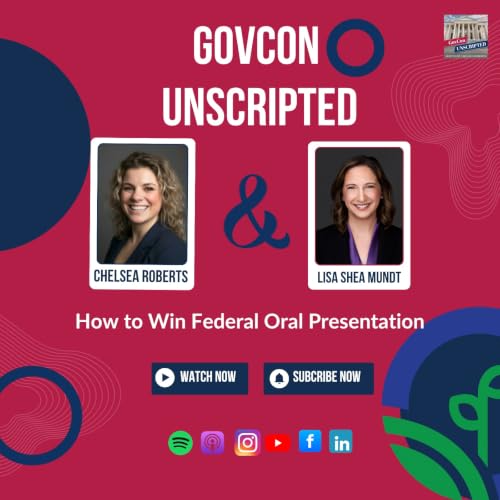
  • How to Win Federal Oral Presentations | The Orals Gap with Lisa Shea Mundt
    Sep 22 2026

    In the 1990s, the government decided proposals had become too easy to fake, so it started asking to hear from the people who would actually do the work. That is the oral presentation, and it is now one of the fastest-growing phases in federal source selection.

    In this week's episode of GovCon Unscripted, orals coach Lisa Shea Mundt, a 15-year veteran of federal proposals, sits down with Chelsea Reberts to explain why the skill that wins on paper doesn't win in the room. She covers confidence ratings versus adjectival scoring, the solicitation language that quietly grades collaboration, why a corporate representative who cannot survive Q&A is a liability, and how to prepare a reluctant technical expert to carry a live presentation.

    Whether you are building your first orals team or tightening a capture plan that treats orals as a formality, this conversation is a practical guide to winning the room.

    Chapters:

    00:00 Why the government stopped trusting proposals

    02:00 What an oral presentation actually is

    03:30 The unwritten requirement hiding in “performance risk”

    05:30 Why COVID made orals explode

    07:30 Confidence ratings vs adjectival scoring

    11:00 Writing a script is not reading a proposal aloud

    16:00 Logos, pathos, ethos in the room

    19:00 “The words need to conform to me”

    22:00 Scripts, notes, and teleprompters: what is allowed

    27:00 When your best technical mind is your worst presenter

    32:00 The Q&A round nobody prepares for


    Resources:

    Follow Lisa Shea Mundt

    Follow Chelsea Roberts


    🎧 Listen now on:

    🔹 Apple: https://podcasts.apple.com/us/podcast/govcon-unscripted/id1766384482

    🔹 Spotify: https://open.spotify.com/show/1NL0kFAvmgECLTJpUZYNHy

    Like and follow us:

    🔹 YouTube: https://www.youtube.com/@GovConUnscriptedUS

    🔹 Instagram: https://www.instagram.com/govconunscriptedpod/

    🔹 Facebook: https://www.facebook.com/govconunscriptedpod/

    🔹 LinkedIn: https://www.linkedin.com/showcase/govcon-unscripted/posts/

    🔹 JOIN OUR #govcon #community: https://www.linkedin.com/groups/14618490/

    Mostra di più Mostra meno
    40 min