Extreme Living copertina

Extreme Living

Extreme Living

Di: Anchal Bhaskar
Ascolta gratuitamente

Offerte di stagione | 0,99 €/mese per i primi 3 mesi

A seguire 9,99 €/mese – si applicano condizioni. Puoi disdire mensilmente.
Extreme Living is a design inquiry into human isolation, exploring how people live, heal, and adapt in confined and extreme environments, from space stations and Antarctic labs to cancer wards and prisons. Hosted by Anchal, exploring how isolation shapes us.Anchal Bhaskar Arte
  • Beyond the Concept: When Space Habitats Have to Become Real with Frank Eichstadt
    Oct 19 2026

    What happens when a space architecture concept has to become something that can actually be built, launched, operated, maintained, and sustained?

    In this episode of Extreme Living, I speak with space architect and industrial designer Frank Eichstadt, who was also one of my professors when I studied space architecture at the University of Houston. Frank’s career has spanned architecture, industrial design, engineering, integration, testing, and human spaceflight.

    In this episode, we discuss:

    • What happens when space architecture moves from concept to reality
    • Designing within mass, power, cost, schedule, and engineering constraints
    • Lessons from Frank’s work on the Enterprise module
    • How microgravity changes the fundamentals of spatial design
    • Designing for professional astronauts versus commercial visitors
    • Why adaptability may be essential to future commercial space stations
    • Logistics, maintenance, sustainment, and the full life of a habitat
    • What submarines, hospitals, and other extreme environments can teach space architecture
    • Cross pollination between healthcare design and space habitats
    • Frank’s advice for future space architects

    At the center of the conversation is one recurring idea: look at the whole picture. A habitat is not just an interior. It is part of a larger system that has to support people before, during, and after the mission.

    Mostra di più Mostra meno
    52 min
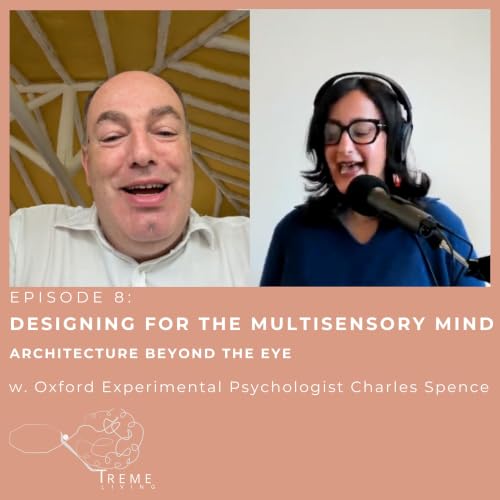
  • Multisensory Design in Extreme Environments with Oxford Experimental Psychologist Charles Spence
    Aug 7 2026

    In this episode of Extreme Living, Anchal speaks with Professor Charles Spence, an experimental psychologist at the University of Oxford whose work explores multisensory perception and how our senses shape the way we experience the world.

    The conversation looks at architecture beyond the eye. How do sound, smell, touch, taste, light, atmosphere, and sensory control shape life in confined and extreme environments such as space stations, submarines, hospitals, prisons, and Antarctic research bases?

    Charles discusses why architecture has often prioritized the visual, what happens when environments become sensory monotonous, and how lack of control over sound, smell, light, and privacy can affect wellbeing.

    The episode also explores flavor perception in space, sonic seasoning, sensory agency, windows, natural light, and what healthcare design might teach future space habitats.


    Chapters

    • The Power of Multisensory Design
    • Confinement and Psychological Effects
    • Why Architecture Is Dominated by the Eye
    • Sensory Deprivation in Modern Buildings
    • Sound, Taste, and Perception
    • Food, Flavor, and Dining in Extreme Environments
    • Sensory Complaints in Hotels and Built Environments
    • Sensory Agency and Neurodiversity
    • Windows, Natural Light, and Space Habitats
    • What Healthcare and Space Design Can Learn From Each Other


    Papers Discussed

    Senses of Place: Architectural Design for the Multisensory Mind
    https://doi.org/10.1186/s41235-020-00243-4

    Factors Affecting Flavor Perception in Space: Does the Spacecraft Environment Influence Food Intake by Astronauts?
    https://doi.org/10.1111/1541-4337.12633

    Mostra di più Mostra meno
    44 min
  • Space Medicine: Health and Isolation in a Mars Analog with Dr. Sheyna Gifford
    Jul 14 2026

    In this episode of Extreme Living, I speak with Dr. Sheyna Gifford, an aerospace medicine physician, analog astronaut, and science communicator.


    In 2015, Sheyna entered a 1,200-square-foot dome on the slope of Mauna Loa in Hawaii with five crewmates for a 365-day Mars analog mission called HI-SEAS IV. Inside the habitat, there was no fresh air, no real-time contact with the outside world, limited food variety, and no simple way to step away from the people around her.

    What makes Sheyna’s perspective especially unique is that she was both living the mission and caring for the crew. She served as the crew’s health and safety officer while also documenting the experience as a crew journalist.


    We talk about what isolation does to the body and mind, how stress shows up in confined environments, why control and choice matter, what future habitats need beyond medical equipment, and what happens when people return to normal life after a year of extreme living.


    Sheyna also discusses the TIME article she wrote during COVID-19, drawing lessons from her Mars analog experience for people suddenly living through isolation on Earth.


    TIME article: https://time.com/5814128/tips-mars-quarantined-earthlings/


    Extreme Living explores how people live, heal, and adapt in confined and extreme environments from space habitats and polar stations to hospitals, prisons, and other places where design meets the edge of human endurance.

    Mostra di più Mostra meno
    54 min
adbl_web_anon_alc_button_suppression_t1
Ancora nessuna recensione