

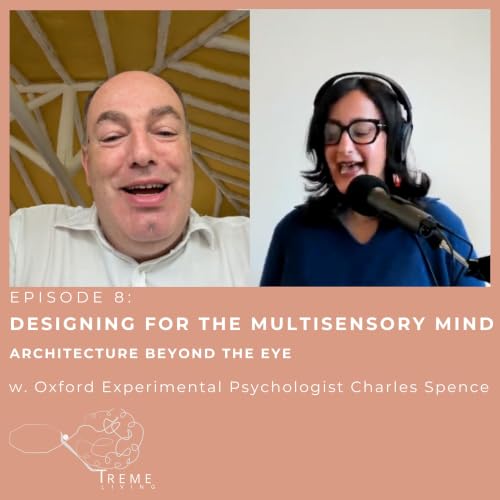
Multisensory Design in Extreme Environments with Oxford Experimental Psychologist Charles Spence
Impossibile aggiungere al carrello
Rimozione dalla Lista desideri non riuscita.
Non è stato possibile aggiungere il titolo alla Libreria
Non è stato possibile seguire il Podcast
Esecuzione del comando Non seguire più non riuscita

Multisensory Design in Extreme Environments with Oxford Experimental Psychologist Charles Spence
-
Letto da:
-
Di:
In this episode of Extreme Living, Anchal speaks with Professor Charles Spence, an experimental psychologist at the University of Oxford whose work explores multisensory perception and how our senses shape the way we experience the world.
The conversation looks at architecture beyond the eye. How do sound, smell, touch, taste, light, atmosphere, and sensory control shape life in confined and extreme environments such as space stations, submarines, hospitals, prisons, and Antarctic research bases?
Charles discusses why architecture has often prioritized the visual, what happens when environments become sensory monotonous, and how lack of control over sound, smell, light, and privacy can affect wellbeing.
The episode also explores flavor perception in space, sonic seasoning, sensory agency, windows, natural light, and what healthcare design might teach future space habitats.
Chapters
- The Power of Multisensory Design
- Confinement and Psychological Effects
- Why Architecture Is Dominated by the Eye
- Sensory Deprivation in Modern Buildings
- Sound, Taste, and Perception
- Food, Flavor, and Dining in Extreme Environments
- Sensory Complaints in Hotels and Built Environments
- Sensory Agency and Neurodiversity
- Windows, Natural Light, and Space Habitats
- What Healthcare and Space Design Can Learn From Each Other
Papers Discussed
Senses of Place: Architectural Design for the Multisensory Mind
https://doi.org/10.1186/s41235-020-00243-4
Factors Affecting Flavor Perception in Space: Does the Spacecraft Environment Influence Food Intake by Astronauts?
https://doi.org/10.1111/1541-4337.12633