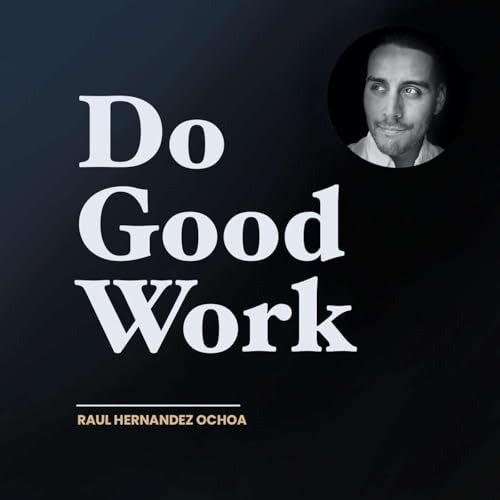
Do Good Work copertina

Do Good Work

Do Good Work

Di: Raul Hernandez Ochoa
Ascolta gratuitamente

Offerte di stagione | 0,99 €/mese per i primi 3 mesi

A seguire 9,99 €/mese – si applicano condizioni. Puoi disdire mensilmente.
A proposito di questo titolo
Do Good Work is not a label but a way of living. It is the constant and diligent effort to achieve a new level of excellence in one’s own life. It is the hidden inner beauty behind the struggle to achieve excellence. It is not perfect but imperfect. It is the effort, discipline and focus that often goes unnoticed. The goal of this podcast is to highlight that drive. The guests I have on this show emulate this drive in their own special way. You’ll be able to apply new ideas into your own life by learning from them. We will also have 1on1 episodes with me where we’ll dive into my own experiences with entrepreneurship and leadership. Every episode is designed to provide you with ideas that you can apply and grow in excellence in all areas of your life, business and career. Do Good Work, RaulAttribution-NonCommercial-NoDerivatives 4.0 International Economia Gestione e leadership Leadership Marketing Marketing e vendite
  • How to Solve a Moonshot: Systems, Design, Prototyping With Tyler Smith of The Luminosity Lab at ASU
    Nov 23 2026

    In this episode, I talked with Tyler Smith, Senior Director of The Luminosity Lab at Arizona State University, about how a university lab goes after moonshot problems and then gets the technology out of the lab and into the world. Tyler explains that the lab started in 2016 with about 10 students, modeled after Lockheed Skunk Works, and has grown to over a hundred, and that his teams go after significant, very difficult problems on purpose. We get into the three methods behind how they tackle a moonshot, systems thinking, design thinking and rapid prototyping, how a project passes stage gates before it becomes real work, and how they judge a problem by its societal impact. Tyler shares two moonshots, a personalized AI for education that started in 2016 and a satellite to satellite wireless power system his team was preparing for a flight demonstration when we recorded, and why he uses AI to amplify what people can build instead of reducing the work. He also names healthcare and energy as problems worth solving, and makes the case that energy needs more people, and explains how the lab launched four companies in a single year and why they built Lab 48 to give companies coming out of the university access to early talent and early capital. I close with the flywheel I see in his model that any firm can run, and a question about what ultra running teaches him about long projects.

    Chapters:

    • 00:00 Hard Problems and Four Companies Out of the Lab
    • 01:50 A Lab Modeled After Skunk Works
    • 03:23 What Counts as a Moonshot
    • 05:15 Setting Aside Time, Talent, and Treasure Limits
    • 07:19 Systems Thinking, Design Thinking, and Rapid Prototyping
    • 08:39 Starting With an Industry, Not an Answer
    • 11:23 Stage Gates Before a Project Is Real
    • 12:16 How to Measure Societal Impact
    • 14:25 From Secret Moonshots to a Personalized AI
    • 17:47 Wireless Power From Satellite to Satellite
    • 19:25 Using AI to Amplify, Not Reduce
    • 23:04 Healthcare and Energy: Problems Worth Solving
    • 24:32 The Case for More People Working on Energy
    • 27:28 Getting Lab Technology to Market
    • 28:53 Crossing the Chasm With Lab 48
    • 30:53 A Flywheel Any Firm Can Run
    • 31:57 What Ultra Running Teaches About Long Projects
    • 34:19 Where to Find Tyler

    Connect with Tyler:

    • The Luminosity Lab
    • Tyler Smith on LinkedIn

    Connect with Raul:

    • Work with Raul
    • Free Growth Resources
    • Connect with Raul on LinkedIn (DMs open)
    Mostra di più Mostra meno
    37 min
  • How to Get Profitable AI: What the 6% Do Differently With Keith Jacobs and Grant Baldwin
    Oct 20 2026

    In this episode, I talked with Keith Jacobs, CEO of geniant, and Grant Baldwin, Partner at geniant, about why most AI investments never show up on the P&L, and what the small group of companies making real money on AI actually does differently. Grant walks through a McKinsey study of 1,700 companies where only 6% are making real money on AI, and Keith and Grant make the case that what sets that 6% apart is redesigning how the work gets done instead of automating a broken process, what Keith calls paving the cow path. We get into why geniant puts anthropologists and psychologists to work before its designers start building with AI, the Olympic level of performance employees will need once the busy work disappears, and why leadership has to clear the path from the top or AI initiatives slow down considerably. We also run a thought experiment on the future of software, closing the context gap until every piece of software is custom to the person using it, and talk about who should own your data and why an opt-in model matters.

    Chapters:

    • 00:00 The Olympian Worker
    • 02:35 Performing at a Higher Level
    • 06:46 Building the Right Thing
    • 09:51 The 6% Making Real Money
    • 11:53 Paving the Cow Path
    • 15:52 Scared to Admit Using AI
    • 17:54 Air Cover From the Top
    • 20:49 A Behavior First Operating Model
    • 22:46 Staying Optimistic About the Risk
    • 24:45 100 Times More Capable
    • 27:23 Closing the Context Gap
    • 30:48 Who Should Own Your Data
    • 33:19 Every Employee Owns Equity
    • 36:38 Thinking Like a CEO

    Connect with Keith & Grant:

    • geniant
    • geniant on LinkedIn
    • Keith Jacobs on LinkedIn

    Connect with Raul:

    • Work with Raul
    • Free Growth Resources
    • Connect with Raul on LinkedIn (DMs open)
    Mostra di più Mostra meno
    42 min
  • B2B Sales Are Risk Transfer With Garrick van Buren
    Oct 13 2026

    In this episode, I talked with Garrick Van Buren about pricing as value creation and why every price is really set against the status quo of “doing nothing,” meaning you must outcompete the comfort of not fixing a problem. We break down value as transformation from current to future state and how to quantify it through revenue gains, cost savings, time savings, and especially retention/churn, with examples like a real estate brokerage commission tool where agent retention drove the true value. Garrick shares his “value stack,” customer rediscovery interviews to uncover unpriced value and unmet needs, and a “How’s My Driving” approach to re-segment customers and refine positioning. We also discuss AI, speed-to-value premiums, services vs product tradeoffs, incremental pricing rollouts, and why founders must remove their own money emotions from pricing using metrics like percentage of annual revenue and risk mitigation.


    00:00 Pricing Against Status Quo

    04:34 Quantifying Value Shifts

    06:24 Revenue Retention and Churn

    08:35 The Value Stack Framework

    09:59 Real Estate CFO Case Study

    14:17 Net New Value With AI

    17:52 Customer Rediscovery Calls

    19:56 Unpriced Value and Missing Offers

    21:31 Services Strategy and Time to Value

    23:21 AI as New KPI

    24:41 Niching and Positioning

    25:01 Customer Rediscovery Buckets

    27:03 Pricing Power Signals

    29:18 Incremental Price Rollouts

    33:02 AI Discounts Debate

    34:26 Speed to Value Premium

    39:23 Jobs to Be Done Lens

    42:28 Detach Emotions from Pricing

    45:40 Risk Transfer and Credibility


    Connect with Garrick:

    • https://forstarters.substack.com

    • https://linkedin.com/in/garrickvanburen

    • https://pricingfromthestart.com


    Connect with Raul:

    • Work with Raul: https://dogoodwork.io/apply

    • Free Growth Resources: https://dogoodwork.io/free-growth-resources

    • Connect with Raul on LinkedIn (DMs open): https://www.linkedin.com/in/dogoodwork/

    Mostra di più Mostra meno
    47 min
adbl_web_anon_alc_button_suppression_t1
Ancora nessuna recensione