Episodi

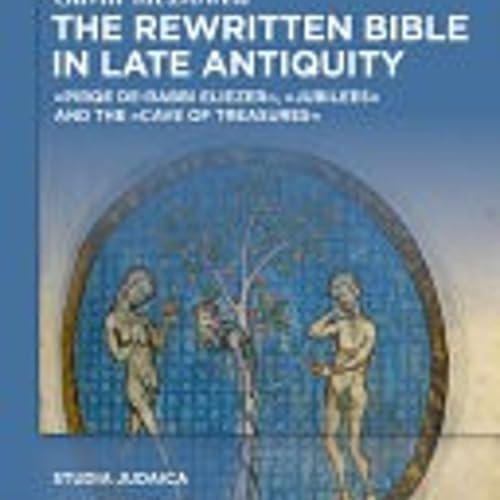
  • Gavin McDowell, *The Rewritten Bible in Late Antiquity: “Pirqe de-Rabbi Eliezer," "Jubilees," and the "Cave of Treasures"*. Berlin: De Gruyter, 2025.
    Sep 14 2026

    This monograph investigates the "Rewritten Bible" genre, which narrates the history of ancient Israel independently from the biblical text. It suggests that the author's portrayal of ancient prophets and patriarchs was shaped more by regional influences than by religious ones. *Pirqe de-Rabbi Eliezer* (PRE) is particularly noteworthy for incorporating several legends about biblical figures that are absent from the classical rabbinic texts of Talmud and Midrash. Contemporary scholars regard the non-rabbinic legends in PRE as remnants of Second Temple literature within Jewish tradition. However, this study aims to interpret the non-rabbinic elements in PRE as a result of the author's integration and modification of influences from the surrounding Christian and Muslim cultures, rather than through a direct lineage of Second Temple texts among Jews. This hypothesis will be assessed by analyzing two works that are similar to PRE in both form and content: Jubilees (second century BCE) and the Cave of Treasures (sixth century CE).


    Mostra di più Mostra meno
    1 ora e 34 min
  • Yermiyahu Ahron Taub, trans., *Dineh: An Autobiographical Novel by Ida Maze*. Amherst, MA: White Goat Press (an imprint of the Yiddish Book Center), 2022.
    Sep 20 2026

    For the very first time, the novel *Dineh* is now available in English translation. This autobiographical work in Yiddish by Ida Maze (1893–1962), published posthumously, has been translated by Yermiyahu Ahron Taub.

    *Dineh* is a poignant yet beautiful pastoral tale and a coming-of-age narrative seen through the eyes of a young girl. Set in what is present-day Belarus, the main character is motivated by her thirst for knowledge, her connections to family and community, and her passion for nature. Maze expertly intertwines Dineh’s story with those of others, particularly women and girls from her community.

    We meet the mysterious seamstress Shprintse; Beyle, who leaves her home to become a maid in Minsk; and Hinde, who discovers love with a young nobleman, among many other unforgettable characters. Maze courageously examines the lives of women, tackling themes such as class disparities, unrequited love, violence (both domestic and state-sponsored), and the perils of childbirth.

    She also explores the experiences of non-Jews and the interactions between Jews and non-Jews. The narrative is driven by the tightening grip of Tsarist anti-Semitism, the increasing restrictions on Jewish economic survival, and the rise of revolutionary movements.

    In summary, *Dineh* provides a haunting insight into rural, village, and small-town life in White Russia during the late 19th and early 20th centuries.


    Mostra di più Mostra meno
    1 ora e 33 min
  • Eric Barrios, *Foreign Soldiers in Judah’s Military: Biblical Attitudes in Light of Extra-Biblical Evidence*. Leiden, Netherlands: Brill, 2026.
    Sep 11 2026

    This book delves into the biblical viewpoints concerning the use of mercenaries in ancient Judah. Although contemporary warfare often casts a negative light on mercenaries, it is unclear if this sentiment was shared in ancient times. Through the collection and examination of evidence related to mercenary employment in Judah, Eric Barrios provides insights into biblical texts that reference mercenaries and other marginalized communities, striving to present a nuanced and comprehensive understanding of the social and religious attitudes towards mercenary usage in Judah and the broader ancient world.


    Mostra di più Mostra meno
    1 ora e 16 min
  • Julia O’Brien, *Prophets Beyond Activism: Rethinking the Prophetic Roots of Social Justice*. Westminster John Knox, 2024.
    Aug 27 2026

    This monograph thoughtfully questions the prevalent progressive belief that the prophets of ancient Israel were mainly focused on social justice. Instead, it boldly presents more enriching approaches to engaging with the prophetic texts in relation to justice causes. The idea that ancient Israel's prophets were chiefly concerned with social justice is so deeply ingrained in the mindset and discussions of progressive Christianity that it could be seen as a form of interpretive orthodoxy. For instance, progressives often depict prophets as individuals who confront authority and label "prophetic preaching" as a form of social critique. However, they frequently do this without providing explanations or considering alternative perspectives. In this work, Julia O’Brien contests the belief that the prophets were exclusively focused on issues aligned with modern social justice movements. By examining prophetic texts through the lens of their historical contexts—when they were composed and how they were revised—she complicates any absolute claims regarding the role of prophets in history. Engaging with readers from various racial, gender, and social backgrounds today prompts challenging inquiries about whose justice these texts genuinely advocate. Although it presents itself as a scholarly and objective stance, the orthodoxy of viewing prophets as social activists was formed in a specific historical context and continues to propagate many of the problematic ideologies from its inception. In light of these issues, O’Brien proposes alternative interpretations of the prophets aimed at justice. The chapters delve into the significance of Amos and Micah for modern economic ethics; the themes of inclusivity and exclusivity in Isaiah; the potential for understanding Jeremiah as a communal voice rather than an isolated figure; and the limitations of Second Isaiah’s creation theology in addressing the climate crisis. This volume is extensive, weaving together meticulous analyses of biblical texts within their literary and historical frameworks, alongside the history of prophetic thought.

    Mostra di più Mostra meno
    1 ora e 43 min
  • Phillip Michael Lasater and Benedikt Hensel, *Fear, Fear of God, God Fearers: Philological and Historical Perspectives on the World of Ancient Judaism and Christianity*. Tubingen, Germany: Mohr Siebeck, 2026.
    Aug 27 2026

    This compilation examines the significance of fear and the reverence of God as essential components within the religious and cultural realms of ancient Judaism and early Christianity. Through the application of philological, historical, and anthropological perspectives, the contributors investigate how emotions, particularly fear, influenced ritual practices, social hierarchies, and individual identities. A thorough analysis of biblical texts, Rabbinic literature, and early Christian writings is conducted alongside the traditions of Egypt and Mesopotamia, situating Jewish and Christian narratives within a broader intercultural framework. Furthermore, epigraphic artifacts, such as inscriptions from Aphrodisias, enhance the discourse and offer a comparative lens.

    Rather than perceiving fear merely as a sign of submission or religious subjugation, the contributors to this volume highlight its complex role in shaping communication methods, collective identities, and cultural interactions. Their findings demonstrate how the linguistic, literary, and ritual expressions of fear reflect wider negotiation processes within communities and across diverse traditions. This interdisciplinary methodology uncovers the conceptual frameworks surrounding fear, challenging oversimplified interpretations and providing new insights into ancient religious experiences. By bringing together distinguished scholars from various disciplines, this volume advances the study of emotions, the sociology of religion, and the intercultural history of ancient faiths, thereby offering essential perspectives for future research.

    Mostra di più Mostra meno
    1 ora e 10 min
  • Assaf Likhovski, *Legal Theory in the Colonies: Hindu and Jewish Scholars under British Rule*. New York: Cambridge University Press, 2026.
    Aug 24 2026

    In colonial India and Mandatory Palestine, early twentieth-century legal scholars made notable contributions to the understanding of law's essence, particularly through their analysis of Hindu and Jewish legal systems, both of which are deeply rooted in ancient religious traditions.

    This book explores the lives and ideas of these scholars, revealing a largely neglected global wave of legal innovation that arose in various non-Western regions. It challenges the belief that non-Western legal scholars in the colonies simply absorbed Western ideas.

    Rather, it argues that Indian and Jewish intellectuals utilized Western historical and sociological approaches to reinterpret Hindu and Jewish law, thus affirming their significance in contemporary legal and constitutional debates. Although the narrative is historical, it also resonates with ongoing tensions between Western liberal legal frameworks and non-Western religious legal systems.

    Mostra di più Mostra meno
    1 ora e 49 min
  • Yael Shemesh, *Elisha: The Holy Man of God*. Lenn Schramm, trans. Leiden: Brill, 2025.
    Aug 21 2026

    In contrast to the narratives surrounding Elijah, the tales of Elisha, particularly the brief legends, have not garnered much scholarly focus or thorough examination. However, this trend is beginning to shift, as recent studies frequently interpret them as being critical of Elisha. This book seeks to illuminate their depth and intricacy through literary analysis, positioning them as the earliest instance of prophetic hagiography in Israelite literature.

    Mostra di più Mostra meno
    1 ora e 20 min
  • Sandra Jacobs, *The Body as Property: Physical Disfigurement in Biblical Law*. London: Bloomsbury Academic, 2015.
    Aug 14 2026

    This monograph posits that physical disfigurement played a role in biblical law to validate legal property acquisition, especially when the status of dependents was officially recognized.

    It is grounded in the fact that the cuneiform script originated in Sumer and Mesopotamia for the purpose of record-keeping: to serve as legal proof of ownership, where the inscription on a tablet recorded the sale or transfer of property.

    In biblical law, the legitimacy of property acquisition was vital, with physical disfigurements signifying dependents, akin to how a veil or head covering denoted a wife or concubine in ancient Assyrian and Judean cultures.

    This is primarily supported by the narratives of prescriptive disfigurements: specifically, circumcision and the piercing of a slave's ear, both of which were mandated only when a son or slave was permanently acquired.

    Additionally, it is contended that legal entitlement was pertinent to the punitive disfigurements noted in Exodus 21:22-24 and Deuteronomy 25:11-12, where the physical violation of women was regarded solely as a violation of male property rights.

    Mostra di più Mostra meno
    1 ora e 13 min