• S01E09: The Unbroken Athlete: Identity, Resilience, and Holistic Recovery
    Jan 19 2026
    Welcome to Blueprint of an Athlete, where science meets sports. In this episode, host Dr. Robin West is joined by Dr. Catherine Logan, an orthopedic surgeon and physical therapist, and Emily Perrin, a clinical social worker and former D1 athlete. Together, they are the founders of The Unbroken Athlete, a resource dedicated to the mental and emotional side of injury recovery. Beyond the Scalpel: Why Physical Healing Isn't Enough Dr. Logan shares her "aha" moment: seeing athletes who were technically "perfect" post-surgery and compliant with rehab, yet unable to return to sport because they didn't "trust" their bodies. Fixing the structural issue is only half the battle; the mental disconnect is often the true barrier to performance. The Invisible Stages of Injury: Grief and Identity Emily Perrin highlights that the early days of an injury aren't just about physical pain—they are about loss.
    • Grief: Injury triggers a legitimate grief response. Athletes lose their social circle, their daily routine, and their sense of purpose.
    • Identity Shift: For many, "athlete" is their core identity. When that is removed, it touches on deep core beliefs like belonging and worthiness.
    • Body Image: Dr. Logan notes that physical changes—atrophy, scars, and loss of athletic "build"—can make an athlete feel like they no longer fit in their own skin.
    Redefining Resilience vs. Mental Toughness The team challenges the traditional "grind it out" definition of mental toughness.
    • Suppression vs. Flexibility: "Toughness" often leads to suppressing symptoms or emotions, which actually delays recovery.
    • Resilience: Defined as an ongoing, fluid process. It requires resources (access to care), relationships (connection), and a regulated nervous system.
    The Clinician’s Role: Proactive, Not Reactive Mental health shouldn't be treated as a "complication" that arises months later. The Unbroken Athlete advocates for:
    • Prehab Integration: Addressing the mental landscape from day one.
    • Confidence Metrics: Asking athletes to rate their confidence (0–10) during physical tasks to identify mismatches between physical ability and mental readiness.
    • Relational Connectivity: Clinicians don't need to be therapists, but they must provide a "human" connection and normalize the emotional journey.
    Advice for Parents and Coaches
    • Prioritize Presence: You don't always have to say the right thing; just being there is more important.
    • Avoid "Everything happens for a reason": While well-intentioned, this can be invalidating to an athlete in the depths of grief.
    • Rupture and Repair: If you say the wrong thing, acknowledge it and make amends.
    Final Takeaways
    • Proactivity is Key: Have a plan for your mental recovery, just as you do for your physical rehab.
    • Unbroken doesn't mean "unscarred": It means rebuilding a connection with your body and gaining the confidence to navigate future adversity.
    Mostra di più Mostra meno
    43 ore e 5 min
  • S01E08: The Invincible Brain: Optimizing Performance with Dr. Majid Fotuhi
    Jan 5 2026

    In this episode of Blueprint of an Athlete, Dr. Robin West is joined by Dr. Majid Fotuhi, a Harvard and Johns Hopkins-trained neurologist and author of The Invincible Brain. They explore why brain health is the ultimate "command center" for athletic performance and recovery.

    The Science of the Concussed Brain

    Dr. Fotuhi explains that concussions involve diffuse axonal injury (twisting of neurons), inflammation, and micro-hemorrhages. Critically, he notes that concussions can occur from rapid acceleration/deceleration—like a shoulder tackle—even without direct head impact.

    The Power of Neuroplasticity

    A major takeaway is that the brain is highly malleable. Through neuroplasticity, the brain can rewire and grow at any age. While repeated impacts and high stress (cortisol) can shrink the hippocampus, targeted training can actually thicken the brain’s cortex and expand memory centers.

    The Five Pillars of Brain Health

    Dr. Fotuhi outlines a foundational approach to building a resilient brain:

    1. Exercise: Physical fitness drives brain health.
    2. Diet: Avoiding processed "junk" foods that physically shrink the brain.
    3. Sleep: Essential for clearing toxins and recovery.
    4. Stress Management: Reducing self-induced stress to protect the hippocampus.
    5. Brain Training: Improving processing speed and executive function.
    Recovery and Longevity

    Dr. Fotuhi emphasizes that athletes must wait for 100% recovery before returning to play. Returning at 90% capacity significantly increases the risk of both secondary concussions and orthopedic injuries (like ACL tears) due to delayed reaction times.

    Key Resource: Dr. Fotuhi’s book, The Invincible Brain, releases in March and provides a 12-week clinically proven program to enhance focus and cognitive resilience.

    Mostra di più Mostra meno
    34 min
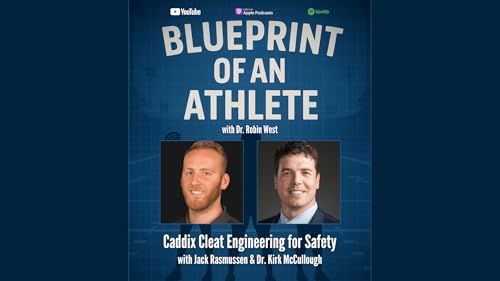
  • S01EP7: Cleat Engineering for Safety with Caddix Cleats – Jack Rasmussen and Dr. Kirk McCullough
    Dec 8 2025

    Welcome to Blueprint of an Athlete, where host Dr. Robin West is joined by Jack Rasmussen, Caddix Cleats CEO, and Dr. Kirk McCullough, Orthopedic Surgeon and NFL/MLS physician, to discuss cleat engineering and lower extremity injury prevention.

    The Spark: A Preventable Injury

    Jack was inspired to start Caddix 12 years ago after watching football player Jamal Charles suffer a non-contact ACL tear—it looked "so preventable." Realizing the issue was the cleat's failure to release, Jack taught himself biomechanics, starting with DIY prototypes focused on flex and rotation.

    The Innovation: The 12-Degree Stud

    The core innovation is in the cleat's front studs, which flex 12 degrees in any direction. Dr. McCullough calls this movement a "biomechanical divot" designed to prevent the dangerous torque that travels up the limb, leading to rotational injuries like ACL tears and high ankle sprains.

    The Data and Performance

    Caddix was validated using the NFL-standard "Beast" machine at UVA BioCore. Testing confirmed the 12-degree flexion provides the optimal balance for release coefficients. On-field testing showed the cleats were, surprisingly, faster than competitors in drills (40s and L-drills).

    Athlete feedback has been excellent, citing minimal break-in time and a wider toe box. The biggest challenges to widespread adoption remain money (competing with 60-year-old companies) and restrictive apparel contracts. The mission is to prove that this "novel concept isn't a hoax" and that better safety leads to better performance.

    Mostra di più Mostra meno
    35 min
  • S01EP6: Guardian Sports: Protective Gear with Erin Hanson
    Dec 1 2025

    Welcome to Blueprint of an Athlete, where host Dr. Robin West is joined by Erin Hanson, Co-founder and CEO of Guardian Sports. After 25 years in material science, Erin and her husband Lee launched Guardian in 2011 with a mission to prove that science and smart design can transform athlete safety.

    The Genesis of the Guardian Cap

    Driven by concern for her son who began playing football, Erin and Lee sought a solution to reduce the repeated head impacts in the sport. They realized a full helmet redesign was too difficult a paradigm shift, leading them to focus on a solution for practice, where the majority of hits occur.

    • The Goal: Design a lightweight, inexpensive, one-size-fits-all soft shell that could retrofit every helmet and significantly reduce impact.
    • The Evolution: The initial cap was sold in 2012. While initially meeting resistance for its look, the design was optimized with elastic straps and the newest 2.0 smooth design to look more like a traditional helmet.
    • Validation: The cap was a winner of the first NFL Head Health Tech Challenge (2017). This recognition and the subsequent independent testing provided the critical validation needed for national adoption.
    • NFL Mandate: The NFL now mandates the Guardian Cap for most positions during contact practices after reporting a >50% reduction in concussions. Player feedback confirms a better experience: "I'm practicing without a headache."
    The Greaseless Lacrosse Revolution

    Guardian’s mission extends beyond football. Inspired by injuries in lacrosse, they turned their attention to the ball itself.

    • The Problem: Standard rubber lacrosse balls age quickly, becoming excessively hard (way above safety specifications) and "greasing" (leaching plasticizers, making them slick and inconsistent).
    • The Solution: The Pearl Lacrosse Ball is US-made from a urethane material. It is greaseless and consistently maintains a low, safe hardness (110–150), which led the standard-setting body to lower the official spec.
    • Safety Meets Performance: The Pearl improves both safety (softer hit) and performance (consistent feel and release from the stick), making it the official ball of the NCAA, PLL, and MCLA.
    Innovations for All Athletes

    Guardian continues to leverage material science to create safer playing environments for all sports:

    • Bio-based Turf Infill: A corn and soy-based infill that replaces the recycled car tire rubber pellets often used in turf fields (which have been linked to health concerns). This new infill is USDA-certified, helps keep fields up to 28 degrees cooler, and has an engineered shape for better performance.
    • Guardian Loop: A comfortable, soft-shell head protection solution that slips on like a headband, designed for non-helmeted sports with incidental contact, such as flag football, soccer, volleyball, and cheerleading.
    Leadership and Longevity

    Erin notes that the biggest barriers to adoption are often appearance and competition from major helmet manufacturers. However, the most successful selling point is athlete longevity and availability. Coaches across the NFL and NCAA are adopting the products because their athletes are healthier and available to play.

    Key Leadership Lesson: Have confidence in the mission. Erin states that navigating the world of a startup was less about business school and more about the "CEO experience" of raising five children. It's about taking a leap of faith and believing in the goal of improving health and safety, even when met with challenges.

    Mostra di più Mostra meno
    35 min
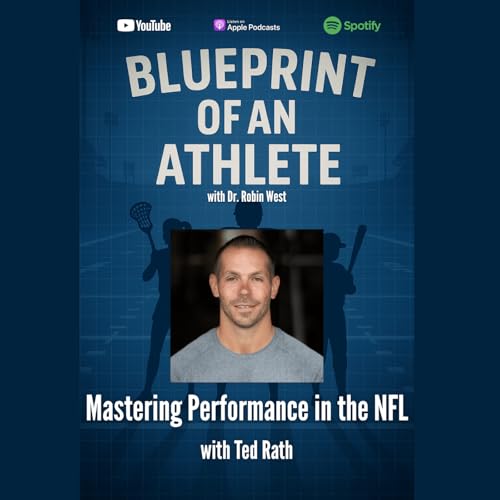
  • S01E05: Mastering Performance in the NFL with Ted Rath
    Nov 17 2025

    Welcome to Blueprint of an Athlete , where host Dr. Robin West, an orthopedic and sports medicine surgeon , is joined by Ted Rath, Director of Sports Performance for the New Orleans Saints. Rath's work spans nearly two decades in the NFL with the Rams and Eagles, minimizing injury and peaking performance across the roster.

    Core Philosophy: Mind, Body, and Process

    Rath’s performance model is guided by caring for the person—the mind, body, and soul. He focuses on teaching orthopedically sound techniques to correct faulty movement patterns, increasing the athlete’s health span beyond their career.

    In the face of adversity and tough seasons , Rath stresses that the process must remain the priority. Focusing on process ensures the team is building a foundation for years of outcomes, not just riding the waves of wins and losses.

    Building Trust and Vulnerability

    The most successful element that "travels well" between the five NFL teams Rath has worked with is developing great relationships. This establishes the trust needed to ask players to endure uncomfortable recovery protocols.

    To build trust quickly, Rath advises leaders to be vulnerable. The greatest four words a leader can say are: "I messed that up". Own the mistake, explain what you learned , and back it up with action.

    The Data-Driven NFL Week

    Rath details the meticulous structure of an NFL week. Monday is a crucial recovery session to flush acute soreness with mobility work, tempo runs, and lower-body strength training.

    He emphasizes the importance of daily communication with the entire coaching, medical, and performance staffs. These meetings review practice loading, injury reports, and workload management.

    Key Indicators for Injury Prevention

    Rath relies on objective data to flag injury risk:

    • Reactive Strength Index (RSI): This force plate metric measures neuromuscular fatigue status—how efficiently an athlete loads and redirects force during a jump. A significant drop flags a concern.
    • Context: Data like RSI is combined with subjective wellness (stress, soreness, sleep) to make informed decisions on practice deloading.

    All data is housed in a custom-built Athlete Management System (AMS) that simplifies millions of rows of data into "actionable" and digestible visual profiles.

    Final Advice

    Rath’s new book, Beyond Comfort, stresses the need to lean into discomfort and respond to adversity. His final advice for all athletes: Master Technique and ensure your daily habits align with your goals. The most underrated recovery tool is sleep.

    Mostra di più Mostra meno
    44 min
  • S01E04: Sports Vision with Dr. Daniel Laby
    Nov 3 2025

    Welcome to Blueprint of an Athlete: Where Science Meets Sports! Host Dr. Robin West, a board-certified orthopedic and sports medicine surgeon, is joined by Dr. Daniel Laby, a leading expert in sports vision whose work has transformed how elite athletes perform.

    For over 30 years, Dr. Laby has helped competitors in MLB, the NBA, NHL, and Olympic sports refine their most powerful tool: their vision system. He discusses the science behind the Sports Vision Pyramid and the difference between ophthalmologists and optometrists in this specialized field.

    The Visual Demands of Sport

    Dr. Laby emphasizes that no sport is played with your eyes closed. He breaks down how visual demands vary:

    • Small, fast targets (baseball, tennis) require high visual acuity. The average MLB player's vision is 20/12—significantly better than the general population's 20/20.
    • Large, slower targets (basketball, soccer) rely more on peripheral vision and spatial awareness.
    • Close contact (boxing, fencing) demands excellent depth perception.
    The Power of the "Quiet Eye"

    A key takeaway for all athletes is the "Quiet Eye" concept:

    • In golf putting or basketball free throws, maintaining a fixed gaze on the target (or the point of anticipated contact) before, during, and after the action is critical.
    • Dr. Laby's research shows that successful free-throw shooters fixate tightly on the rim, while those who miss have scattered visual patterns.
    • By preventing the brain from initiating an eye movement too early, the Quiet Eye ensures 100% concentration on the motor task, leading to greater accuracy and success.

    Dr. Laby concludes that wearables and technology (like stroboscopic glasses and eye tracking) are revolutionizing the field, moving testing away from simple eye charts toward dynamic, sport-specific analysis.

    Resources:

    • Sports Vision with Dr. Laby website
    • Sports Vision Pyramid
    • Sports Vision with Dr. Laby YouTube
    Mostra di più Mostra meno
    52 min
  • S01E03: Whoop: Wearable Technology with Dr. Greg Grosicki
    Oct 20 2025

    Welcome to Blueprint of an Athlete: Where Science Meets Sports! Dr. Robin West is joined by Dr. Greg Grosicki, a Research Scientist at Whoop who turns large datasets on recovery, sleep, and cardiovascular metrics into actionable insights for athletes.

    Dr. Grosicki explains that the Whoop band, initially focused on performance, has expanded its mission to include unlocking healthspan. The low-profile strap worn 24/7 monitors three core pillars:

    1. Strain: Quantifies cardiovascular load during activity using heart rate and HRV.
    2. Sleep: Measures duration, efficiency, architecture (REM/SWS), and the critical metric of Sleep Consistency—found to be more strongly linked to long-term health outcomes than duration alone.
    3. Recovery: A score (0–100) based heavily on your Resting Heart Rate (RHR) and Heart Rate Variability (HRV) compared to your personal baseline.

    The Hero Metric: Heart Rate Variability (HRV) HRV is the variation in time between heartbeats. A higher HRV is generally better, but Dr. Grosicki stresses that it is highly individual and should never be compared between people—only used to track within-person trends against a personal baseline.

    HealthSpan and Whoop Age Whoop's HealthSpan feature provides a Whoop Age (effective age) based on nine physiological and behavioral metrics (excluding HRV) that are scientifically linked to longevity. This feature gamifies health, encouraging long-term positive behaviors.

    The Future of Wearables: The conversation highlights that the next frontier for Whoop is the Advanced Labs feature, which integrates data from up to 60 blood biomarkers with continuous Whoop metrics. This holistic data empowers members to take preventative action, moving wearable technology toward a game-changing role in preventative health and personalized recovery.

    Listen to the full episode for a deep dive into the science behind training, recovery, and making better everyday decisions!

    Mostra di più Mostra meno
    40 min
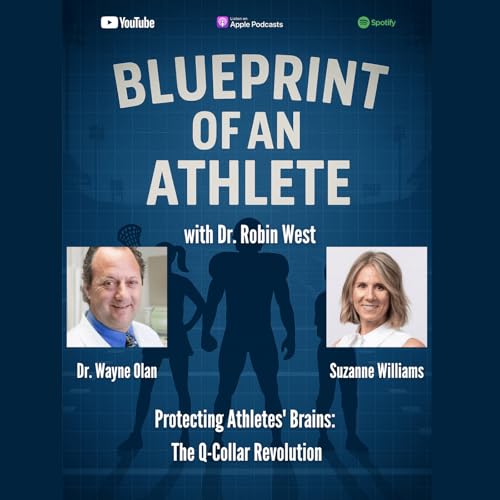
  • S01E2: Protecting Athletes' Brains: The Q-Collar Revolution with Dr. Wayne Olan & Suzanne Williams
    Oct 6 2025

    Welcome to The Blueprint of an Athlete with Dr. Robin West, where science meets sports. This podcast explores how data, analytics, and cutting-edge technologies, including wearables, equipment, clothing, nutrition, and recovery tools, are transforming the way athletes train, compete, and recover. Each episode breaks down evidence-based strategies to improve performance, enhance recovery, and mitigate injury risk, offering athletes, parents, coaches, fans, and health professionals a roadmap to unlocking full potential.

    In the inaugural episode of Blueprint of an Athlete, Dr. Robin West discusses the Q-Collar, an innovative device designed to protect athletes' brains from injuries. Joined by Dr. Wayne Olan and Suzanne Williams, the conversation delves into the mechanics of the Q-Collar, the science behind jugular vein compression, and the importance of understanding traumatic brain injuries (TBIs). The guests emphasize the need for education on TBIs, the effectiveness of the Q-Collar in preventing brain injuries, and the challenges faced in promoting its adoption among athletes and parents. They also share compelling evidence from studies that demonstrate the protective benefits of the Q-Collar, making a strong case for its use across various sports.

    Key Takeaways

    • The Q-Collar acts like a seatbelt for the brain.
    • Jugular vein compression stabilizes the brain during impacts.
    • Scientific studies show the Q-Collar reduces brain injury risk.
    • Subconcussive hits can cause brain injuries without symptoms.
    • Education is key to understanding TBI and its risks.
    • The Q-Collar is FDA-cleared and proven safe and effective.
    • Athletes report fewer headaches and better recovery when using the Q-Collar.
    • TBI is a concern across all sports, not just football.
    • The Q-Collar is easy to size and wear for athletes.
    • Peer recommendations drive the adoption of the Q-Collar.

    Learn more at Q30 innovations here.

    Mostra di più Mostra meno
    32 min