Blueprint of an Athlete with Dr. Robin West copertina

Blueprint of an Athlete with Dr. Robin West

Blueprint of an Athlete with Dr. Robin West

Di: Dr. Robin West
Ascolta gratuitamente

3 mesi a soli 0,99 €/mese

Dopo 3 mesi, 9,99 €/mese. Si applicano termini e condizioni.

A proposito di questo titolo

Hosted by Dr. Robin West, a board-certified orthopaedic sports medicine surgeon and longtime NFL and MLB team physician, this podcast explores the science that drives performance, recovery, and injury prevention. Dr. West talks with top experts, innovators, and athletes to share practical, evidence-based insights on training, technology, nutrition, protective equipment, and mental preparation. Whether you are an athlete, parent, coach, or simply curious about how science is shaping sports, these conversations are designed to inform, empower, and elevate your understanding of human performance.

Disclosure: Throughout her career, Dr. Robin West has advised innovators and experts who develop products and technologies in sports medicine aimed at preventing injury, enhancing recovery, and improving performance. Blueprint of an Athlete exists to educate, inform, and inspire, not to endorse any specific brand, product, or device.

Copyright 2026 All Rights Reserved
Scienza
  • S01E09: The Unbroken Athlete: Identity, Resilience, and Holistic Recovery
    Jan 19 2026
    Welcome to Blueprint of an Athlete, where science meets sports. In this episode, host Dr. Robin West is joined by Dr. Catherine Logan, an orthopedic surgeon and physical therapist, and Emily Perrin, a clinical social worker and former D1 athlete. Together, they are the founders of The Unbroken Athlete, a resource dedicated to the mental and emotional side of injury recovery. Beyond the Scalpel: Why Physical Healing Isn't Enough Dr. Logan shares her "aha" moment: seeing athletes who were technically "perfect" post-surgery and compliant with rehab, yet unable to return to sport because they didn't "trust" their bodies. Fixing the structural issue is only half the battle; the mental disconnect is often the true barrier to performance. The Invisible Stages of Injury: Grief and Identity Emily Perrin highlights that the early days of an injury aren't just about physical pain—they are about loss.
    • Grief: Injury triggers a legitimate grief response. Athletes lose their social circle, their daily routine, and their sense of purpose.
    • Identity Shift: For many, "athlete" is their core identity. When that is removed, it touches on deep core beliefs like belonging and worthiness.
    • Body Image: Dr. Logan notes that physical changes—atrophy, scars, and loss of athletic "build"—can make an athlete feel like they no longer fit in their own skin.
    Redefining Resilience vs. Mental Toughness The team challenges the traditional "grind it out" definition of mental toughness.
    • Suppression vs. Flexibility: "Toughness" often leads to suppressing symptoms or emotions, which actually delays recovery.
    • Resilience: Defined as an ongoing, fluid process. It requires resources (access to care), relationships (connection), and a regulated nervous system.
    The Clinician’s Role: Proactive, Not Reactive Mental health shouldn't be treated as a "complication" that arises months later. The Unbroken Athlete advocates for:
    • Prehab Integration: Addressing the mental landscape from day one.
    • Confidence Metrics: Asking athletes to rate their confidence (0–10) during physical tasks to identify mismatches between physical ability and mental readiness.
    • Relational Connectivity: Clinicians don't need to be therapists, but they must provide a "human" connection and normalize the emotional journey.
    Advice for Parents and Coaches
    • Prioritize Presence: You don't always have to say the right thing; just being there is more important.
    • Avoid "Everything happens for a reason": While well-intentioned, this can be invalidating to an athlete in the depths of grief.
    • Rupture and Repair: If you say the wrong thing, acknowledge it and make amends.
    Final Takeaways
    • Proactivity is Key: Have a plan for your mental recovery, just as you do for your physical rehab.
    • Unbroken doesn't mean "unscarred": It means rebuilding a connection with your body and gaining the confidence to navigate future adversity.
    Mostra di più Mostra meno
    43 ore e 5 min
  • S01E08: The Invincible Brain: Optimizing Performance with Dr. Majid Fotuhi
    Jan 5 2026

    In this episode of Blueprint of an Athlete, Dr. Robin West is joined by Dr. Majid Fotuhi, a Harvard and Johns Hopkins-trained neurologist and author of The Invincible Brain. They explore why brain health is the ultimate "command center" for athletic performance and recovery.

    The Science of the Concussed Brain

    Dr. Fotuhi explains that concussions involve diffuse axonal injury (twisting of neurons), inflammation, and micro-hemorrhages. Critically, he notes that concussions can occur from rapid acceleration/deceleration—like a shoulder tackle—even without direct head impact.

    The Power of Neuroplasticity

    A major takeaway is that the brain is highly malleable. Through neuroplasticity, the brain can rewire and grow at any age. While repeated impacts and high stress (cortisol) can shrink the hippocampus, targeted training can actually thicken the brain’s cortex and expand memory centers.

    The Five Pillars of Brain Health

    Dr. Fotuhi outlines a foundational approach to building a resilient brain:

    1. Exercise: Physical fitness drives brain health.
    2. Diet: Avoiding processed "junk" foods that physically shrink the brain.
    3. Sleep: Essential for clearing toxins and recovery.
    4. Stress Management: Reducing self-induced stress to protect the hippocampus.
    5. Brain Training: Improving processing speed and executive function.
    Recovery and Longevity

    Dr. Fotuhi emphasizes that athletes must wait for 100% recovery before returning to play. Returning at 90% capacity significantly increases the risk of both secondary concussions and orthopedic injuries (like ACL tears) due to delayed reaction times.

    Key Resource: Dr. Fotuhi’s book, The Invincible Brain, releases in March and provides a 12-week clinically proven program to enhance focus and cognitive resilience.

    Mostra di più Mostra meno
    34 min
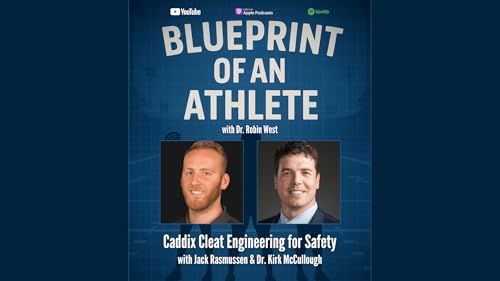
  • S01EP7: Cleat Engineering for Safety with Caddix Cleats – Jack Rasmussen and Dr. Kirk McCullough
    Dec 8 2025

    Welcome to Blueprint of an Athlete, where host Dr. Robin West is joined by Jack Rasmussen, Caddix Cleats CEO, and Dr. Kirk McCullough, Orthopedic Surgeon and NFL/MLS physician, to discuss cleat engineering and lower extremity injury prevention.

    The Spark: A Preventable Injury

    Jack was inspired to start Caddix 12 years ago after watching football player Jamal Charles suffer a non-contact ACL tear—it looked "so preventable." Realizing the issue was the cleat's failure to release, Jack taught himself biomechanics, starting with DIY prototypes focused on flex and rotation.

    The Innovation: The 12-Degree Stud

    The core innovation is in the cleat's front studs, which flex 12 degrees in any direction. Dr. McCullough calls this movement a "biomechanical divot" designed to prevent the dangerous torque that travels up the limb, leading to rotational injuries like ACL tears and high ankle sprains.

    The Data and Performance

    Caddix was validated using the NFL-standard "Beast" machine at UVA BioCore. Testing confirmed the 12-degree flexion provides the optimal balance for release coefficients. On-field testing showed the cleats were, surprisingly, faster than competitors in drills (40s and L-drills).

    Athlete feedback has been excellent, citing minimal break-in time and a wider toe box. The biggest challenges to widespread adoption remain money (competing with 60-year-old companies) and restrictive apparel contracts. The mission is to prove that this "novel concept isn't a hoax" and that better safety leads to better performance.

    Mostra di più Mostra meno
    35 min
Ancora nessuna recensione