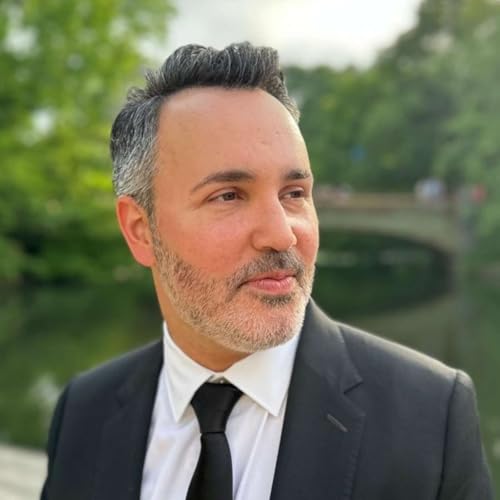
• Demystifying Human Complexity - Arel Moodie
    Apr 23 2026

    Connect with Arel: https://www.linkedin.com/in/arelmoodie/

    Check out Talkadot: https://www.talkadot.com/
    Explore Arel's thinking: https://arelmoodie.com/


    Why do one-hour meetings sometimes drag on for four?
    Why do smart, well-intentioned teams frequently clash and fail to align during periods of disruption?

    In this episode of Accessible Disruption, hosts Anthony Vade and Tahira Endean sit down with Arel Moodie, founder of Talkadot and an expert in adult development theory, to decode the hidden frameworks driving workplace friction.

    Arel shares his fascinating journey from surviving the inner city to diving deep into the academic research of adult ego development. If your team is struggling to see eye-to-eye, or if you feel like you are constantly talking past your colleagues, this episode will provide you with a powerful new lens for understanding human complexity.

    What You’ll Learn in This Episode:

    • The 4 Stages of Adult Development: Arel breaks down the four conventional stages of development—Self-Centric, Group-Centric, Skill-Centric, and Strategic —and explains how people in different stages often talk past one another.
    • The ALIGN Method for Disruption: Discover Arel's crucial framework for handling change, which starts by defining the core problem and agreeing on which developmental stage the team needs to operate from to solve it.
    • Disrupting "Too Comfortable" Teams: Learn how leaders can use targeted challenges to shake up teams stuck in a "status quo" Group-Centric phase and move them toward tactical or strategic action.
    • Talkadot and Data-Driven Speaking: Arel shares his journey as a tech co-founder building Talkadot, a platform bringing data and actionable feedback to the professional speaking industry.

    Whether you are trying to understand persistent conflicts in your office, wondering how to make your corporate values more actionable, or looking to elevate your impact as a professional speaker, this episode delivers actionable, research-backed insights. Tune in to find out how to stop chasing talent with a net and start building a garden they want to land in!

    Mostra di più Mostra meno
    57 min
  • Mindful Design in a "Phygital" World - Caitlin Krause
    Apr 16 2026

    Connect with Caitlin: https://www.linkedin.com/in/caitlinkrause/

    See Cailin's work: https://www.caitlinkrause.com/


    Are our digital spaces draining our energy, or are they designed for joy and connection?

    In this episode of Accessible Disruption, hosts Anthony Vade and Tahira Endean sit down with Caitlin Krause, a Stanford lecturer, founder, and author of Mindful by Design, Designing Wonder, and Digital Wellbeing.


    Caitlin challenges the idea that digital and extended reality (XR) worlds are just tools for escapism, arguing instead that they should be an intentional "layer" over our physical, somatic reality. Drawing from her roots as a middle school teacher to her current work designing immersive experiences, Caitlin shares her optimistic "Middle Path" approach to technology. She envisions a future where digital media serves to mediate human-to-human relationships with grace and compassion, rather than isolating us behind screens.


    What You’ll Learn in This Episode:

    • The True Essence of Design: Discover why design isn't just about planning, but about pairing intention with active creativity to empower human freedom and dignity.
    • Digital Layering vs. Escapism: Learn why the future of spatial computing isn't about leaving our bodies behind, but adding a "phygital" layer that respects our embodied presence and somatic cues.
    • Attention as Currency: Understand why where we place our focus is a literal "payment," and how to find digital "third spaces" that prioritize community and belonging over algorithm-driven doom-scrolling.
    • Designing for the Whole Human: Hear Tahira and Caitlin discuss the importance of accommodating participants' multi-layered physical, emotional, and mental needs without forcing them to "walk the plank" into uncomfortable vulnerability.
    • Data Rights and Open Source: Explore how spaces like the Engage platform and MIT's Project Nanda are pushing for better data privacy, user-owned 3D assets, and interoperable systems in virtual worlds.

    Whether you are an event designer, a corporate leader navigating hybrid workspaces, or simply someone looking for a healthier relationship with your devices, this episode will inspire you to approach technology with intention, curiosity, and active self-compassion.

    Mostra di più Mostra meno
    49 min
  • Redefining Behavior Change and Change Management - Dr. Kristin Malek
    Apr 9 2026

    Connect with Kristin: https://www.linkedin.com/in/drkevents/

    Buy Kristin's Book: https://a.co/d/0a9uNGWk


    Why do so many massive organizational changes fail, and how can we design experiences that actually transform mindsets? In this episode of Accessible Disruption, hosts Anthony Vade, Tahira Endean, and Ryan Hill sit down with Dr. Kristin Malek (affectionately known as Dr. K) to explore the neurobiology behind true transformation.


    If you've ever felt like your company's "core values" read like a vague horoscope, or if you're struggling to sustain momentum during a long-term corporate transition, this conversation is exactly what you need. Dr. K brings deep expertise in psychology and behavioral science to explain why traditional change models often fall flat and what leaders should be doing instead.


    What You’ll Learn in This Episode:

    • Change Management vs. Behavior Design: Discover why traditional, top-down checklists fall short, and why true change must target the unconscious mind—which controls 95% of our actions and goal-getting.
    • The Values Mismatch: Learn why telling your team what the company values are simply doesn't work, and how individually eliciting values is the real key to driving lasting change.
    • The PATH Model: Dr. K introduces her custom framework (Perceive, Align & Design, Take Action, Hold) and explains why the often-ignored "Hold" phase is the most critical step for cementing new habits.
    • The Danger of "Teaching to the Middle": Understand why starting your presentations and campaigns with the basics is essential to avoid instantly losing half your audience.

    Whether you are an event designer, a corporate leader navigating a complex merger, or simply someone looking to understand your own mental roadblocks, this episode is packed with human-centered insights to help you successfully navigate disruption. Tune in to discover how to get curious about your own behavioral triggers and design a better path forward!

    Mostra di più Mostra meno
    41 min
  • Assembling Humans for Belonging - Dan Berger
    Feb 5 2026

    Connect with Dan: https://www.linkedin.com/in/danberger/
    Connect with his speaking and book: https://www.danjberger.com/ & https://www.belongingquest.com/
    Visit Assemble: https://assembleboise.com/
    Take the Belonging Quiz: https://www.belongingquest.com/quiz

    In this episode of Accessible Disruption, the Strategy Table team sits down with Dan Berger, the former founder of Social Tables and current CEO of Assemble Hospitality Group. The conversation spans Dan's prolific career, focusing on his transition from the high-velocity world of tech startups to his current ventures in "hardware," physical businesses ranging from home automation to high-end corporate retreat venues. Berger opens up about the personal evolution that informed his new direction, including his recent mental health journey and how it reshaped his understanding of leadership and human connection.

    The central theme of the discussion is the science and psychology of "belonging," a topic Berger explores deeply in his book, The Quest. He breaks down the five-step process of fostering a sense of belonging within a team, starting with hospitality and safety, and argues that true belonging must first be established in one's personal life before it can be effectively cultivated in a professional environment. The group also dives into the logistics of meaningful collaboration, questioning whether traditional office environments or poorly planned corporate receptions are still relevant in a world increasingly dominated by remote work and a shift toward transactional employment.

    Berger also presents several "counter-cultural" stances on workplace culture, most notably his argument that alcohol has no place in professional gatherings or off-sites because it can hinder productivity and lead to poor decision-making. He emphasizes the importance of data-driven leadership, sharing how he used AI to aggregate his own personality assessments into an "owner's manual" for his team. The episode concludes with practical advice for leaders on using Key Performance Indicators (KPIs) such as revenue and employee retention to measure belonging, and a call to action for listeners to explore their own "belonging archetypes."

    Mostra di più Mostra meno
    46 min
  • Neurospark+ and Human Capacity - Yush Sztalkoper
    Jan 29 2026

    In this episode of Accessible Disruption, the hosts are joined by Yush Sztalkoper, founder of NeuroSpark+, to tackle the overlooked "human capacity risk" inherent in today's rapid AI-driven transformations. Yush argues that while companies rigorously assess technical and financial risks, they often fail to evaluate if their workforce has the biological bandwidth to absorb change. She introduces her strategic approach, "stabilize first," positing that human nervous systems must be regulated and secure before they can effectively adopt new technologies; otherwise, organizations risk stalled adoption and widespread burnout.

    The conversation dives deep into the intersection of neurodiversity and leadership, with Yush sharing how her journey raising a twice-exceptional son revealed that standard corporate systems often force individuals to "mask" their struggles until they reach a breaking point. She outlines her framework of five human domains, wiring, regulation, energy, processing, and belonging, and advocates for "universal design" in the workplace. By designing systems that support the "edges" (neurodivergent needs), leaders actually create better, more sustainable conditions for the entire workforce, preventing the "chronic override" that leads to exhaustion.

    Finally, the group explores the practical application of AI as a "maximizer" rather than just a replacement, discussing how tools like large language models can act as accommodations that bridge executive function gaps for neurodivergent and neurotypical brains alike. The episode concludes with a call for leaders to move beyond rigid standard operating procedures and develop the empathy to recognize when their teams have hit their limits. To learn more about human readiness advisory, visit NeuroSpark+ or connect with Yush directly on LinkedIn.

    Mostra di più Mostra meno
    52 min
  • Trust, Connection, Play, Change – Jenny Sauer-Klein
    Nov 6 2025

    In this episode of "Accessible Disruption," hosts Anthony Vade and Tahira Endean speak with Jenny Sauer-Klein about her career in making change accessible and appealing. Jenny shares how she first disrupted the traditional yoga world with AcroYoga, a practice she co-founded that combines yoga, acrobatics, and Thai massage. She contrasts the somber, individualistic nature of traditional yoga conferences with AcroYoga's exuberant, playful, and community-based approach. The practice was designed to reward strength as well as flexibility and emphasize that "we can do more together than we can alone".

    Jenny explains that pioneering AcroYoga required overcoming participants' initial fears and limiting beliefs. The key was building trust and confidence through gradual, incremental steps and creating psychological safety. She used playful, non-acrobatic icebreakers to build rapport, enabling strangers to feel safe enough to try more risky physical movements together. Jenny later applied these values of trust, connection, and playfulness to the corporate world through "The Culture Conference". She also discusses the difficult decision to leave AcroYoga, which taught her the importance of letting go of projects and following what is "most alive".

    The conversation focuses on Jenny's latest project, the "conference for conferences," which aims to disrupt boring, disembodied corporate events. She criticizes the standard "flat line" conference model, keynotes, breakout workshops, fireside chats, and panels, as a passive "sit and listen" experience. Instead, she advocates for minimizing information dissemination and maximizing the collaborative, interactive potential of in-person gatherings. She details her "Primary Shift" framework, which involves identifying where an audience is starting "from" and where the event needs to take them "to". Jenny encourages event organizers to be transparent with audiences when experimenting and to create "brave spaces" where both presenters and attendees can take risks together.

    Mostra di più Mostra meno
    45 min
  • Suzanne Dameron, MS, APR - Creative Problem Solving
    Oct 30 2025

    Connect with Suzanne Dameron today: Suzanne Dameron
    Learn more about Suzanne’s Work: Third Edge Studio

    Suzanne Dameron, MS, APR, a distinguished communications consultant and FourSight facilitator, joined the Accessible Disruption podcast to discuss the power of Creative Problem Solving (CPS) in navigating change. After more than 20 years in public relations, Dameron formed The Third Edge Studio to focus fully on CPS and change management, defining her work as leading organizations toward resilience through process. She outlined the modern four-step CPS process, which is practical and already used by humans unconsciously every day. The four steps are: Clarifying (understanding the present situation), Ideating (generating ideas), Developing (making the best idea workable), and Implementing (taking action).

    The discussion highlighted that while everyone has the capacity for all four steps, people have cognitive preferences for certain steps —a key insight derived from the Foresight thinking profile work. These preferences explain why the same process can be draining for one person and energizing for another. The CPS process is inherently resilient and relies on the core principle of separating the generation of options (divergent thinking) from the selection of options (convergent thinking) in each step, a refinement of traditional brainstorming. Dameron named her company, The Third Edge Studio, after the concept of the "third edge," or liminal space, which is the often uncomfortable space of transition and ambiguity where transformation occurs.

    Dameron stressed that CPS is specifically designed to address complex problems—those with multiple possible solutions, making it a vital tool for navigating the rapid pace of change in the current era. She emphasized the vital role of a facilitator in guiding individuals and teams through these challenges, ensuring they don't get stuck and helping them deepen their thinking beyond what they could achieve alone. The process works by inviting collaboration and helping people find their own solutions, which builds resilience and better human skills, such as tolerance for ambiguity and better listening. Her call to action was for listeners to research CPS and explore the concepts in the book Good Team Bad Team.

    Mostra di più Mostra meno
    41 min
  • Creating Mental Health Standards – Dr Ferron Gray
    Sep 11 2025

    Connect with Dr Ferron Gray today: Dr Ferron Gray

    Learn more about Dr Ferron Gray’s Work: Grae Matta Foundation

    This episode of Accessible Disruption features Dr. Ferron Gray, a highly specialized forensic psychologist and President of the Grae Matta Foundation. The non-profit organization helps businesses, institutions, and organizations develop mental health standards, policies, and campaigns that are specific to their industry. The foundation’s mission is to improve mental health in both the workplace and higher education. Dr. Gray was inspired to start the foundation after his goddaughter and her father both committed suicide following long waits for mental health services. He realized the core issue was a lack of sufficient policy, and sought to create industry-specific standards to ensure mental health services are fit for purpose.

    Dr. Gray is currently working to create a mental health standard for the events industry, which he notes is one of the most stressful in the world. He explains that event professionals, often seen as “dream makers,” face unique stress due to a lack of boundaries with clients, who may not respect their off-hours. He believes a cultural shift is needed, and this can be achieved through policy and targeted public advertising, which would help clients understand and respect these boundaries. In addition to policy, Dr. Gray also discusses the importance of rest and sleep, suggesting that dedicated time off after an event should be built into the event plan to combat the habitual cycle of constantly moving from one project to the next.

    When discussing how to create change, Dr. Gray advises that industries should not wait for governments, which are slow to act, but should instead take action themselves by creating their own policies and standards. He says that if enough businesses join a call to action, they can collectively create policies that will affect the entire industry. He also contrasts his work with academia and the events industry, noting that academia can be more daunting to work with because, despite being highly educated, they have mental health services that are “not fit for purpose” and staff who are severely stressed from helping students. He praises the IMEX group as an example of an organization doing well in supporting its staff and guests. For individuals and organizations looking to begin their mental health journey, he suggests small changes such as offering mental health days and encouraging structured breaks throughout the day. Dr. Gray’s final call to action is for organizations to “design resilience into their cultures” because the workforce of today and tomorrow demands it.

    Mostra di più Mostra meno
    38 min