

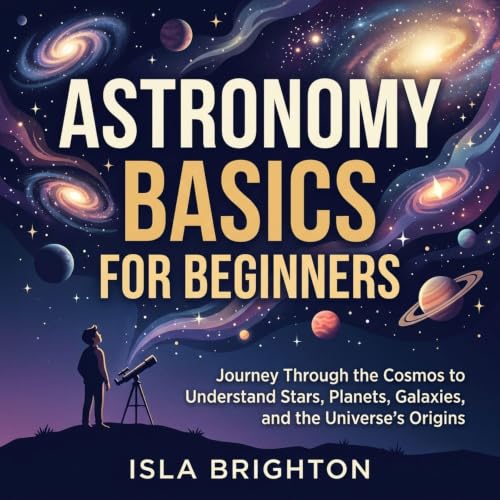
Astronomy Basics for Beginners
Journey Through the Cosmos to Understand Stars, Planets, Galaxies, and the Universe's Origins
Impossibile aggiungere al carrello
Puoi avere soltanto 50 titoli nel carrello per il checkout.
Riprova più tardi
Riprova più tardi
Rimozione dalla Lista desideri non riuscita.
Riprova più tardi
Non è stato possibile aggiungere il titolo alla Libreria
Per favore riprova
Non è stato possibile seguire il Podcast
Per favore riprova
Esecuzione del comando Non seguire più non riuscita
L'offerta termina il 28 dicembre 2026.
Risparmia più del 90% nei primi 3 mesi.
Ascolta quanto vuoi, scegliendo tra migliaia di audiolibri e serie originali inclusi.
Scarica il tuo audiolibro e ascolta offline, senza interruzioni
Rinnovo automatico a 9,99 €/mese dopo 3 mesi. Disdici mensilmente. L'offerta termina il 28 dicembre 2026.

Astronomy Basics for Beginners
Letto da:
AI Voice Michele from HumanizeAudio.com
Acquista ora a 7,04 €
-
Letto da:
-
AI Voice Michele from HumanizeAudio.com
-
Di:
-
Isla Brighton

Questo titolo è stato narrato da una voce virtuale
La voce virtuale è generata da un computer, e viene utilizzata per la narrazione degli audiolibri.
A proposito di questo titolo
This audiobook is narrated by an AI Voice. This written text was created using AI. Astronomy Basics for Beginners: Journey Through the Cosmos to Understand Stars, Planets, Galaxies, and the Universe's Origins introduces young readers to core ideas in astronomy with clear, direct language. It is written for kids ages eight to sixteen and for the adults who guide them. The book focuses on the science behind space in a way that builds curiosity and steady progress.
Rather than relying on pictures, these volumes are text-only to stretch reading skills and expand vocabulary. Reading without illustrations helps students learn how to picture ideas in their own words and prepares them for more advanced science books.
The series takes a unique angle by zooming in on defining moments of failure, setback, and comeback in science instead of telling long biographies. That focus shows how mistakes and surprises drive real discovery and how scientists test ideas, fail, adapt, and try again.
Each chapter explains the tools of astronomy, the role of evidence, and how measurements work in plain terms that suit middle school readers. The writing highlights cause and effect, simple models, and clear examples so readers can practice thinking like scientists.
A factual example included in the text is the story of the Hubble Space Telescope, which launched in 1990 with a flawed mirror and then regained full power after a 1993 servicing mission corrected its optics. That real setback and repair shows how careful engineering and follow-up work create big comebacks.
Parents get clear notes on how to support reading, suggest hands-on activities, and recommend low-cost ways to watch the night sky together. The material links simple experiments, observation ideas, and citizen science projects to the reading so learning becomes practical and social.
adbl_web_anon_alc_button_suppression_t1
Ancora nessuna recensione