Episodi

  • Class by Paul Fussell
    Nov 9 2026

    In this episode Jerry and Stably discussed Class: A Guide Through the American Status System by Paul Fussell. They go through Fussell’s nine-class system, from the “top out-of-sight” to the “bottom out-of-sight.” They also cover his argument that class depends on where your money comes from, your taste, how closely you’re supervised at work, and how anxious you are about status, more than on income. The hosts look at the middle class’s insecurity, the confidence the upper class and high proles share, and “prole drift.” They ask what has changed since the 1980s, including social media and political yard signs. They place themselves in the system as children of immigrants and debate Fussell’s bohemian “Category X.”

    Mostra di più Mostra meno
    1 ora e 36 min
  • More Everything Forever by Adam Becker
    Oct 19 2026

    In this episode Jerry and Stably discussed More Everything Forever: AI Overlords, Space Empires, and Silicon Valley’s Crusade to Control the Fate of Humanity by Adam Becker. Jerry values its look at the rationalist, effective altruist, and longtermist network and its critique of singularity, nanotechnology, and space-colonization beliefs. Stably finds it uneven and closer to magazine polemic than history, citing guilt by association and an AI chapter that has aged poorly. They question Becker’s proposed cap on billionaire wealth and ask what tangible harm his targets have caused, weighing Bill Gates’s geoengineering as an example. Neither fully recommends it, though both want a balanced primer for general readers.

    Mostra di più Mostra meno
    1 ora e 8 min
  • Buddha's Little Finger by Victor Pelevin
    Sep 25 2026

    In this episode Jerry and Stably discussed Buddha's Little Finger by Victor Pelevin. The hosts explored this postmodern Russian novel that weaves together multiple narrative threads across different time periods and realities. The protagonist Pyotr Void exists simultaneously as a patient in a 1990s Russian mental hospital and as a commissar to Bolshevik commander Chapayev in 1919. Through encounters with fellow patients whose delusions form separate vignettes—including a man believing he is a Mexican telenovela actress romantically involved with Arnold Schwarzenegger, and a drunk Russian intellectual inducted into a Japanese samurai clan—Pelevin constructs sophisticated commentary on post-Soviet Russian identity. Jerry and Stably discussed the novel's Buddhist philosophy, particularly how it functions as a Zen teaching device through paradox and riddle-like dialogue, depicting Pyotr's journey toward enlightenment and the realization of non-self. The translation was praised for its quality, and the hosts noted how Pelevin uses the patient hallucinations as political metaphors representing Russia's conflicting fantasies of merger with the West and East.

    Mostra di più Mostra meno
    50 min
  • Ethics: Inventing Right and Wrong by J.L. Mackie
    Sep 10 2026

    In this episode Jerry and Stably discussed Ethics: Inventing Right and Wrong by J.L. Mackie, a dense, academic defense of moral error theory: the claim that no objective morality exists. They walked through Mackie's argument from relativity (moral codes vary across cultures) and his "argument from queerness" (an objective morality would have to be an inexplicably motivating fact unlike anything else we recognize as real), and his conclusion that this needn't lead to nihilism, since morality functions as an evolved, practically useful system for cooperation given humans' limited sympathy and scarce resources. They connected this to evolutionary psychology, discussed how rapid technological change (AI, simulated realities, warfare) could strain inherited moral intuitions, and debated whether openly admitting morality's non-objectivity destabilizes social cohesion. Despite finding the prose difficult, both recommended the book, particularly for readers already sympathetic to skepticism about objective morality.

    Mostra di più Mostra meno
    52 min
  • The Great Leveler by Walter Scheidel
    Aug 11 2026

    In this episode Jerry and Stably discussed The Great Leveler: Violence and the History of Inequality from the Stone Age to the Twenty-First Century by Walter Scheidel. The hosts examined Scheidel's thesis that historically, reductions in economic inequality have only occurred through four violent mechanisms: mass-mobilization warfare, transformative revolution, state collapse, and pandemic. They praised the book's meticulous, well-documented scholarship while noting its dense, repetitive style, and debated whether relative inequality (Scheidel's focus) matters as much as absolute living standards, using the Russian Revolution as a case study of leveling accompanied by catastrophic loss of wealth. They also discussed why humans psychologically fixate on inequality and whether today's disparities are comparable to historical ones. Both agreed the book rewards patience but isn't a breezy read, recommending readers focus on the introduction and conclusion if pressed for time.

    Mostra di più Mostra meno
    47 min
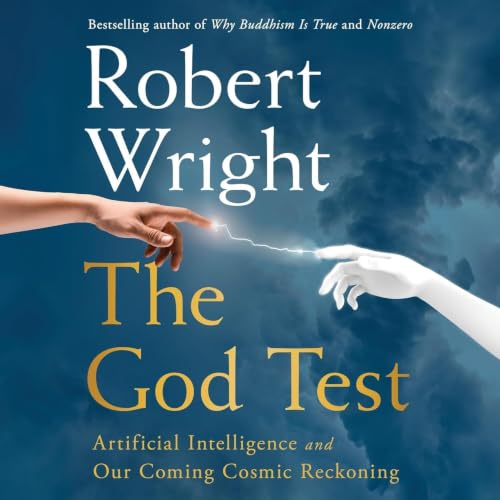
  • The God Test by Robert Wright
    Jul 16 2026

    In this episode Jerry and Stably discussed The God Test: Artificial Intelligence and Our Coming Cosmic Reckoning by Robert Wright. The book's first half explains AI's rise and risks; the second argues, via Teilhard de Chardin-style "complexification," that evolution is driving Earth toward a unified planetary consciousness, or "noosphere," with AI as the catalyst. Wright frames this as requiring expanded cognitive empathy and coordinated global governance to avoid catastrophe. Jerry and Stably examined the book's undercurrents of Buddhism, nonzero-sum game theory, and cosmic purpose, questioned whether Wright's proposed top-down steering contradicts his own bottom-up instincts, and debated whether moral progress or natural selection will ultimately determine humanity's fate. They also touched on Thomas Metzinger's theory of consciousness as a useful counterpoint.

    Mostra di più Mostra meno
    1 ora e 16 min
  • Addiction by Design by Natasha Dow Schull
    Jul 2 2026

    In this episode Jerry and Stably discussed Addiction by Design: Machine Gambling in Las Vegas by Natasha Dow Schüll. The academic ethnography examines how slot machines—once a marginal casino afterthought—now generate most gambling revenue, driven largely by local repeat players rather than tourists. Schüll interviews designers, executives, and addicted gamblers, showing how machines are engineered to induce a self-erasing "zone" akin to flow states, prioritizing extended play over winning. Jerry and Stably debate her capitalism-focused framing, question whether her extreme case studies represent typical gamblers, and connect the addictive "zone" to evolutionary mismatch theory and Schopenhauer's concept of denying the Will. They also touch on Nevada's pre-1969 ownership rules that once limited corporate casino ownership. Despite its dry, jargon-heavy academic style, both hosts found it compelling and recommend it.

    Mostra di più Mostra meno
    1 ora e 9 min
  • The Special One by Diego Torres
    Jun 16 2026

    This episode covers The Special One: The Secret World of Jose Mourinho by Diego Torres, Jerry's pick timed to Mourinho's appointment as Real Madrid manager. Jerry and Stably discuss the book's chronicle of Mourinho's tumultuous 2010-2013 Madrid tenure, focusing on his combative management style: cultivating an atmosphere of fear and favoritism, sidelining players unrepresented by super-agent Jorge Mendes, and blaming referees for losses. They examine his fraught relationship with president Florentino Perez, the locker-room fractures between Portuguese and Spanish players, and his eventual exit following a player revolt. Both note the book's one-sided framing and oddly literal English translation, while drawing comparisons to authoritarian leadership styles. They recommend it for soccer fans despite its insider assumptions.

    Mostra di più Mostra meno
    1 ora e 5 min