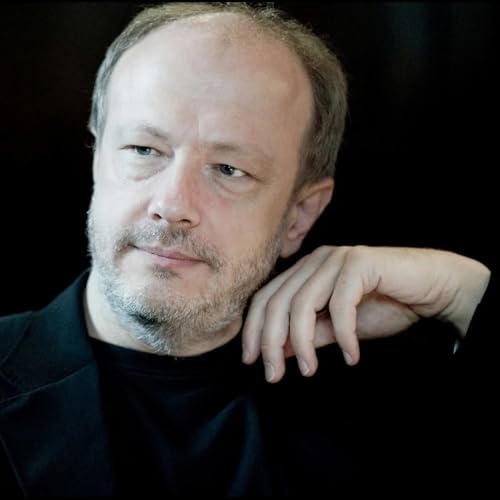
Over the years, Canadian pianist and composer Marc-André Hamelin has built a reputation as the pianist who can play anything - and he does so with verve and style. But, at heart, he is an artist who is deeply fascinated by the new.
In this context, we talk about his experience as one of the first pianists in the West to be enthralled by the works of Alexander Scriabin: a cosmopolitan Russian composer who traveled widely, wrote poetry, and was fascinated by India. Scriabin's career was a remarkable story of continuous innovation. He died suddenly at 43 - just as he was on the cusp of new discoveries, composing new works extending into new musical territory that still remains largely unexplored.
In episode 1 of this 2-part interview, Marc-André Hamelin talks about his early attraction to Scriabin, and the challenges of finding a way to explore his passion at a time when the composer was relatively little-known in the West. In the process, he also discusses his musical training, the music scene in Montreal where he grew up, his thoughts on piano competitions, and some of his favorite piano works.
In episode 2, we will explore a unique aspect of pianist Marc-André Hamelin's background: his personal connection to Scriabin.
Early in his career, Marc had the privilege of meeting someone with close personal links to Scriabin: Madeleine La Liberté. Madeleine, herself a pianist, studied with, and later married, Alfred La Liberté, a great Canadian musician and pedagogue who was a close associate of Scriabin. La Liberté met Scriabin in New York. He quickly became a member of the composer's inner circle, working with him for extended periods during his sojourns in Western Europe. La Liberté would go on to make invaluable contributions to the development of Canadian musical culture, and to the preservation of Scriabin's legacy, in Canada and beyond.
Marc-André speaks with typical grace and humility about his amazing connection with Scriabin, which situates him directly within the composer's own musical and humanistic lineage.
Marc's discography includes the complete piano sonatas of Scriabin (recorded for Hyperion). His recent recital programs feature, at last, the work that first captivated him at 16: Scriabin's revolutionary Fourth Sonata, music of desire and its fulfillment, culminating, in the final movement, in an exuberant dance of cosmic delight.
Music heard in Episode 1:
Prokofieff, Piano Sonata No. 7 in B-flat major op. 83, performed by Glenn Gould:
https://www.youtube.com/watch?v=eXoL60ipygo.
Scriabin, Sonata No. 2, Sonata-Fantaisie, in G-sharp minor, Op. 19, performed by Ruth Laredo:
https://youtu.be/dIxtP0aHWEQ?si=cShxfXNOlkEq8iy1
Scriabin, Sonata No. 4 in F-sharp major, Op. 30, performed by Vladimir Sofronitsky:
https://youtu.be/v5MFrX8yWhs?si=f3kHbny64ruNw6YF
Scriabin, Opus 74, performed by Sviatoslav Richter:
https://www.youtube.com/watch?v=_Nf0_goimek
Thomas de Hartmann, Symphonie-poème, Op.50 No.1 (1934):
https://youtu.be/pC_HSFCuSxc?si=CfqQLLHxtH0U6Zbu
Episode credits:
Sound Engineer: Jóhann Vignir


 38 min
 41 min
 44 min
 1 ora e 7 min
 1 ora
1 ora 58 min
 Jul 19 202457 min
 1 ora e 18 min