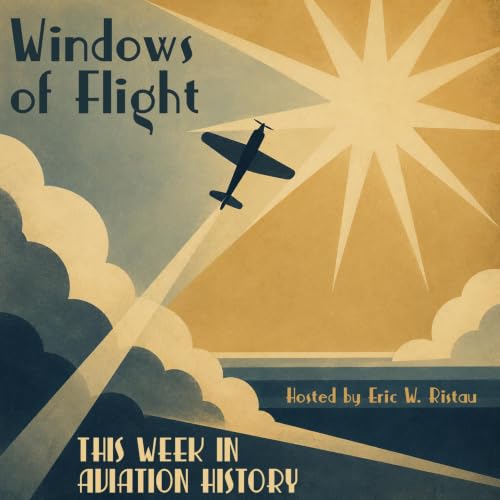
Windows of Flight: Weekly Aviation History copertina

Windows of Flight: Weekly Aviation History

Windows of Flight: Weekly Aviation History

Di: Eric W. Ristau
Ascolta gratuitamente

Every week in aviation history holds a story worth telling. Windows of Flight explores the moments that shaped human flight — from the first machines to leave the ground, to the pilots and dreamers who pushed every boundary they found. Aviation thriller author Eric W. Ristau brings you weekly episodes covering the milestones, the firsts, the record-breakers, and the remarkable people behind them. Made for pilots, aviation history enthusiasts, and anyone who loves a great story. From the earliest aviators, the World War I and World War II to the jet age. New episodes every week.Eric W. Ristau
  • June 28, 2026 - This Week in Aviation History Through the Windows of Flight
    Jun 29 2026

    The history of aviation is written in moments of brilliant achievement and sudden silence. The first week of July gives us both — two milestones on Independence Day twenty years apart, and one disappearance that the world has never stopped trying to explain.

    We start on July 4th, 1908, in a grape-growing town in upstate New York, where a motorcycle racer named Glenn Curtiss flew a fragile biplane called the June Bug 1,550 meters in front of witnesses who certified every foot of it. The Scientific American Trophy. The fury of the Wright brothers. And the beginning of a career that would shape American military aviation for the next decade.

    Then July 4th, 1927 — nineteen years later to the day — when a sleek wooden aircraft called the Lockheed Vega lifted off from Burbank, California for the first time. No struts, no bracing wires, smooth as an egg and fifty miles per hour faster than anything else carrying passengers. Over the next decade, that aircraft and its sisters would carry Wiley Post around the world, carry Hubert Wilkins over the poles, and carry Amelia Earhart solo across the Atlantic in 1932. The Vega didn't just set records. It made records possible.

    And finally, July 2nd, 1937 — when Earhart and her navigator Fred Noonan, flying a newer Lockheed design on an around-the-world attempt, made their last radio transmissions to a Coast Guard cutter that could hear them but couldn't respond. The search covered 250,000 square miles of Pacific Ocean and found nothing. The ocean has kept its secret for nearly ninety years.

    Two Independence Days. One disappearance. All of aviation between them.

    Windows of Flight is brought to you by the Border Series — aviation thriller novels by host Eric Ristau. Old bold pilots, vintage aircraft, and plots ripped straight from today's headlines. Find the Border Series wherever books are sold, and learn more at www.ericristau.com.


    Mostra di più Mostra meno
    11 min
  • June 21, 2026 - This Week in Aviation History Through The Windows of Flight
    Jun 22 2026

    WINDOWS OF FLIGHTEpisode Summary: The Fourth Week of June

    The history of aviation is full of moments when human beings looked at something that had never been done and decided to do it anyway. The fourth week of June gives us three of them — a floating hotel with mahogany paneling that became the world's first airline, two Army lieutenants who threaded a needle across the Pacific by sextant and radio, and the pilots who kept an entire city of two and a half million people alive through the longest winter of the Cold War.

    We start on June 19th, 1910, in Frankfurt, Germany, where the world's first scheduled passenger airline service began — not with an airplane, but with a zeppelin. DELAG, the German Airship Travel Corporation, offered its passengers wicker chairs, mahogany paneling, large windows, and a promenade deck from which to watch the countryside slide past at forty miles an hour. Between 1910 and the outbreak of the First World War, they carried more than 37,000 passengers without a single fatality. It was the future — until it wasn't.

    Then June 28th, 1927, and a Fokker trimotor called the Bird of Paradise lifting off from Oakland, California with two Army lieutenants at the controls. Lester Maitland and Albert Hegenberger were pointing their aircraft at Hawaii — 2,407 miles of open Pacific with no landmarks, no alternates, and no margin for error. Hegenberger had spent two years building the radio navigation system that would guide them there. What happened when the signal faded is the kind of story that makes you appreciate every instrument approach you've ever flown.

    And finally, June 26th, 1948, at Tempelhof Airport in West Berlin, where a C-47 touched down with sacks of flour and the Berlin Airlift began. The Soviet Union had closed every road, rail line, and canal into the city two days earlier. Two and a half million people needed 4,500 tons of supplies every single day just to survive. The math said it couldn't be done by air. The men who flew it anyway — including a pilot named Gail Halvorsen who started dropping chocolate bars on handkerchief parachutes to the children at the fence — proved the math wrong for fifteen months straight.

    Three stories. Three different ways the airplane changed what the world believed was possible.

    Windows of Flight is brought to you by the Border Series — aviation thriller novels by host Eric Ristau. Old bold pilots, vintage aircraft, and plots ripped straight from today's headlines. Find the Border Series wherever books are sold, and learn more at www.ericristau.com.


    Mostra di più Mostra meno
    11 min
  • June 14, 2026 - This Week in Aviation History Through The Windows of Flight
    Jun 14 2026

    The history of aviation is not just the history of aircraft. It is the history of the people who fought their way into the sky against every obstacle that stood between them and the horizon. The third week of June belongs entirely to three women who were told, in one way or another, that aviation wasn't for them — and who went anyway.

    We start on June 15th, 1921, in a small coastal town in northern France, where a twenty-nine-year-old woman from Waxahachie, Texas walked out of a flight school and into history. Bessie Coleman had been turned away by every American flight school she applied to — because she was a woman, because she was Black, or both. So she learned French, crossed an ocean, and earned her international pilot's license in France. She came home a barnstormer, used her visibility to fight segregation, and spent the rest of her short life saving money to build a flight school for Black Americans. The school she never got to build cast a long shadow — one that reaches all the way to the Tuskegee Airmen.

    Then June 17th, 1928, and a red-and-gold Fokker trimotor called Friendship lifting off from Newfoundland with Amelia Earhart aboard. She wasn't flying the airplane that day — and she knew it. Her own word for her role on the crossing was "cargo." The discomfort she felt about the glory that followed drove her for the next four years, until she climbed into a Lockheed Vega alone and crossed the Atlantic on her own terms. The 1928 flight matters not for what she did, but for what she refused to let herself get away with not doing afterward.

    And finally, June 21st, 1913, at Griffith Park in Los Angeles, where a four-foot-eight carnival performer named Tiny Broadwick became one of the first people ever to parachute from a powered aircraft. The following year, demonstrating for the Army in San Diego, she made a split-second decision that detached her from her static line and sent her into free fall — and the improvised hand-pull that brought her parachute open became the foundation for every ripcord that has ever saved a pilot's life.

    Three women. One week. All of aviation changed.

    Windows of Flight is brought to you by the Border Series — aviation thriller novels by host Eric Ristau. Old bold pilots, vintage aircraft, and plots ripped straight from today's headlines. Find the Border Series wherever books are sold, and learn more at www.ericristau.com.

    Mostra di più Mostra meno
    10 min
adbl_web_anon_alc_button_suppression_t1
Ancora nessuna recensione