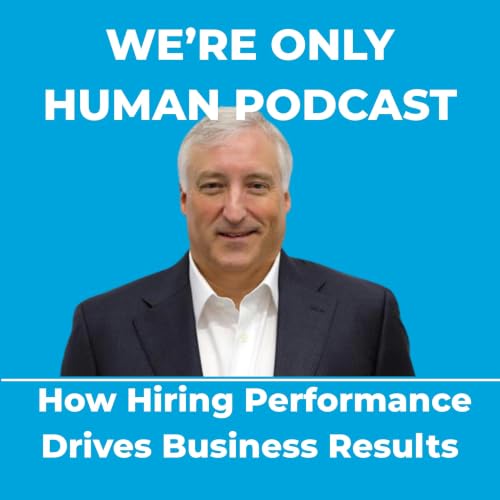
We're Only Human copertina

We're Only Human

We're Only Human

Di: WRKdefined Podcast Network
Ascolta gratuitamente

Offerte di stagione | 0,99 €/mese per i primi 3 mesi

A seguire 9,99 €/mese – si applicano condizioni. Puoi disdire mensilmente.
An HR podcast focusing on the intersection of people and technology at work, We’re Only Human examines research, technology, and practical strategies for creating better outcomes for employers and the workforce. It’s a wealth of insight for anyone looking to create a high-performing organization.All rights reserved by WRKdefined Economia Gestione e leadership Management Ricerca del lavoro Successo personale
  • How Hiring Performance Drives Business Results
    Sep 30 2026
    How does hiring performance affect business performance, and how can talent leaders use AI without losing candidate trust? In this conversation, the Marc Thompson, CEO of ICIMS explains why hiring belongs in strategy and board discussions, not just HR. He covers why job openings are rising while hires stay flat, how to show a CFO or board the cost of vacancies and bad hires, and where AI helps recruiters and where humans must stay in charge. You will also hear why the difference between AI and automation matters, why context and the applicant tracking system are central to the next wave of agentic hiring, and how conversational tools may change the way managers hire. Key Takeaways Hiring is a strategy and operations issue. Businesses cannot meet their goals without the right people in the right roles at the right time. Job openings rose 17 percent in July while hires stayed flat, according to ICIMS workforce data. That means demand is not converting into people on the job, which delays projects and growth. One customer reached a 33-day time to fill, 33 percent better than its industry benchmark, while recruiter productivity rose 17 percent. To win board support, tie vacancies and bad hires to specific business objectives and back the case with data. Estimates put the cost of a bad hire at 50 to 200 percent of salary, and hiring, onboarding, and replacing someone can consume months of a 12-month plan. Speed matters, but a good hiring decision from a process both candidates and recruiters trust matters more. 58 percent of TA leaders could not clearly tell AI from automation. Automating a broken process only gets you to the wrong answer faster. AI works best on repetitive tasks like screening, scheduling, and interview communications. 80 percent of TA leaders say recruiters now spend more time engaging candidates, and 73 percent say it strengthens hiring manager partnerships. Humans should own the final decision. Candidates preferred the message "We use AI for screening, but a human makes the final decision." AI adoption will move at the speed of trust. The biggest AI opportunity is intelligence built on context such as roles, skills, hiring manager preferences, policies, and interview history. The system of record becomes more valuable as agentic hiring grows, with 46 percent of companies already using or planning agentic AI. Timestamps 00:03:00 Why the right person, role, and timing matter 00:04:00 Job openings up, hires flat: what it means 00:07:00 How to make hiring a board-level priority 00:09:00 The real cost of a bad hire 00:11:00 Balancing hiring speed with candidate trust 00:12:00 AI versus automation in recruiting 00:14:00 Keeping humans in charge of hiring decisions 00:17:00 Why context makes recruiting AI useful 00:19:00 Agentic hiring and the system of record 00:22:00 Conversational hiring and the future of the ATS Keywords talent acquisition, hiring performance, AI in recruiting, agentic AI, applicant tracking system, candidate trust, cost of a bad hire, time to fill, enterprise hiring, recruiting automation Connect with Marc and ICIMS To connect with Marc Thompson, follow him on LinkedIn, and to learn more about ICIMS, its intelligent hiring platform, and customer case studies, visit the company LinkedIn page and website below. Marc Thompson on LinkedIn: https://www.linkedin.com/in/marc-thompson-284a783/ ICIMS on LinkedIn: https://www.linkedin.com/company/icims/home/ ICIMS website: https://www.icims.com/
    Mostra di più Mostra meno
    29 min
  • How to Explain Pay Decisions at Work
    Sep 8 2026
    In this episode, Shari Kalsta of Jera Compensation Consulting explains why compensation strategy is no longer just about spreadsheets and market data. As pay transparency laws spread and employees gain access to more information about salaries, organizations must rethink how they explain compensation decisions. Shari shares practical lessons from two decades in compensation consulting on why communication, storytelling, and leadership alignment are now essential skills for HR and compensation teams. Listeners will learn how to build a clear compensation philosophy, align leaders on pay decisions, and translate complex pay data into messages employees and managers actually understand. Key Takeaways Compensation strategy is becoming more social and emotional as pay transparency increases. Many organizations publish salary ranges but fail to explain the reasoning behind them. Employees often have partial information about pay that leads to confusion or false assumptions. A clear compensation philosophy should explain how pay decisions are made and why. Compensation teams must shift from technical analysis to storytelling and communication. Leaders often define promotions and pay decisions differently, creating misalignment. Successful compensation programs require leadership alignment before rollout. Managers and recruiters need clear guidance so they can explain pay decisions consistently. Storytelling helps leaders and employees understand compensation concepts better than data alone. Compensation systems fail when organizations build the structure but do not train people to use it. Connect with Shari on LinkedIn: https://www.linkedin.com/in/shari-kalsta-ccp-grp-22578b7/ Timestamps 00:00 Why compensation conversations matter today 01:00 Shari’s path into compensation consulting 04:00 Learning the complexity of compensation strategy 06:00 How perspective and bias shape compensation decisions 09:00 The impact of pay transparency laws 12:00 Why most companies lack a clear compensation philosophy 15:00 The biggest mistake compensation teams make 18:00 Why storytelling is essential in compensation communication 21:00 The car shopping analogy for compensation budgets 26:00 Solving hiring pain points with structured compensation Keywords compensation strategy pay transparency compensation philosophy salary ranges HR compensation communication pay equity compensation consulting HR leadership alignment compensation storytelling workplace pay strategy
    Mostra di più Mostra meno
    32 min
  • How Healthcare Teams Hire Better Talent
    Apr 13 2026
    In this episode, you will learn how modern talent acquisition leaders improve hiring outcomes while protecting the human side of recruiting. The conversation explores how healthcare organizations handle massive hiring volumes, why candidate experience still matters in a competitive labor market, and how recruiting teams use data to connect HR metrics to real business outcomes. Ryan Henning, Director, Talent Acquisition, Highmark Health, shares practical insights on internal mobility challenges, reducing time to fill, improving candidate experience, and how talent acquisition teams influence patient outcomes by hiring the right people faster. Key Takeaways: Recruiting teams can dramatically reduce time to fill while maintaining strong candidate experience. Hiring the right people faster directly impacts patient care and operational performance in healthcare. Internal candidates often take longer to hire than external candidates, even though they are known employees. Talent acquisition leaders must translate HR metrics into business impact when speaking with executives. Candidate experience matters even in uncertain job markets and should never be taken for granted. Lowball offers or poor communication can damage employer reputation and long-term hiring success. Data helps talent acquisition teams influence leadership decisions and demonstrate business value. Recruiters should operate as consultants to hiring managers, not just resume processors. Early career and high school pipeline programs are becoming critical in healthcare workforce planning. Process improvements in interview scheduling and hiring workflows can significantly improve hiring speed. Connect with Ryan on LinkedIn: https://www.linkedin.com/in/ryan-henning-phr-0376901a/ Also mentioned in this conversation: Episode 180 on reducing recruiting cycle time: https://megaphone.link/DIRED7119433062 Timestamps: 00:00 Why candidate experience still matters today 02:00 Ryan Henning’s role leading talent acquisition at Highmark Health 04:00 Why healthcare organizations recruit talent starting in high school 06:00 The long-term workforce strategy behind healthcare pipelines 11:30 Hiring 10,000 employees while improving recruiting metrics 14:30 Translating HR data into business impact for executives 18:00 Why internal hiring often takes longer than external hiring 22:30 How recruiting experience affects employee performance 24:00 Fixing interview scheduling and recruiting process inefficiencies 26:00 Lessons on collaboration and knowledge sharing in recruiting Top Keywords: candidate experience in recruiting healthcare talent acquisition strategy internal mobility hiring challenges reducing time to fill roles healthcare recruiting pipeline talent acquisition metrics and data recruiting process improvement early career healthcare programs HR business impact of recruiting healthcare workforce shortages
    Mostra di più Mostra meno
    29 min
adbl_web_anon_alc_button_suppression_t1
Ancora nessuna recensione