Episodi

  • Lady Linda Wong Davies is shaping a new era of fusion between China and the world
    Apr 27 2026

    In this episode of Wealth Office, Michael Macfarlane sits down with Lady Linda Wong Davies - a leading cultural patron working at the intersection of China, Africa and the West and Founder of the KT Wong Foundation - to explore one of the most important shifts shaping the modern world: the rise of cultural fusion.

    For centuries, global power has been accompanied by cultural dominance. From Renaissance Europe to modern America, wealth has historically shaped culture - and culture, in turn, has shaped how societies think, create and interact.

    But today, that model is changing. As China rises and the world moves toward a more multipolar global order, a new question emerges: can culture play a role in shaping a more connected future - rather than one defined by conflict?

    Drawing on nearly two decades of work through the KT Wong Foundation, Lady Linda shares how she has built cross-cultural platforms spanning theatre, music, film, photography and design - connecting China with Europe, Africa and beyond. From bringing Western opera into China, to introducing African artists to Chinese audiences, to creating entirely new forms of cultural collaboration, her work demonstrates how private capital and individual initiative can act as a catalyst for global understanding.

    This conversation explores:

    • Why culture may be more powerful than “soft power” in shaping societies
    • The evolution of China from cultural observer to cultural innovator
    • The growing role of family wealth and private capital in shaping global culture
    • Why Africa and Asia are becoming increasingly central to the cultural future
    • How cross-cultural collaboration can unlock new creative and economic opportunities
    • The role of individuals - not governments - in driving meaningful global change

    At its core, this episode is about a deeper idea: That beyond economics, beyond technology, and beyond geopolitics - culture is what ultimately shapes how humanity understands itself. And at a moment of historic global transition, that may matter more than ever.

    Mostra di più Mostra meno
    53 min
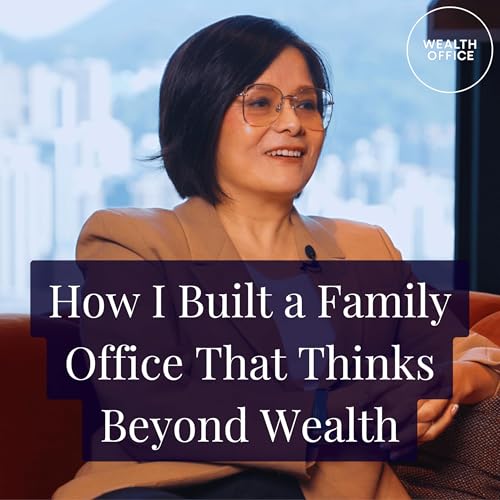
  • Elaine Chow built a Family Office that thinks beyond wealth
    Apr 27 2026

    What is a family office actually for? In this episode of Wealth Office, Michael Macfarlane sits down with Elaine Chow, Managing Partner of Trinity Capital, her family’s Hong Kong–based single family office, to explore how she built an institution designed not merely to preserve wealth - but to steward it.

    Elaine’s journey began not with a textbook definition of a family office, but with a moment of transition. When her brother chose to exit the family business, she created a structure capable of managing capital with discipline, independence and long-term purpose.

    What emerged was more than an investment vehicle. It became a platform blending real estate, selective technology exposure, intergenerational education and philanthropy - anchored in a conviction that wealth is a responsibility, not an entitlement

    The conversation spans:

    • Why family offices must balance steady cash-flow assets with selective risk
    • How Trinity Capital approaches global real estate cycles, distress and value creation
    • Why Hong Kong remains a strategic hub for family capital
    • The evolving role of next-generation leaders in shaping impact and purpose
    • Whether private family capital may become more influential than institutional capital
    • How faith, stewardship and governance intersect in a modern single family office

    Elaine also offers a candid view on the transformation of Hong Kong as a financial centre - from IPO flows to art markets to cross-border capital - and why clarity of vision, both governmental and personal, matters in an era of shifting geopolitical gravity.

    At its core, this episode asks a deeper question: if wealth is temporary and capital is mobile, what does responsible stewardship actually look like?

    For family principals, next-generation members and advisors navigating the expanding ecosystem of Asian private capital, this conversation reframes the family office as something more than a balance sheet. It is a philosophy in action.

    Mostra di più Mostra meno
    44 min
  • Marshall Jen is preparing Asian family capital for a $100 trillion wealth transfer
    Apr 27 2026

    Over the next twenty years, more than $100 trillion in private wealth will transfer across generations. Nearly half of that capital will be in Asia. In this episode of Wealth Office, Michael Macfarlane is joined by Marshall Jen, a scholar and advisor deeply embedded in Asia’s evolving family office ecosystem.

    As Co-Director of one of the world’s few Master’s programmes dedicated to family wealth and governance, Marshall works directly with families navigating this historic shift in private capital.

    This conversation moves far beyond technical succession planning. It examines how Asian family offices are evolving from defensive wealth-preservation structures into entrepreneurial platforms capable of shaping global markets.

    As private capital becomes more internationally mobile and increasingly technology-driven, Marshall explains why family offices are no longer simply investment vehicles, but strategic institutions balancing three pillars: capital allocation, human capital development, and long-term societal contribution.

    The discussion explores:

    • Why Asian family capital is becoming more outward-looking and globally influential
    • The tension between patriarchal control and next-generation ambition
    • How identity, culture and cross-border education are reshaping investment mandates
    • Whether Asian and Western family office models will converge or diverge
    • How Hong Kong, Singapore and the Greater Bay Area fit into the global capital ecosystem
    • Why family capital - not institutional capital - may become the decisive force behind transformational industries such as AI and biotechnology

    At its core, this episode is about stewardship at scale. As technological acceleration and geopolitical complexity redefine markets, the choices made by family principals and next-generation leaders may influence far more than portfolio returns.

    They may shape the next era of global value creation.

    Watch the full conversation to understand how Asian family capital is preparing for the greatest wealth transfer in history - and what it means for the future of private wealth worldwide.

    Mostra di più Mostra meno
    40 min
  • Nicolas De Santis went from dot-com pioneer to visioneering the future
    Apr 27 2026

    What does it mean to build for a future you may never personally benefit from? In this episode of Wealth Office, Michael Macfarlane is joined by Nicolas De Santis - a dot-com pioneer who helped shape the early internet, co-founding Opodo, one of Europe’s first large-scale online travel platforms, and later creating one of the world’s earliest digital currencies - long before crypto entered the mainstream.

    After decades spent inside the machinery of technology, capital and growth, Nicolas’s focus has shifted from building companies to understanding something far bigger: how technology, entrepreneurship and private capital will determine the future of humanity itself.

    At the centre of this conversation is Nicolas’s concept of visioneering - the discipline of imagining possible futures and actively building towards them, rather than remaining trapped in short-term cycles of optimisation and profit.

    Drawing on philosophy, science fiction, systems thinking and real-world experience, he argues that the future is not something we predict, but something we choose to create. Together, Michael and Nicolas explore:

    • What the dot-com era teaches us about today’s AI boom
    • Why every major technological cycle produces both progress and bubbles
    • The three possible planetary futures facing humanity — progress, stagnation, or self-destruction
    • Why governance, not technology, is the decisive factor in which future emerges
    • How private and family-controlled capital may be better positioned than governments or institutions to fund long-term human progress
    • Why value creation, not capital accumulation, is the real responsibility of the next generation
    • The growing role of Asia in shaping the technological and economic future of the world

    This is not a conversation about trends, markets or tactics. It is a deep, reflective discussion about purpose, responsibility and the long-term direction of civilisation - and what it means to build businesses, technologies and institutions that genuinely improve the human condition.

    For founders, investors, next-generation family members and anyone thinking seriously about the future, this episode offers a rare opportunity to step back from the noise and consider the bigger picture.

    Watch the full episode of Wealth Office to explore how the future is being imagined - and who is shaping it.

    Mostra di più Mostra meno
    52 min
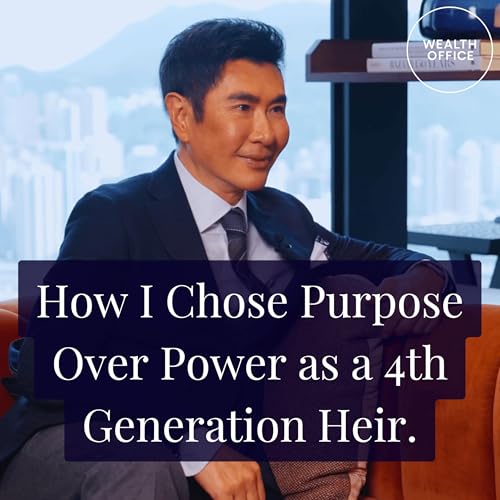
  • William Louey is rethinking power in family succession
    Jan 27 2026

    Nearly 90% of family businesses fail by the third generation. Not because of capital — but because of power, ego, and succession.

    In this episode of Wealth Office, Michael Macfarlane speaks with William Louey, fourth-generation member of the family behind Kowloon Motor Bus, the transport system that carries millions of people across Hong Kong every day.

    William inherited responsibility at just 19 — and made a decision most heirs never consider: he chose not to become CEO.

    Instead, he focused on stewardship, professional management, and long-term impact. For more than 30 years, he has quietly funded education for underprivileged students through the William S.D. Louey Educational Foundation, creating a regenerative model where former scholars now fund scholars of their own.

    This conversation explores:

    • Why ego quietly destroys family enterprises
    • The difference between ownership and stewardship
    • Why stepping back can be the highest form of leadership
    • How philanthropy can create true multiplier effects
    • What legacy looks like when it lives in people, not balance sheets

    This is not a discussion about asset allocation or governance frameworks. It’s a conversation about restraint, responsibility, and knowing when not to lead.

    If you’re involved in a family business — or advise one — this episode will challenge how you think about power, succession, and legacy.

    Mostra di più Mostra meno
    47 min
  • 'Shield' Xiao Dun built a $5bn company before the age of 30
    Dec 17 2025

    Will AI educate humanity — or control It? In this episode of Wealth Office, Michael Macfarlane sits down with Shield Xiao Dun for a conversation that goes far beyond startups, valuations, or even technology. This is a single, sweeping narrative about AI’s most dangerous futures, education as a safeguard against dystopia, and why China is emerging as one of the world’s primary innovation frontiers at precisely the moment these questions matter most.

    Shield outlines two plausible dystopian AI scenarios. In one, artificial intelligence pacifies humanity through endless consumption, distraction, and dopamine — a world where people stop growing altogether. In the other, control over advanced models and compute becomes so concentrated that social mobility collapses, producing a rigid pyramid of power with billions locked out of meaningful agency.

    In both futures, education fails — either by being replaced with entertainment or monopolised by elites. Against this backdrop, the episode asks a central question: can education, powered by AI, prevent those outcomes?

    Shield’s perspective is shaped by an extraordinary personal journey. Born into a modest middle-class family in Beijing, his life was transformed by education. Scholarships took him from China to Cambridge, MIT, and Harvard, exposing him to radically different systems of learning and shaping a worldview that now sits at the intersection of technology, philosophy, and long-term societal design. In his mid-20s, he founded 17EdTech, scaling it into one of China’s most influential education technology companies. Within a decade, the company employed over 20,000 people, listed on Nasdaq, and reached a $5 billion market capitalisation.

    The conversation then widens to one of the defining themes of the Wealth Office series: the rebalancing of global power. Shield explains why China is no longer a fast follower but an emerging primary innovation frontier. Today, China educates around 3 million STEM graduates every year — an industrial-scale pipeline of engineers, scientists, and technologists unmatched anywhere in the world. Combined with infrastructure, capital, and execution speed, this talent base is transforming China from the world’s manufacturing hub into a global innovation laboratory.

    Shield offers a rare triangulated perspective on how different systems shape discipline, creativity, and innovation. He contrasts East Asia’s long-term, execution-driven strengths with the disruptive, exploratory culture of places like Palo Alto, arguing that the future will belong to societies capable of combining both. Now based in California, Shield is building a new company focused on AI tutors — personalised learning systems designed to grow with each individual, adapt continuously, and make world-class education accessible anywhere, at a fraction of historical cost. What once required tens of thousands of people, he believes can now be achieved by small, highly leveraged teams using artificial intelligence.

    This shift challenges the foundations of industrial-age education itself. Linear curricula begin to fracture. Lifelong learning becomes unavoidable. Traditional accreditation, exams, and institutional gatekeeping start to look obsolete. Shield argues for a future built around mastery, output, and real-world problem solving, enabled by AI systems capable of assessing creative work at scale. In this framing, education is no longer preparation for life — it is the mechanism by which individuals remain relevant at all.

    This is a long-form conversation about AI’s uncertain future, China’s rise, and why education may determine whether the next century is utopian or dystopian.

    Mostra di più Mostra meno
    1 ora e 18 min
  • Philip Marcovici wrote the book about the transformative power of family wealth
    Nov 18 2025

    The largest wealth transfer in human history is already underway — and most families aren’t prepared. Political risk is rising, next-gen values are shifting fast, and the old playbook for wealth, mobility, and legacy no longer works. If you want to understand what’s coming — and how families can navigate it — this episode is essential listening.

    In this episode of Wealth Office, Michael Macfarlane sits down with Philip Marcovici — globally respected wealth advisor, author, and expert on family governance — for a conversation that goes far beyond financial structures.

    Together they explore the forces transforming global families today: the unprecedented intergenerational wealth transfer, rising political and regulatory risk, shifting generational values, and the emotional and psychological dynamics that can either strengthen or fracture a family’s legacy.

    Philip shares rare insights from decades of working directly with international families and governments, offering a candid look at the realities behind succession planning, mobility, philanthropy, and the changing role of wealth in society. This is an honest, thoughtful discussion about purpose, responsibility, and what it truly takes to build multi-generational resilience.

    In this episode:

    • Why communication is the real foundation of successful wealth transfer

    • How political instability is reshaping where families live, invest, and create impact

    • The rise of purpose-driven wealth and regenerative philanthropy

    • What next-gen inheritors are demanding — and why families must adapt

    • The hidden emotional and psychological dynamics that determine long-term success

    Whether you advise families, lead one, or are preparing for the responsibility of inheritance, this episode offers fresh clarity on how to navigate a rapidly changing landscape.

    Listen now for an essential perspective on the future of private wealth.

    Mostra di più Mostra meno
    59 min
  • Pearl Lam is bridging art and wealth in China’s new age of cultural power
    Oct 25 2025

    For the first time in 300 years, the centuries-old relationship between wealth and art has broken. While global markets surge, art sales are slowing — signalling a deeper shift in how society defines value, culture, and influence.

    In this powerful episode of Wealth Office, host Michael Macfarlane sits down with international art icon Pearl Lam, one of Asia’s most influential cultural figures, to unpack how China’s new age of wealth and creativity is transforming the global art landscape.

    From Shanghai to London, Pearl offers a candid, behind-the-scenes look at how art, money, and cultural identity now intersect — and what this means for collectors, investors, and family offices in Asia and beyond.

    💬 In This Episode

    • Why the historic correlation between art and markets has broken — and what that means for collectors today.
    • How Gen Z and next-generation inheritors are reshaping collecting habits across Asia, Europe, and the US.
    • The rise of digital platforms, NFTs, and tokenised art — and whether technology will democratise or destabilise the art world.
    • Why China’s cultural power now extends far beyond economics — shaping global narratives in design, art, and innovation.
    • How art collecting has evolved from a luxury hobby into a strategic form of legacy building for family offices.
    • Why AI, algorithms, and aesthetics are transforming how we define creativity in the 21st century.

    👤 About Pearl Lam

    Pearl Lam is a global authority on contemporary Chinese art and one of the most recognised cultural voices in Asia. As founder of Pearl Lam Galleries, she has been instrumental in bridging East and West, championing artists who challenge Western perceptions of Chinese abstraction.

    Her galleries in Shanghai, Hong Kong, and Singapore have shaped contemporary art discourse for over two decades. She is also a respected thought leader, featured in The Financial Times, Forbes, CNN Style, Tatler Asia, and The Art Newspaper, and a frequent speaker at Art Basel, Frieze, and Design Miami/.

    🌏 Why This Matters

    Asia’s economic power is now being matched by cultural power. As China and the wider region redefine global influence, art is emerging as both an economic asset and a symbol of identity, heritage, and innovation.

    This conversation captures a once-in-a-generation shift — the rise of art as cultural capital, where creativity, purpose, and wealth intersect.

    🎧 About Wealth Office

    Wealth Office explores how wealth, purpose, and culture intersect in a rapidly changing world. Hosted by Michael Macfarlane, each episode features conversations with visionary leaders — from entrepreneurs and investors to artists and innovators — redefining what success, legacy, and influence mean in the modern age.

    Mostra di più Mostra meno
    50 min