Episodi

  • Making AI a core language, not an elective with Dr. Rick Fernandez
    Jul 27 2026

    Every so often, a conversation cuts through the noise and gets to the heart of what education leadership demands right now. This is one of those conversations.

    In this episode, Dr. Michael T. Conner is joined by Dr. Rick Fernandez, former superintendent, former high school principal, Chief Growth Officer at BlueKit Software, and co-host of the Boyz of EdTech podcast, for a powerful discussion on leadership, data, competition, and the future of learning.

    Dr. Fernandez brings a grounded, unfiltered perspective on the realities facing school districts today. From the pressure of school choice and vouchers to the blind spots hidden inside district data, he challenges leaders to think more honestly about what their systems know, what they assume, and what families are really asking for.

    This is not a surface-level conversation about trends. It is a call for sharper thinking, stronger systems, and a deeper commitment to preparing students for a future already being reshaped by artificial intelligence. Dr. Conner and Dr. Fernandez move with urgency, humor, and candor through the kinds of questions education leaders cannot afford to avoid.

    If you are a superintendent, principal, district leader, educator, or anyone invested in the future of public education, this episode will push your thinking and leave you with plenty to sit with.

    Dr. Fernandez’s challenge for the next generation comes down to three words: curiosity, consistency, and entrepreneurship.

    Mostra di più Mostra meno
    1 ora
  • Mastery Over Method: How Richmond County Redesigned Grading for the AI Era
    Jul 13 2026

    What does it really take to build a school system ready for the future?

    In this episode of Voices for Excellence, Dr. Michael Conner welcomes Dr. Tommy Welch, Deputy Superintendent of School Improvement and Strategic Initiatives for Richmond County School System, for an energising conversation about continuous improvement, artificial intelligence, and the leadership required to serve every learner well.

    This is not a story about chasing the next trend. It is about a district choosing to think differently about growth, mastery, opportunity, and readiness. Richmond County is reimagining how data is used, how grading reflects learning, how AI belongs inside instruction, and how schools can create stronger pathways through STEM, CTAE, and dual enrollment.

    At the centre of the conversation is a powerful idea: continuous improvement is not a programme. It is a mindset. And in a district marked by both wealth and poverty, that mindset matters.

    Tune in to hear how Richmond County is building the systems, culture, and courage to prepare students not just for graduation, but for the world ahead.

    Mostra di più Mostra meno
    53 min
  • Interoperability, AI Sobriety, and the Data Warehouse with Daniel Crook
    Jun 29 2026

    Daniel Crook, founder of School Harbor and co-founder of AEG Systems, joins Dr. Michael Conner for a direct, infrastructure-first conversation about what K–12 districts are getting wrong about AI adoption.

    Daniel has spent years working inside the systems that districts rely on to manage data, make decisions, and integrate technology at scale. His assessment is clear: the AI problem in education isn't a platform problem, it's a foundation problem. Too many districts are evaluating AI tools before they've built the data infrastructure that would allow those tools to function effectively.

    In this episode, Daniel walks through why the data warehouse is the non-negotiable starting point, what interoperability actually requires in practice, not in theory, and the three criteria every district leader should apply before selecting or expanding any AI platform. He also introduces the concept of AI sobriety: an implementation philosophy that grounds strategy in the technology's current capabilities rather than its projected future state.

    The conversation also touches on the Netflix analogy for understanding where edtech sits in the broader AI development cycle, and why the districts building administrative intelligence now will have a significant structural advantage over those still chasing student-facing tool count.

    A grounded, no-hype episode for superintendents, CTOs, instructional technology leads, and anyone responsible for AI strategy in K–12 education.

    Episode 127 | Voices for Excellence

    Mostra di più Mostra meno
    58 min
  • Coding Is the New Cursive: Why Every Kid Needs It (And It's Not About Software Engineering) | Stewart Brown
    Jun 15 2026

    Today's kindergartners will retire in 2082, but are we preparing them for that world or ours? In this episode, Dr. Michael Conner sits down with Stewart Brown, Director of Partnerships at Code4Kids, to challenge the "21st century" trap that's already widening the gap for Generation Alpha and Beta.

    Stewart and Michael dig into why coding is becoming as essential as cursive, a fundamental literacy every student needs, not just a technical skill for future developers. They explore how cross-curricular computer science can bridge math, science, arts, and social studies, and why the education system urgently needs to move beyond outdated frameworks and embrace what Stewart calls 22nd-century thinking.

    The conversation unpacks why understanding technology matters far more than becoming a software engineer, and how Code for Kids is already reshaping what digital literacy looks like in practice, through connective, curriculum-integrated education that gives students real agency in a technology-saturated world.

    Stewart Brown is a multiple founder of international EdTech companies and a trusted voice in AI literacy in education. Code for Kids, launched in 2018, integrates coding, robotics, digital literacy, and STEAM across the curriculum.

    This is essential listening for educators, administrators, and parents asking the question that matters most: how do we truly prepare students for their future? Subscribe to Voices for Excellence for conversations that challenge education's status quo.

    Mostra di più Mostra meno
    48 min
  • Emotional Intelligence Isn't Soft, It's the Durable Skill Driving Academic Success | Dr Donna Housman
    Jun 1 2026

    Stop managing behavior. Start changing it.

    Dr. Mike Conner sits down with Dr. Donna Housman, CEO and founder of Housman Learning, to explore the paradigm shift reshaping early childhood education: why emotional intelligence isn't a soft skill, it's the durable, sustainable driver of academic achievement and lasting behavioral change.

    Key Topics:

    • The evolution of emotional intelligence from "soft skill" to critical educational driver
    • ECSEL (Emotional, Cognitive, and Social Early Learning): The evidence-based program closing the preparation gap
    • Why self-regulation, not funding, is the real differentiator in high-risk populations
    • The achievement gap is a symptom; the preparation gap (birth to kindergarten) is the disease
    • How early childhood emotional competence prevents the "troubled teen" crisis before it starts
    • Teacher satisfaction, retention, and the post-COVID educational landscape

    Dr. Housman brings 30 years of clinical psychology expertise and longitudinal research proving that developing emotional intelligence starting as early as 3 months old transforms children's trajectories, and challenges the entire education sector to rethink what "preparation" really means.

    Subscribe for deep conversations on education, human development, and the research-backed practices that create lasting change.

    Mostra di più Mostra meno
    44 min
  • The Circles of Genius We're Wasting: Why Lived Experience Matters More Than Motivation with Shokry Elady
    May 18 2026

    Organizations love to say they’ve “given people the tools to succeed”, so why do the same individuals and teams keep being labeled as the problem?

    In this episode, host Dr. Michael Conner talks with Dr. Shokry Eldaly (Teachers College, Columbia University) about what’s really missing: structures that make efficacy possible. Shokry breaks down why motivation isn’t the primary barrier, how rigid systems discount lived experience, and what it looks like to build collective impact without blaming individuals.

    In this conversation:

    • Why “lack of motivation” is often a convenient story
    • How structures shape outcomes more than individual effort
    • Lived experience as essential data for change
    • Hope as a practical strategy for collective impact

    Subscribe to Voices for Excellence for conversations that challenge how we lead, learn, and grow together.

    Mostra di più Mostra meno
    54 min
  • Keeping People at the Center of AI Integration with Matthew Berkshire
    May 4 2026

    Schools aren't just content delivery systems, they're the places where belonging happens, and that matters more in the age of AI than it did before.

    Matthew Berkshire, Director of Curriculum and Instruction at Greenville Central School District in New York, built something unusual: a school improvement process that used AI to strengthen the human trust network, not replace it. When Greenville adopted the Agile Evolutionary Group platform, the Diagnostic revealed hidden patterns in pacing, intervention, and assessment that educators had felt but couldn't name. The real work started after, sitting together, reviewing insights against lived experience, and making decisions as a learning organization.

    In this conversation with Dr. Michael T. Conner, Berkshire walks through what intentional AI integration looks like: starting with people who already trust each other, designing conditions for learning rather than supervising instruction, and keeping professional judgment and collective efficacy at the center. He talks about pandemic lessons, how the AEG platform fit into an already-strong school improvement process, the challenge of keeping dynamic collaboration alive across 6-12 departmental alignment meetings, and why, even with AI, the educators make the final call.

    What You'll Learn
    • How to integrate AI tools without removing people from the process
    • What the AC-Stage means for instructional leadership
    • Why the Diagnostic is a beginning, not an ending
    • How to design conditions for learning across a whole district
    • The difference between technology that supports and technology that replaces

    This episode is essential listening for instructional leaders, superintendents, and anyone building the conditions for continuous improvement in a learning organization.

    And on that note, onward and upward.

    Mostra di più Mostra meno
    47 min
  • When the Superintendent Becomes the Chief Advocate, Everything Shifts
    Apr 20 2026

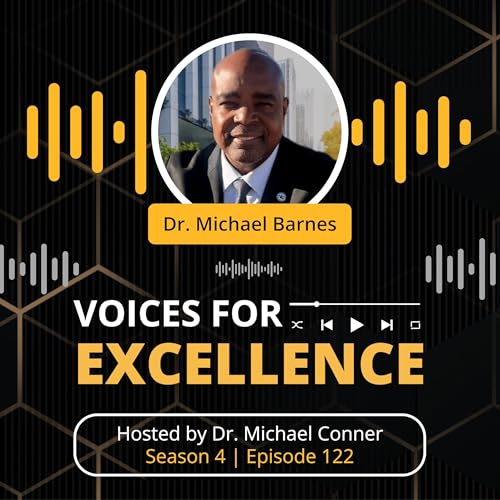
    The superintendent isn't a budget manager, they're the chief advocate for all children. Dr. Michael J. Barnes rebuilt Mayfield City Schools around this principle, and the results speak for themselves.

    The superintendent is the chief advocate for all children in their community. Nobody else can say that, not the mayor, not the school board, not the superintendent of the next district over. But somewhere along the way, superintendents drifted from the instructional chair into operations and politics. Dr. Michael J. Barnes reversed that drift entirely.

    At Mayfield City Schools (Ohio), Barnes built a four-track personalized learning model that blew up the time/learning equation. Traditional, Cross-Curricular, Self-Paced, and The Option. When students got agency over their learning design, attendance skyrocketed, not because of better discipline policies, but because students were actually designing their own learning. Time stopped being the constant. Learning became it.

    In this conversation with Dr. Conner, Barnes walks the AC-Stage reframe: what does instructional leadership look like when the industrial model is obsolete? What's the role of the superintendent in an Innovation Core? Why do design thinking, engineering, and entrepreneurship matter as much as math? How do you navigate the VUCA landscape of state politics without abandoning your moral imperative?

    What You'll Learn
    • The superintendent's real job: chief advocate for all children
    • How to flip the time/learning variable, when learning is constant, time becomes flexible
    • The four-track personalized learning model and why student agency drives attendance
    • Why instructional leadership means staying in the learning chair, not the politics chair
    • The Creative Staircase framework for systemic innovation
    • How to navigate the VUCA landscape in state politics without compromising your vision

    This conversation is essential for any superintendent or central office leader in the AC-Stage of education. Dr. Conner and Dr. Barnes dig into the frameworks that move the dial from excellence as an aspiration to excellence as a system.

    And on that note, onward and upward.

    Mostra di più Mostra meno
    51 min