

VRST 2025 Self-Confrontation in VR: How Seeing Yourself Shapes Motor Skill Reflection
Impossibile aggiungere al carrello
Rimozione dalla Lista desideri non riuscita.
Non è stato possibile aggiungere il titolo alla Libreria
Non è stato possibile seguire il Podcast
Esecuzione del comando Non seguire più non riuscita

VRST 2025 Self-Confrontation in VR: How Seeing Yourself Shapes Motor Skill Reflection
-
Letto da:
-
Di:
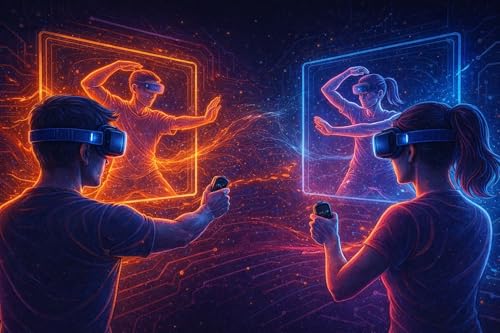
What happens when you watch yourself perform in VR—and then have to critique that performance? This study explored self-reflection in motor skill learning using a Karate training task. Participants were embodied as a "trainer" avatar and asked to give verbal feedback on a "trainee"—which was either their own 3D-scanned appearance or a stranger, performing either their own recorded movements or an expert's. The results revealed a psychological "role conflict": participants felt split between being the evaluator and being evaluated. Seeing their own appearance triggered deeper, more emotional reflection, while recognizing their own movements created bodily connection even in a stranger's avatar. The findings suggest VR embodiment isn't binary but multi-faceted, with implications for training and therapy.
Dennis Dietz, Samuel Benjamin Rogers, Julian Rasch, Sophia Sakel, Nadine Wagener, Andreas Martin Butz, and Matthias Hoppe. 2025. The 2×2 of Being Me and You: How the Combination of Self and Other Avatars and Movements Alters How We Reflect on Ourselves in VR. In Proceedings of the 31st ACM Symposium on Virtual Reality Software and Technology (VRST '25). Association for Computing Machinery, New York, NY, USA, 11 pages. https://doi.org/10.1145/3756884.3765986