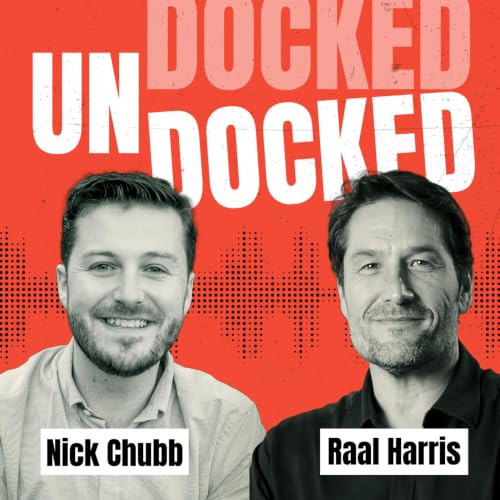
UnDocked: The Maritime Transformation Show copertina

UnDocked: The Maritime Transformation Show

UnDocked: The Maritime Transformation Show

Di: Raal Harris and Nick Chubb
Ascolta gratuitamente

Undocked is a weekly podcast where Nick Chubb and Raal Harris explore what’s changing in maritime and technology. Through candid conversations and guest interviews, the show unpacks emerging trends, overlooked stories, and strategic insights, offering a fresh, unfiltered perspective on the evolving future of one of the world’s oldest industries.2026 Raal Harris and Nick Chubb
  • The Battle for Shipbuilding Capacity and Private Equity Targets Vessel Operations
    Jul 23 2026

    Nick and Raal explore shipbuilding’s geopolitical revival, friendshoring, autonomous vessel insurance, and the risks of an overheated global orderbook cycle ahead for shipping. They also examine how seafarers are already using AI beyond formal governance, why MF Shipping’s people-first digital strategy stands out, and what maritime technology consolidation means for operators.

    CHAPTERS

    00:44 The human element of maritime AI

    04:03 Treating AI like a new employee

    06:33 Seafarers, shadow AI and governance

    13:55 MF Shipping’s people-first digital strategy

    17:43 Transparent KPIs and operational priorities

    27:50 Why most AI projects show no measurable return

    32:39 Agentic AI at the Digital Ship Summit

    35:17 A decade of maritime technology consolidation

    40:19 Insurance pathways for autonomous vessels

    46:45 A seven-billion-dollar week in shipbuilding

    50:06 China’s dominance of the global orderbook

    53:16 National shipbuilding strategies and friendshoring

    55:39 AI-enabled shipyards and software-driven vessels

    57:38 The risk of renewed vessel oversupply

    The episode opens with Raal’s reflections from a maritime roundtable on AI and the human element. Seafarers are already using consumer AI tools for spreadsheets, emails, administrative work and personal support, often beyond the visibility of company policies.

    MF Shipping offers a more deliberate model. After surveying around 900 seafarers, the company is shaping its digital strategy around simpler workflows, reduced administrative burden and better operational decisions. Its public KPIs also challenge the industry to measure digital success by its effect on people, rather than the number of systems deployed.

    Nick and Raal then examine the accelerating consolidation of maritime technology, including private equity interest in vessel operations, autonomy, cybersecurity and safety. Broader platforms may simplify fragmented technology stacks, but they also raise questions about integration, competition and control of maritime data.

    The episode closes with shipbuilding’s return as a geopolitical concern. New investments in India, Bangladesh and the United States sit against China’s dominant share of global orders.

    Governments are responding with industrial policy, allied shipbuilding partnerships and friendshoring, while Korean and Chinese yards develop AI-enabled design and production systems. The strategic race is intensifying just as the global orderbook approaches another potential cycle of oversupply.

    EPISODE PARTNER

    This episode of UnDocked is brought to you by Insight Enterprises.

    Every vessel runs its own mix of devices, software and support arrangements. Without a common view across the fleet, a small IT issue on one ship can turn into a major operational problem across all of them.

    When the cruise ship Aroya was in refit, Insight tracked and deployed over 650 devices and 2,000 Wi-Fi access points on a single vessel — a day-in-the-life view of what's possible when every device on board sits on one architecture.

    Insight's Ship-to-Shore IT Asset Management brings that same standardised architecture to your whole fleet, so shore teams get real visibility, digital assets are managed consistently, and vessels stay connected to shore instead of running blind.

    Because better visibility leads to better decisions, made sooner.

    Simplify your fleet IT with Insight and SmartSea.

    Mostra di più Mostra meno
    58 min
  • Freedom of Navigation Under Fire, China's Unexpected Green Push, and Trusting AI at Sea
    Jul 16 2026

    Freedom of navigation comes under renewed pressure as proposals to charge for transit through the Strait of Hormuz raise profound questions about international maritime law. The conversation then turns to China's accelerating maritime decarbonisation strategy before exploring how AI is reshaping shipping, and why its biggest challenge may be governance rather than capability.

    CHAPTERS

    • 00:00 Freedom of navigation under pressure
    • 05:04 Why charging for the Strait of Hormuz matters
    • 08:12 China's accelerating electric shipping strategy
    • 12:20 Smart ships, autonomy and China's maritime infrastructure
    • 17:02 AI, geopolitics and competing development models
    • 21:14 AI ends shipping's copy-and-paste era
    • 25:03 Why maritime software is beginning to look the same
    • 32:22 Emergence World and AI societies
    • 39:44 Explainable AI and the human element
    • 44:36 Shipping's next digital bottleneck
    • 50:08 A lesson from computer-based training

    This week begins with the deteriorating security situation in the Strait of Hormuz, following renewed attacks on merchant shipping and proposals to introduce charges for transiting one of the world's most important waterways. Nick and Raal examine what this could mean for the long-standing principle of freedom of navigation, and why weakening that norm would have consequences far beyond the Middle East.

    The discussion then shifts to China, where rapid investment in electric vessels, autonomous shipping and digital maritime infrastructure paints a more nuanced picture of the country's decarbonisation strategy than many in the West assume. Rather than simply replacing one fuel with another, China appears to be redesigning parts of the maritime system around new technologies and long-term industrial planning.

    From there, the conversation moves into artificial intelligence. Recent consolidation across maritime software providers prompts a discussion about whether competitive advantage will come from owning proprietary data or building the best interfaces to it. As AI increasingly becomes the layer connecting multiple systems, attention turns to the quality of underlying data, explainability and the limits of automation.

    Finally, an extraordinary AI experiment, where different frontier models were allowed to govern virtual societies, provides a springboard into a wider debate about AI behaviour, accountability and what safe deployment should look like in highly regulated industries such as shipping.

    EPISODE PARTNER

    This episode of UnDocked is brought to you by IEC Telecom.

    Connectivity today goes far beyond a single service. IEC Telecom delivers a fully integrated ecosystem for modern maritime operations, combining multi-orbit connectivity, cybersecurity, network management and crew welfare into one platform.

    Learn more at https://iec-telecom.com

    Mostra di più Mostra meno
    54 min
  • Compliance Over Competence, Human APIs, and Cognitive Load
    Jul 9 2026

    This week, Nick and Raal explore two new research reports examining the gap between maritime systems as they're designed and how they're actually used at sea. They discuss cognitive overload on modern bridges, alarm fatigue, shortcomings in competence-based training, and why culture, leadership, and teamwork matter far more than compliance alone.

    CHAPTERS

    • 00:24 CEO departures continue across container shipping
    • 02:37 New research into human factors and operational reality
    • 05:06 Why interviews often reveal more than surveys
    • 16:39 Alarm fatigue, cognitive overload, and the modern bridge
    • 20:23 Digitalisation, distraction, and unintended consequences
    • 25:08 Fatigue, simulation, and operational decision-making
    • 34:03 What competence really means at sea
    • 42:07 Why compliance training can create capability gaps
    • 44:41 Leadership, culture, and why every ship is different
    • 52:29 AI update: Fable returns
    • 53:16 Holiday sign-off

    The episode opens with another round of senior leadership changes across container shipping before turning to two new research reports examining one of maritime's most persistent problems: the gap between how systems are designed and how ships actually operate.

    Nick shares findings from primary research with serving seafarers, masters and fleet managers, revealing how disconnected bridge systems increasingly rely on humans to act as the interface between technologies. The discussion explores cognitive overload, alarm fatigue and why bridge teams are often managing software rather than navigation during periods of highest risk.

    The conversation then shifts to competence. The research suggests today's compliance-focused training is increasingly detached from operational reality, with situational awareness, decision-making under pressure and teamwork emerging as the industry's biggest capability gaps. Nick and Raal argue that leadership, culture and effective familiarisation have a greater influence on operational performance than certificates alone.

    Read the Thetius report here: https://thetius.com/competent-or-compliant-seafarer-readiness-in-modern-maritime-operations/

    EPISODE PARTNER

    This episode of UnDocked is brought to you by KVH.

    From commercial shipping to offshore and government fleets, KVH enables consistent, high-performance connectivity across every environment. Their integrated approach means hardware, airtime, and network management all work together seamlessly.

    Learn more at kvh.com

    Mostra di più Mostra meno
    54 min
adbl_web_anon_alc_button_suppression_t1
Ancora nessuna recensione