• Why I Plan to Buy a Thank You Hashem Hoodie but Won’t Sit in the Back of the Wagon with the Baal Shem Tov
    Jan 23 2026

    A quiet “thank you” in Tzfas sparked a movement. From that simple beginning, "Thank You Hashem" evolved into a chorus of songs, hoodies, and heartbeats that you see on street corners and in shul hallways alike. We approached with curiosity and caution—questioning whether catchy slogans and lively concerts can genuinely convey Emunah—or if, amid all the hype, we risk reducing God from Master of the universe to a mascot on a sweatshirt.


    Our journey takes a pivotal turn with the Ramban on Parshas Bo. He explains why miracles occur, why mitzvos exist, and what they point to every day: living evidence that God exists, knows, and cares. The Ramban’s bold statement shifts everything—the core intention of all mitzvos is to believe in God and acknowledge that He formed us. If the world’s purpose is human recognition and gratitude, then public reminders can support private devotion—provided they inspire intention and avoid shortcuts.


    We discuss origins with the Bloomstein brothers, how music and merchandise spread the message, and the critiques: commercialization, pop aesthetics, and concerns about spiritual fast food. Then we find harmony. Gratitude isn’t just a feeling; it’s a form of service. A hoodie isn’t holiness, but it can serve as a nudge toward it. When songs motivate us to say “I see You” more often—in joy, in struggle, in the everyday—they become tools, not toys. The true test is whether our practices deepen awareness, humility, and thankfulness.


    Join us as we shift from skepticism to a stronger embrace of radical gratitude. If you’re wrestling with faith in a noisy world, this conversation offers both caution and encouragement: maintain reverence, hold onto thought, and let reminders draw you back to the purpose of creation. If this resonated, subscribe, share with a friend, and leave a review sharing where you stand on TYH and the work of gratitude.

    Support the show

    Join The Motivation Congregation WhatsApp community for daily motivational Torah content!

    ------------------
    Check out our other Torah Podcasts and content!

    • SUBSCRIBE to The Motivation Congregation Podcast for daily motivational Mussar!
    • Listen on Spotify or 24six!
    • Find all Torah talks and listen to featured episodes on our website, themotivationcongregation.org


    Questions or Comments? Please email me @ michaelbrooke97@gmail.com

    Mostra di più Mostra meno
    30 min
  • Parshas Vaera: How Hashem Taught Moshe the Secret to Getting Anyone to Listen
    Jan 16 2026

    Fire and ice fall from the sky, frogs flood the palace, and yet the most surprising instruction isn’t a plague—it’s a posture: speak to Pharaoh as Melech Mitzrayim. We dig into Vaera’s high drama and ask the hard question: why would Moshe be told to honor a tyrant? Drawing on Rashi’s breakdown of Moshe’s three objections, a striking Zohar about illegitimate kings, and Rav Moshe Sternbuch’s powerful thesis, we explore how public honor reframes Pharaoh’s downfall as an unmistakable act of God rather than a political stumble.

    From there, we pivot to a pragmatic read with everyday stakes. What if that instruction also models a timeless persuasion principle—treat people with dignity and they will hear you? The Ramban’s guidance on humility and gentle speech becomes a blueprint for conversations that land. Avraham’s hospitality shows how influence is built not with pressure but with honor. And when we bring it home, Rambam’s insights on marriage and mutual respect, plus a clear approach to parenting and professional negotiations, turn a biblical moment into a usable playbook: lead with respect, ask with clarity, and watch defenses drop.

    Expect a fast path from text to life: why honoring the other person doesn’t excuse wrong, how to pair conviction with courtesy, and where this approach helps—at home, with kids, at work, and in heated debates. If you’re ready to trade volume for influence and friction for traction, press play, subscribe for more source-driven takeaways, and tell us where you’ll try this first.

    Support the show

    Join The Motivation Congregation WhatsApp community for daily motivational Torah content!

    ------------------
    Check out our other Torah Podcasts and content!

    • SUBSCRIBE to The Motivation Congregation Podcast for daily motivational Mussar!
    • Listen on Spotify or 24six!
    • Find all Torah talks and listen to featured episodes on our website, themotivationcongregation.org


    Questions or Comments? Please email me @ michaelbrooke97@gmail.com

    Mostra di più Mostra meno
    28 min
  • Parshas Shemos: Imagine the Way Rebbetzin Batsheva Kanievsky Took Out the Garbage and Reb Moshe Feinstein Poured Milk in His Cheerios
    Jan 9 2026

    A tyrant schemes, two women defy—and the future shifts. Our story begins in a tense, oppressive Egypt, where fear is weaponized into policy, and cruelty becomes law. Amid this darkness, the narrative turns to Shifra and Puah—midwives who reject the king’s decree to kill, choosing instead to nurture life. Rashi identifies them as Yocheved and Miriam, yet the Torah preserves their action-based names: the Swaddler and the Crooner. This naming choice offers profound insight: true greatness often unfolds quietly, through care, patience, and acts of courage in the smallest, most private spaces.

    From this intimate moment, we pull back to explore a deeper question: why would the Torah immortalize names tied to seemingly humble tasks? The answer invites us to reconsider the very nature of scale—nothing is inherently small or large; it is intention that grants significance. Take money as an example. It has the power to distort character, but when earned with integrity, shared generously, and used to stabilize lives, it becomes a tool for devotion and purpose. Instead of dismissing money as “dirty,” we can reframe the conversation around integrity, alignment, and responsible stewardship.

    Next, we turn to the sanctity of the home. Intimacy, too, can be reduced to spectacle or elevated into covenant. Our tradition envisions parents as partners with God—an idea that transforms daily acts of love into sacred work. Through respect, timing, and mutual care, desire becomes a vessel for meaning rather than an escape into self. Rambam provides a guide: align life’s rhythms—food, sleep, music, work, and rest—with clarity and wisdom. This isn’t about shrinking life to a checklist but enlarging every action with purpose. Swaddling a child, signing a contract, or even taking out the trash can become steps toward a life that is coherent, ethical, and fully awake.

    Shifra and Puah’s quiet defiance offers us a timeless blueprint for courage: elevate the ordinary, protect the vulnerable, and weave purpose into every moment. If their story resonates with you, follow the show, share it with someone who carries quiet responsibilities, and leave a review to help others discover these conversations.

    Support the show

    Join The Motivation Congregation WhatsApp community for daily motivational Torah content!

    ------------------
    Check out our other Torah Podcasts and content!

    • SUBSCRIBE to The Motivation Congregation Podcast for daily motivational Mussar!
    • Listen on Spotify or 24six!
    • Find all Torah talks and listen to featured episodes on our website, themotivationcongregation.org


    Questions or Comments? Please email me @ michaelbrooke97@gmail.com

    Mostra di più Mostra meno
    30 min
  • Parshas Vayechi: Rule Yourself First
    Jan 2 2026

    A crown should go to the strongest, the firstborn, or the loudest—unless the Torah is teaching a different law of power. We open Yaakov's closing blessings and follow the path that leads past Reuven, Shimeon, and Levi to Yehudah, the lion who can lie down. Not because he overwhelms others, but because he governs himself. That shift—from dominance to discipline—becomes the episode’s heartbeat.

    We unpack Rashi’s luminous reading of “from the prey, my son, you rose,” showing how Judah earns kingship through two costly choices: defusing his brothers’ plot against Joseph and admitting fault to save Tamar. Then we step into the Kuzari’s court, where a king seeks truth and a rabbi explains that a chassid is a ruler first over his own senses. Justice, provision, and restraint begin inside. The Vilna Gaon ties the bow: moshel me’atzmo—one who rules himself—is fit to rule a city. When appetite bows to truth, authority becomes trustworthy, and power becomes service.

    From there, we bring the lens to now. In an age of excess and endless options, self-mastery is not a slogan; it is survival. We talk about habits that anchor integrity, how to resist easy consensus when values are at stake, and why public credibility grows from private discipline. The lion’s calm isn’t sleep; it’s strength in order. If you’re leading a team, a classroom, a family, or just your own day, this conversation offers a clear, ancient blueprint for modern leadership that actually holds.

    If this resonated, follow the show, share it with a friend who leads, and leave a short review telling us one habit you’re choosing to master next. Your take might spark someone else’s turning point.

    Support the show

    Join The Motivation Congregation WhatsApp community for daily motivational Torah content!

    ------------------
    Check out our other Torah Podcasts and content!

    • SUBSCRIBE to The Motivation Congregation Podcast for daily motivational Mussar!
    • Listen on Spotify or 24six!
    • Find all Torah talks and listen to featured episodes on our website, themotivationcongregation.org


    Questions or Comments? Please email me @ michaelbrooke97@gmail.com

    Mostra di più Mostra meno
    33 min
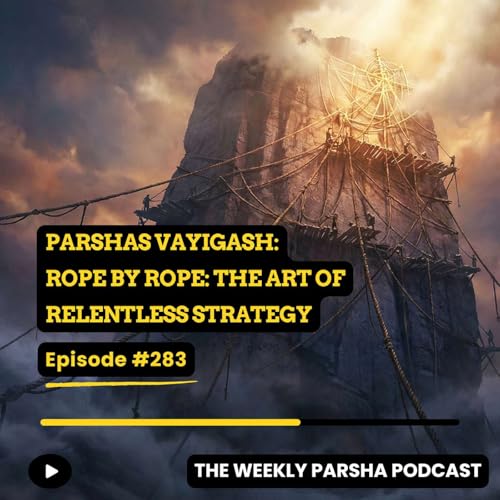
  • Parshas Vayigash: Rope by Rope: The Art of Relentless Strategy
    Dec 26 2025

    The air is tight with silence, the court of Yosef unmoving, and then Yehuda steps forward. That one act—crossing an invisible line of protocol—opens a masterclass on courage, responsibility, and the kind of reasoning that can thaw a heart guarded by power. We trace the moment Binyamin’s fate hangs by a thread and watch how Yehuda weaves threads into a rope: memory, duty, empathy, and personal guarantee, each linked to the next until justice can breathe.

    We walk you through the Midrash on “deep waters are counsel in the heart of man,” turning a vivid parable into a practical tool. Imagine a well of ice-cold water no hand can reach; now imagine building a rope, thread by thread, until the bucket touches what lies beneath. That’s the framework here—rope-to-rope reasoning—steady, disciplined, and exact. We explore how this method shows up in Yehuda’s speech and why it works: it respects truth, invites empathy, and keeps going until the right argument lands.

    The Malbim adds dimension by distinguishing knowledge you’re taught from insight you derive. We connect that to real scenarios—improving prayer and focus, making a case in court, navigating a tough real estate market—showing how to ask better questions, follow causes upstream, and iterate without ego. The takeaway is as simple as it is demanding: don’t quit before the well. If the first approach fails, add another rope. Adjust with humility, test with clarity, and keep your hands steady until the bucket rises with something cold, clear, and unmistakably true.

    If this resonated, subscribe, share the episode with someone who’s one step from a breakthrough, and leave a review telling us the next “rope” you’ll tie.

    Support the show

    Join The Motivation Congregation WhatsApp community for daily motivational Torah content!

    ------------------
    Check out our other Torah Podcasts and content!

    • SUBSCRIBE to The Motivation Congregation Podcast for daily motivational Mussar!
    • Listen on Spotify or 24six!
    • Find all Torah talks and listen to featured episodes on our website, themotivationcongregation.org


    Questions or Comments? Please email me @ michaelbrooke97@gmail.com

    Mostra di più Mostra meno
    23 min
  • Parshas Mikeitz: Why You Can't Succeed Until You Let Go (The Menasheh Prerequisite)
    Dec 18 2025

    What if growth isn't about grinding harder, but carrying less? In this episode, we explore Joseph's surprising blueprint for success: first, name your pain to release its hold, then build from a place of freedom. By examining why Menashe ("God made me forget") precedes Ephraim ("God made me fruitful"), we uncover a timeless principle that turns spiritual insight into daily strategy.

    We bridge this ancient narrative with lived experience. The Sforno interprets "forgetting" as the ultimate release from past troubles—a capacity we all possess but seldom use. Rambam takes this further, describing repentance (teshuvah) as the act of becoming "a different person," breaking the cycle that keeps us tethered to yesterday's failures. We'll apply this to real-world scenarios: the difficult client you still resent, the project that imploded, the habit you can't seem to break. The aim isn't amnesia; it's the disciplined choice to stop letting the past dictate your next move.

    You will leave with a clear, actionable approach: hold onto your principles, but drop the baggage. Cultivate a short memory where it serves you, like an athlete who takes the eleventh shot with the same confidence as the first, despite missing the previous ten. Crowd out rumination with forward-pulling goals and redirect your focus to where it truly belongs—the work that bears fruit. Detachment precedes growth, not because the pain wasn't real, but because your future cannot flourish while the past occupies center stage.

    Ready to travel lighter and build stronger? Listen now, subscribe for more practical Torah wisdom, and share with us: What are you choosing to set down today?

    Support the show

    Join The Motivation Congregation WhatsApp community for daily motivational Torah content!

    ------------------
    Check out our other Torah Podcasts and content!

    • SUBSCRIBE to The Motivation Congregation Podcast for daily motivational Mussar!
    • Listen on Spotify or 24six!
    • Find all Torah talks and listen to featured episodes on our website, themotivationcongregation.org


    Questions or Comments? Please email me @ michaelbrooke97@gmail.com

    Mostra di più Mostra meno
    21 min
  • Parshas Vayishlach: The War Against Flippancy and Minyan Factories
    Dec 5 2025

    What if holiness isn’t a place we visit, but a home we build? In Parshat Vayishlach, Chazal offer a powerful progression: Avraham called the sacred site a mountain, Yitzchak a field, and Yaakov a house. This isn’t just poetry; it’s a blueprint for spiritual growth. A mountain can be a chance ascent, a field requires cultivation, but a house is where you live. Yaakov’s journey invites us to turn fleeting moments of inspiration into a durable, lived-in relationship with God—a spiritual home that can withstand the distractions of modern life.

    We explore how Yaakov’s secret lies in the idea of keva: fixed times, fixed places, and fixed commitments. By setting boundaries for Shabbat before it was commanded, he demonstrated how structure protects sanctity. This principle appears in the halachic concept of chazaka (an established pattern) and the practical wisdom of having a makom kavua (a set place) for tefillah. Repetition, when infused with love, solidifies identity. The modern "minyan factory" mindset, with its endless menu of options, erodes this resolve. When there’s always another minyan in fifteen minutes, prayer risks becoming a spiritual drive-through. We offer a counter-vision: elevate one primary minyan to be non-negotiable. Arrive a few minutes early. Let silence settle your heart before the words begin.

    This is a call to trade quantity for depth. Choose five to ten minutes of slow, focused learning over scattered moments. Find a chavrusa that can weather your calendar. Commit to a cycle of study that repeats until it sings from within, like those who restart the same masechta until it becomes their native tongue. Small, steady choices anchor a life of meaning: Torah as daily bread, not a passing snack; tefillah as a table you return to, not a slot you chase. The Torah says, Titain emes l’Yaakov—"Give truth to Jacob." If truth is what endures, then keva is how we make it endure.

    If this resonates, take one small step today. Choose a set minyan and a set learning time, and guard them. Subscribe for more thoughtful episodes, share this with a friend seeking a steadier path, and leave a review to tell us the first boundary you’ll draw.

    Support the show

    Join The Motivation Congregation WhatsApp community for daily motivational Torah content!

    ------------------
    Check out our other Torah Podcasts and content!

    • SUBSCRIBE to The Motivation Congregation Podcast for daily motivational Mussar!
    • Listen on Spotify or 24six!
    • Find all Torah talks and listen to featured episodes on our website, themotivationcongregation.org


    Questions or Comments? Please email me @ michaelbrooke97@gmail.com

    Mostra di più Mostra meno
    27 min
  • Parshas Vayeitzei: Started From the Bottom, Now We're Here
    Nov 28 2025

    Angels on a ladder, a promise of land, and a family saga filled with tension set the stage—but the heart of this episode is a piercing question: why do the sages single out Rivka as a “rose among thorns,” while Rachel and Leah, no less righteous, don’t receive the same praise? We follow the thread from Yaakov’s dream through Lavan’s deceit to the naming of the twelve tribes, and then zoom in on character, context, and the hidden mechanics of influence.

    We explore Rivka’s acts of radical kindness at the well and the return of light to Sarah’s tent, reading classic sources that frame her as uniquely untouched by her corrupt milieu. Then we test the apparent asymmetry. Rachel protects Leah from shame, Leah rejects a life of moral compromise, and both confront their father’s idolatry—so what gives? Drawing on Rav Shmuel Birnbaum’s insight, we uncover a counterintuitive key: influence often begins with warmth. Rivka was admired and embraced by people who were still wrong; resisting approval takes uncommon strength. Rachel and Leah were treated as outsiders, which blunted the culture’s ability to imprint on them.

    From there, we bring the idea down to earth. A story of Rav Aryeh Levin at the bustling Jerusalem market shows how respect opens doors that rebuke slams shut. We talk about the shift toward gentler chinuch: greeting students by name, asking questions, setting firm standards without contempt. If you want to change hearts, don’t exile people from your circle; meet them with dignity so your words can land.

    Walk away with a practical takeaway for leadership, teaching, and daily life: to shape a soul, start by honoring it. If this lens moved you, tap follow, share with a friend who loves Parsha insights, and leave a review telling us where kindness changed your mind.

    Support the show

    Join The Motivation Congregation WhatsApp community for daily motivational Torah content!

    ------------------
    Check out our other Torah Podcasts and content!

    • SUBSCRIBE to The Motivation Congregation Podcast for daily motivational Mussar!
    • Listen on Spotify or 24six!
    • Find all Torah talks and listen to featured episodes on our website, themotivationcongregation.org


    Questions or Comments? Please email me @ michaelbrooke97@gmail.com

    Mostra di più Mostra meno
    27 min