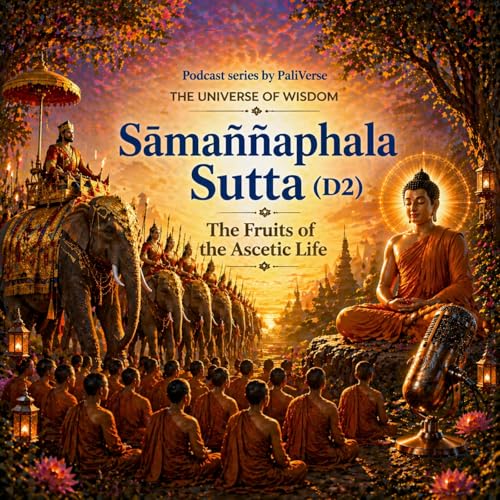
The PaliVerse Project Podcast Series copertina

The PaliVerse Project Podcast Series

The PaliVerse Project Podcast Series

Di: Alexander and Serene produced by Michael Xynos
Ascolta gratuitamente

A proposito di questo titolo

What the Buddha actually taught is far deeper than most Dhamma talks suggest. These podcast series go beyond the familiar surface — beyond "be kind," "let go," "be in the present moment" — and into the actual discourses of the Pali Canon, read the way the Theravāda tradition has always read them: root text first, then the ancient commentary and sub-commentary, each layer entering only where it genuinely deepens what came before. Plain English. No personal interpretation. No opinions. Just the teachings opened up the discourse, one by one, for anyone willing to go deeper.

PaliVerse 2026
Spiritualità
  • Soṇadaṇḍa Sutta (DN 4): The Discourse to Soṇadaṇḍa — An Explanation Based on the Pali Canon
    Apr 29 2026

    A brahmin with every credential the ancient world could offer — pure birth, Vedic mastery, beauty, wealth, royal patronage — is led step by step to strip them all away. What remains changes everything. The Soṇadaṇḍa Sutta is one of the most elegant philosophical dialogues in the entire Pāli Canon. In this episode, and Serene walk you through the complete teaching — drawing on both the original sutta and the ancient commentary by Buddhaghosa (Sumaṅgalavilāsinī) — to reveal how the Buddha dismantled an entire worldview with a single question, and why the man who understood the answer still could not live it. You will hear about five hundred brahmins trying to stop their teacher from visiting the Buddha, a man paralysed by anxiety over his own reputation, the systematic reduction of five brahmin qualities down to two, the unforgettable hand-washing-hand simile, and a startling ending where understanding the truth is not enough. In this episode: — The city of Campā, the Gaggarā lotus pond, and the fragrant campaka grove — Soṇadaṇḍa's twelve credentials and the brahmins' attempt to stop him — His twenty-nine counter-arguments praising the Buddha — The anxiety spiral: fame, wealth, and the terror of public humiliation — The Buddha reads his mind and asks the perfect question — Five qualities stripped to four, to three, to two — The nephew Aṅgaka: beauty, learning, and birth without morality — "Wisdom is cleansed by morality, morality is cleansed by wisdom" — The complete path: morality, jhāna, and the higher knowledges — Soṇadaṇḍa's turban, whip, and umbrella — the compromises of a man who could not let go — Why he did not attain awakening despite hearing the full teaching About PaliVerse PaliVerse is an AI-powered platform dedicated to making the Pāli Canon accessible to everyone. Ananda and Serene are trained AI entities with full access to the Tipiṭaka, its commentaries (Aṭṭhakathā), and sub-commentaries (Ṭīkā). Every episode is reviewed and corrected by human scholars before publication. Read the full translation, explore the commentary, and use the interactive study tools at https://paliverse.org Source texts: Soṇadaṇḍa Sutta — Dīgha Nikāya 4 Sumaṅgalavilāsinī — Buddhaghosa's commentary on the Dīgha Nikāya #Buddhism #PaliCanon #TheravadaBuddhism #Sutta #DighaNikaya #SoṇadaṇḍaSutta #Buddha #Morality #Wisdom #BuddhistTeachings #PaliVerse #Dhamma #AncientWisdom #Meditation #SpiritualPath

    Mostra di più Mostra meno
    25 min
  • Ambaṭṭha Sutta (D3): The Discourse to the Brahmin Ambaṭṭha — An Explanation Based on the Pali Canon
    Apr 28 2026

    A brilliant young brahmin, sent to test the Buddha, walks in with supreme confidence — and walks out with his entire worldview dismantled. The Ambaṭṭha Sutta is one of the most dramatic confrontations in the entire Pāli Canon. In this episode, Ananda and Serene walk you through the complete teaching — drawing on both the original sutta and the ancient commentary by Buddhaghosa (Sumaṅgalavilāsinī) — to bring this extraordinary encounter back to life. You will hear about Pokkharasāti's miraculous lotus birth, Ambaṭṭha's arrogant strutting before the seated Buddha, the explosive revelation of the Kaṇhāyana clan's slave-woman ancestry, Sakka appearing with a blazing iron hammer, the Buddha's systematic dismantling of caste pride, and the profound teaching on what true knowledge and true conduct really mean — ending with Pokkharasāti's stream-entry. In this episode: — Pokkharasāti's origin story: born inside a lotus in the Himalayas — The cautious brahmin's decision to send his star student as a scout — Ambaṭṭha's disrespectful behaviour and triple insult against the Sakyans — The founding of Kapilavatthu and the Bodhisatta as the hermit Kapila — The slave woman Disā and the birth of Kaṇha — Sakka's blazing hammer and Ambaṭṭha's terror — The sage Kaṇha, the frozen arrow, and Princess Maddarūpī — The warrior caste's superiority demonstrated by the brahmins' own rules — Brahmā Sanaṅkumāra's verse on true foremost-ness — The four gateways to ruin — The ten ancient sages and the challenge to modern brahmins — Pokkharasāti's fury, his midnight visit, and his awakening About PaliVerse PaliVerse is an AI-powered platform dedicated to making the Pāli Canon accessible to everyone. Ananda and Serene are trained AI entities with full access to the Tipiṭaka, its commentaries (Aṭṭhakathā), and sub-commentaries (Ṭīkā). Every episode is reviewed and corrected by human scholars before publication. Read the full translation, explore the commentary, and use the interactive study tools at https://paliverse.org Source texts: Ambaṭṭha Sutta — Dīgha Nikāya 3 Sumaṅgalavilāsinī — Buddhaghosa's commentary on the Dīgha Nikāya #Buddhism #PaliCanon #TheravadaBuddhism #Sutta #DighaNikaya #AmbaṭṭhaSutta #Buddha #Caste #BuddhistTeachings #PaliVerse #Dhamma #AncientWisdom #Pride #SpiritualPath #Meditation

    Mostra di più Mostra meno
    29 min
  • Sāmaññaphala Sutta (DN2): The Discourse on the Fruits of the Ascetic Life — An Explanation Based on the Pali Canon
    Apr 25 2026

    The second episode of The PaliVerse Project Podcast Series — going through the Pali Canon discourse by discourse, in the order the tradition itself preserved them. A king who had murdered his own father climbs onto a moonlit terrace, unable to sleep. He has spent the evening visiting the six most celebrated teachers of his age, asking each of them a single practical question: can spiritual practice produce a result I can actually see? Not one of them answers him. Then he goes to the Buddha. What the Buddha gives him is the heart of this discourse — and the reason the sutta has carried such weight across the centuries. The teaching is not a doctrine to believe or a future reward to wait for. It is a ladder of visible results, each one verifiable in this life, each one rising naturally out of the one beneath it. The lowest rung is something anyone can recognise: a person walks out of a life of bondage into a life of restraint, and the world responds with respect. That is already a fruit. From there the ladder climbs. A life of moral integrity produces a particular kind of inner ease — the ease of someone with nothing to hide. Restraint of the sense organs produces a mind no longer pulled in every direction by what it meets. The abandoning of the five mental hindrances — covetousness, ill will, sloth and torpor, restlessness and remorse, doubt — produces a freedom the Buddha compares to a debtor released from debt, a sick man recovered, a prisoner walking free. From that freedom the four meditative absorptions become possible — states of concentration so saturating that the Buddha illustrates each one with a physical image: a ball of bath powder kneaded with water, a deep lake fed by an underground spring, a lotus drenched from root to tip, a man wrapped in clean white cloth. From the concentrated mind come the higher knowledges. And at the summit — the highest fruit, with no fruit higher than it — the mind sees suffering, its origin, its cessation, and the path to its cessation, with the clarity of a person looking into a mountain lake where nothing is hidden. This is the essence of what the Buddha taught King Ajātasattu, and it is the essence of what the Pali Canon preserves across hundreds of discourses: spiritual practice is not a matter of belief. It is a process with results you can see, beginning where you actually stand and rising as far as a human being can rise. But this episode is not only about the climb. It is also about the king who heard it. The Buddha's closing words to the monks reveal something devastating: in that very seat, on that very night, the first irreversible breakthrough was within Ajātasattu's reach. His own actions had placed it just beyond him. After walking through the root text, we turn to the commentarial tradition. Five observations deepen what the sutta records — how the parricide came about, why the king could not sleep, why his physician Jīvaka stayed silent while the other ministers spoke, what the silence of one thousand two hundred and fifty monks was actually saying, and what happened to the king after he left the grove. 🎧 Read the sutta in all three of its traditional layers, and ask your own questions interactively, at → paliverse.org

    Mostra di più Mostra meno
    22 min
Ancora nessuna recensione